
Cookie-Einstellungen
Diese Website benutzt Cookies, die für den technischen Betrieb der Website erforderlich sind und stets gesetzt werden. Andere Cookies, die den Komfort bei Benutzung dieser Website erhöhen, der Direktwerbung dienen oder die Interaktion mit anderen Websites und sozialen Netzwerken vereinfachen sollen, werden nur mit Ihrer Zustimmung gesetzt.
Konfiguration
Technisch erforderlich
Diese Cookies sind für die Grundfunktionen des Shops notwendig.
"Alle Cookies ablehnen" Cookie
"Alle Cookies annehmen" Cookie
Ausgewählter Shop
CSRF-Token
Cookie-Einstellungen
FACT-Finder Tracking
Individuelle Preise
Kundenspezifisches Caching
Session
Währungswechsel
Komfortfunktionen
Diese Cookies werden genutzt um das Einkaufserlebnis noch ansprechender zu gestalten, beispielsweise für die Wiedererkennung des Besuchers.
Facebook-Seite in der rechten Blog - Sidebar anzeigen
Merkzettel
Statistik & Tracking
Endgeräteerkennung
Kauf- und Surfverhalten mit Google Tag Manager
Partnerprogramm

| Artikelnummer | Größe | Datenblatt | Manual | SDB | Lieferzeit | Menge | Preis |
|---|---|---|---|---|---|---|---|
| ATA-HPA064895.25 | 25 µl | - |
7 - 10 Werktage* |
330,00 €
|
|||
| ATA-HPA064895.100 | 100 µl | - |
7 - 10 Werktage* |
463,00 €
|
Bei Fragen nutzen Sie gerne unser Kontaktformular.
Bestellen Sie auch per E-Mail: info@biomol.com
Größere Menge gewünscht? Bulk-Anfrage
Bestellen Sie auch per E-Mail: info@biomol.com
Größere Menge gewünscht? Bulk-Anfrage
Protein function: Prolyl hydroxylase that mediates hydroxylation of proline residues in target... mehr
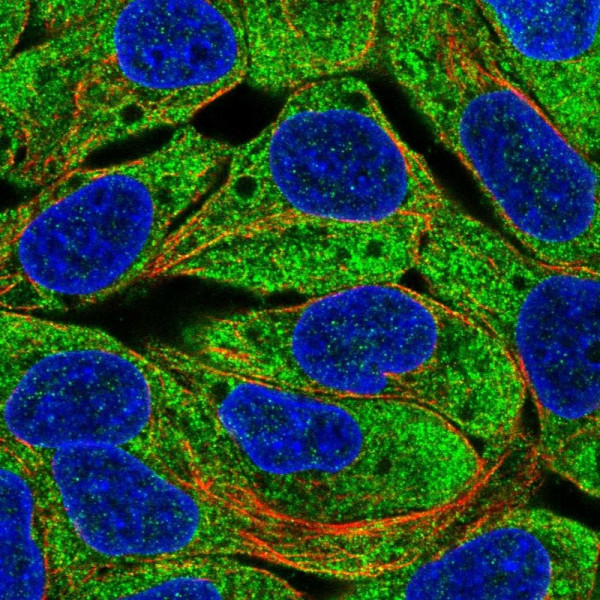
Produktinformationen "Anti-EGLN3"
Protein function: Prolyl hydroxylase that mediates hydroxylation of proline residues in target proteins, such as PKM, TELO2, ATF4 and HIF1A (PubMed:19584355, PubMed:21620138, PubMed:21483450, PubMed:22797300, PubMed:20978507, PubMed:21575608). Target proteins are preferentially recognized via a LXXLAP motif. Cellular oxygen sensor that catalyzes, under normoxic conditions, the post-translational formation of 4- hydroxyproline in hypoxia-inducible factor (HIF) alpha proteins (PubMed:11595184, PubMed:12181324). Hydroxylates a specific proline found in each of the oxygen-dependent degradation (ODD) domains (N- terminal, NODD, and C-terminal, CODD) of HIF1A (PubMed:11595184, PubMed:12181324). Also hydroxylates HIF2A (PubMed:11595184, PubMed:12181324). Has a preference for the CODD site for both HIF1A and HIF2A (PubMed:11595184, PubMed:12181324). Hydroxylation on the NODD site by EGLN3 appears to require prior hydroxylation on the CODD site (PubMed:11595184, PubMed:12181324). Hydroxylated HIFs are then targeted for proteasomal degradation via the von Hippel-Lindau ubiquitination complex (PubMed:11595184, PubMed:12181324). Under hypoxic conditions, the hydroxylation reaction is attenuated allowing HIFs to escape degradation resulting in their translocation to the nucleus, heterodimerization with HIF1B, and increased expression of hypoxy- inducible genes (PubMed:11595184, PubMed:12181324). ELGN3 is the most important isozyme in limiting physiological activation of HIFs (particularly HIF2A) in hypoxia. Also hydroxylates PKM in hypoxia, limiting glycolysis (PubMed:21620138, PubMed:21483450). Under normoxia, hydroxylates and regulates the stability of ADRB2 (PubMed:19584355). Regulator of cardiomyocyte and neuronal apoptosis. In cardiomyocytes, inhibits the anti-apoptotic effect of BCL2 by disrupting the BAX-BCL2 complex (PubMed:20849813). In neurons, has a NGF-induced proapoptotic effect, probably through regulating CASP3 activity (PubMed:16098468). Also essential for hypoxic regulation of neutrophilic inflammation (PubMed:21317538). Plays a crucial role in DNA damage response (DDR) by hydroxylating TELO2, promoting its interaction with ATR which is required for activation of the ATR/CHK1/p53 pathway (PubMed:22797300). Also mediates hydroxylation of ATF4, leading to decreased protein stability of ATF4 (Probable). [The UniProt Consortium] Buffer: 40% glycerol and PBS (pH 7.2). 0.02% sodium azide is added as preservative. Highest antigen sequence identity to mouse: 93% and to rat: 93%
| Schlagworte: | Anti-PHD3, Anti-HPH-3, Anti-HPH-1, Anti-HIF-PH3, Anti-Egl nine homolog 3, Anti-Prolyl hydroxylase EGLN3, Anti-HIF-prolyl hydroxylase 3, Anti-Hypoxia-inducible factor prolyl hydroxylase 3, Anti-Prolyl hydroxylase domain-containing protein 3 |
| Hersteller: | Atlas Antibodies |
| Hersteller-Nr: | HPA064895 |
Eigenschaften
| Anwendung: | ICC |
| Antikörper-Typ: | Polyclonal |
| Konjugat: | No |
| Wirt: | Rabbit |
| Spezies-Reaktivität: | human |
| Immunogen: | Recombinant Protein Epitope Signature Tag (PrEST) antigen sequence: YFDAEERAEA KKKFRNLTRK TESALTED (ATA-APrEST92513) |
Datenbank Information
| KEGG ID : | K09592 | Passende Produkte |
| UniProt ID : | Q9H6Z9 | Passende Produkte |
| Gene ID : | GeneID 112399 | Passende Produkte |
| Protein Atlas Nr. : | ENSG00000129521 |
Handhabung & Sicherheit
| Lagerung: | -20°C |
| Versand: | +20°C (International: +20°C) |
Achtung
Nur für Forschungszwecke und Laboruntersuchungen: Nicht für die Anwendung im oder am Menschen!
Nur für Forschungszwecke und Laboruntersuchungen: Nicht für die Anwendung im oder am Menschen!
Hier folgen Informationen zur Produktreferenz.
mehr
Hier kriegen Sie ein Zertifikat
Loggen Sie sich ein oder registrieren Sie sich, um Analysenzertifikate anzufordern.
Bewertungen lesen, schreiben und diskutieren... mehr
Kundenbewertungen für "Anti-EGLN3"
Bewertung schreiben
Loggen Sie sich ein oder registrieren Sie sich, um eine Produktbewertung abzugeben.
Zuletzt angesehen