
Cookie-Einstellungen
Diese Website benutzt Cookies, die für den technischen Betrieb der Website erforderlich sind und stets gesetzt werden. Andere Cookies, die den Komfort bei Benutzung dieser Website erhöhen, der Direktwerbung dienen oder die Interaktion mit anderen Websites und sozialen Netzwerken vereinfachen sollen, werden nur mit Ihrer Zustimmung gesetzt.
Konfiguration
Technisch erforderlich
Diese Cookies sind für die Grundfunktionen des Shops notwendig.
"Alle Cookies ablehnen" Cookie
"Alle Cookies annehmen" Cookie
Ausgewählter Shop
CSRF-Token
Cookie-Einstellungen
FACT-Finder Tracking
Individuelle Preise
Kundenspezifisches Caching
Session
Währungswechsel
Komfortfunktionen
Diese Cookies werden genutzt um das Einkaufserlebnis noch ansprechender zu gestalten, beispielsweise für die Wiedererkennung des Besuchers.
Facebook-Seite in der rechten Blog - Sidebar anzeigen
Merkzettel
Statistik & Tracking
Endgeräteerkennung
Kauf- und Surfverhalten mit Google Tag Manager
Partnerprogramm


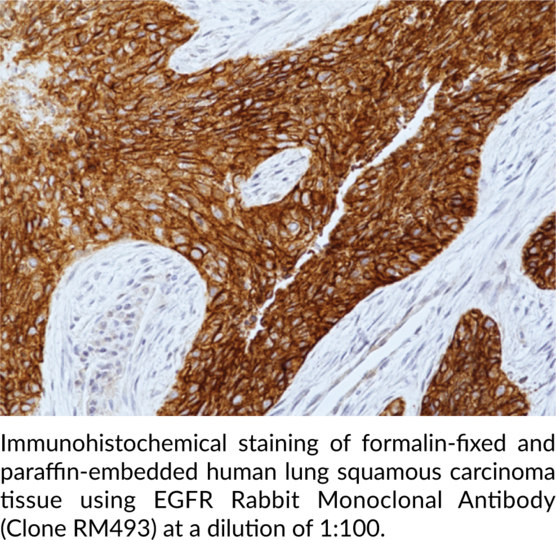
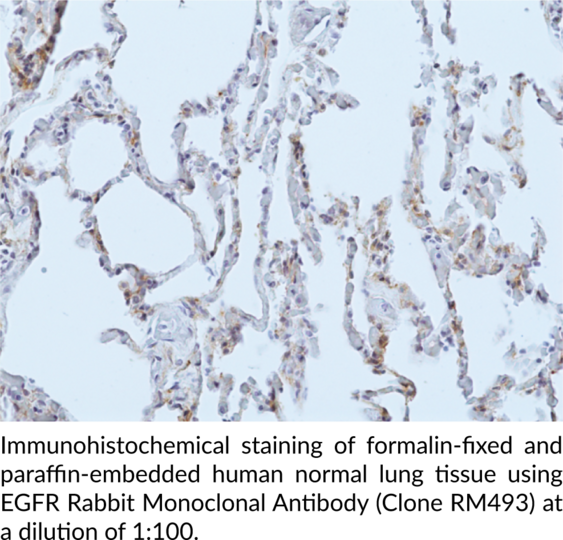
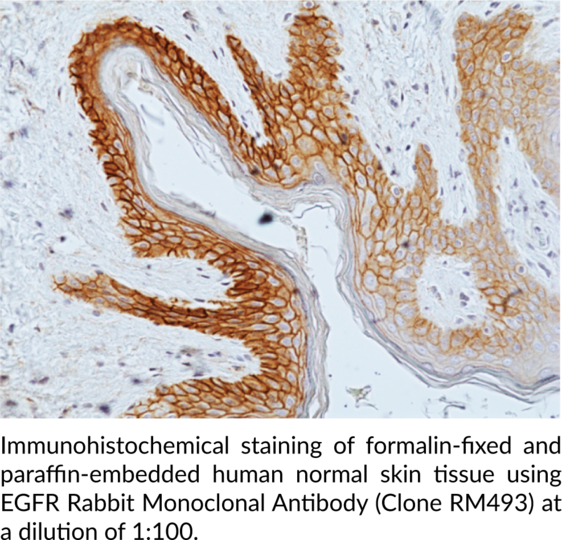
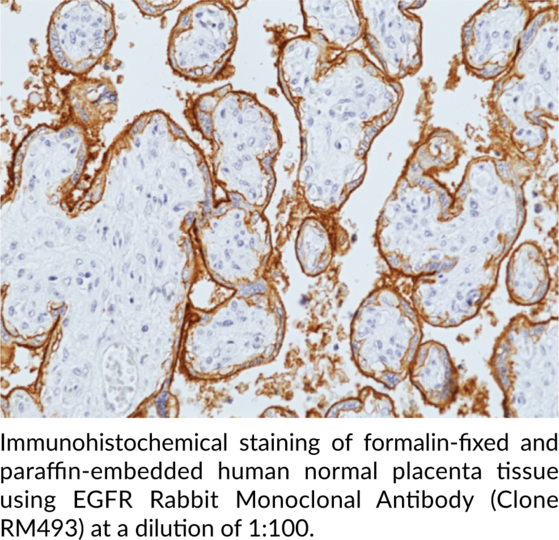


| Artikelnummer | Größe | Datenblatt | Manual | SDB | Lieferzeit | Menge | Preis |
|---|---|---|---|---|---|---|---|
| Cay42845-100 | 100 µl | - |
6 - 10 Werktage* |
554,00 €
|
Bei Fragen nutzen Sie gerne unser Kontaktformular.
Bestellen Sie auch per E-Mail: info@biomol.com
Größere Menge gewünscht? Bulk-Anfrage
Bestellen Sie auch per E-Mail: info@biomol.com
Größere Menge gewünscht? Bulk-Anfrage
Epidermal growth factor receptor (EGFR), also known as HER1 and ErbB1, is a cell surface receptor... mehr
Produktinformationen "Anti-EGFR Rabbit (Clone RM493)"
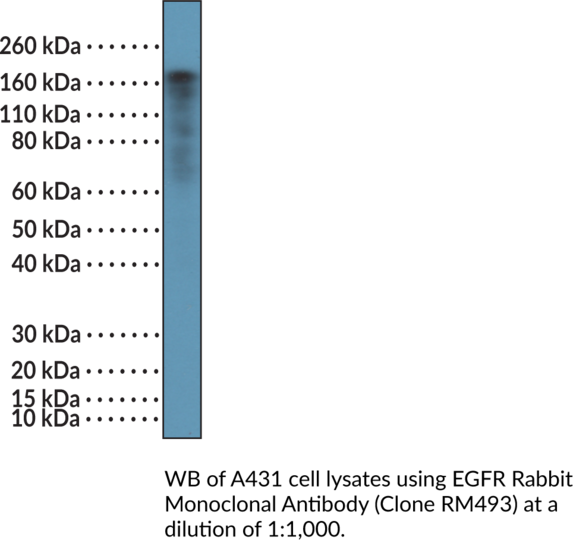
Epidermal growth factor receptor (EGFR), also known as HER1 and ErbB1, is a cell surface receptor and member of the EGF family of receptor tyrosine kinases with roles in cell proliferation, differentiation, and survival. It is a 170 kDa transmembrane receptor composed of an intracellular tyrosine kinase domain, a transmembrane lipophilic segment, and an extracellular domain that is expressed in epithelial, mesenchymal, and neuronal tissues. Under unstimulated conditions, EGFR is an auto-inhibited monomer in the plasma membrane. Upon canonical ligand binding, EGFR undergoes homodimerization or heterodimerization with HER2, HER3, or HER4, which induces a conformational change in the cytoplasmic domain that facilitates autophosphorylation and intracellular signaling. EGFR inhibits autophagy under nutrient-rich growth conditions and, conversely, induces autophagy under serum-starved conditions by interacting with the autophagy inhibitor Rubicon to induce its dissociation from Beclin-1. Overexpression of EGFR is found in multiple solid tumors, including renal, breast, ovarian, and head and neck cancer, as well as non-small cell lung cancer (NSCLC). EGFRL858R is associated with increased susceptibility to tyrosine kinase inhibition and cell death, while EGFRT790M is associated with kinase inhibitor resistance in NSCLC. Inhibition of EGFR reduces angiotensin II-induced cardiac hypertrophy in mice. Cayman's EGFR Rabbit Monoclonal Antibody (Clone RM493) can be used for immunohistochemistry (IHC) and Western blot (WB) applications.. Cross reactivity: (+) EGFR: . (+) Human: .. Protein function: Receptor tyrosine kinase binding ligands of the EGF family and activating several signaling cascades to convert extracellular cues into appropriate cellular responses (PubMed:2790960, PubMed:10805725, PubMed:27153536). Known ligands include EGF, TGFA/TGF-alpha, AREG, epigen/EPGN, BTC/betacellulin, epiregulin/EREG and HBEGF/heparin- binding EGF (PubMed:2790960, PubMed:7679104, PubMed:8144591, PubMed:9419975, PubMed:15611079, PubMed:12297049, PubMed:27153536, PubMed:20837704, PubMed:17909029). Ligand binding triggers receptor homo- and/or heterodimerization and autophosphorylation on key cytoplasmic residues. The phosphorylated receptor recruits adapter proteins like GRB2 which in turn activates complex downstream signaling cascades. Activates at least 4 major downstream signaling cascades including the RAS-RAF-MEK-ERK, PI3 kinase-AKT, PLCgamma-PKC and STATs modules (PubMed:27153536). May also activate the NF-kappa-B signaling cascade (PubMed:11116146). Also directly phosphorylates other proteins like RGS16, activating its GTPase activity and probably coupling the EGF receptor signaling to the G protein-coupled receptor signaling (PubMed:11602604). Also phosphorylates MUC1 and increases its interaction with SRC and CTNNB1/beta-catenin (PubMed:11483589). Positively regulates cell migration via interaction with CCDC88A/GIV which retains EGFR at the cell membrane following ligand stimulation, promoting EGFR signaling which triggers cell migration (PubMed:20462955). Plays a role in enhancing learning and memory performance. [The UniProt Consortium]
| Schlagworte: | Epidermal Growth Factor Receptor, ErbB-1, HER1 |
| Hersteller: | Cayman Chemical |
| Hersteller-Nr: | 42845 |
Eigenschaften
| Anwendung: | IHC, WB |
| Antikörper-Typ: | Monoclonal |
| Klon: | RM493 |
| Konjugat: | No |
| Wirt: | Rabbit |
| Spezies-Reaktivität: | human |
| Immunogen: | Recombinant human EGFR extracellular domain |
| Format: | Purified |
Datenbank Information
| KEGG ID : | K04361 | Passende Produkte |
| UniProt ID : | P00533 | Passende Produkte |
| Gene ID : | GeneID 1956 | Passende Produkte |
Handhabung & Sicherheit
| Lagerung: | -20°C |
| Versand: | -20°C (International: -20°C) |
Achtung
Nur für Forschungszwecke und Laboruntersuchungen: Nicht für die Anwendung im oder am Menschen!
Nur für Forschungszwecke und Laboruntersuchungen: Nicht für die Anwendung im oder am Menschen!
Hier folgen Informationen zur Produktreferenz.
mehr
Hier kriegen Sie ein Zertifikat
Loggen Sie sich ein oder registrieren Sie sich, um Analysenzertifikate anzufordern.
Bewertungen lesen, schreiben und diskutieren... mehr
Kundenbewertungen für "Anti-EGFR Rabbit (Clone RM493)"
Bewertung schreiben
Loggen Sie sich ein oder registrieren Sie sich, um eine Produktbewertung abzugeben.
Zuletzt angesehen