Diese Website benutzt Cookies, die für den technischen Betrieb der Website erforderlich sind und stets gesetzt werden. Andere Cookies, die den Komfort bei Benutzung dieser Website erhöhen, der Direktwerbung dienen oder die Interaktion mit anderen Websites und sozialen Netzwerken vereinfachen sollen, werden nur mit Ihrer Zustimmung gesetzt.
Konfiguration
Technisch erforderlich
Diese Cookies sind für die Grundfunktionen des Shops notwendig.
"Alle Cookies ablehnen" Cookie
"Alle Cookies annehmen" Cookie
Ausgewählter Shop
CSRF-Token
Cookie-Einstellungen
FACT-Finder Tracking
Individuelle Preise
Kundenspezifisches Caching
Session
Währungswechsel
Komfortfunktionen
Diese Cookies werden genutzt um das Einkaufserlebnis noch ansprechender zu gestalten, beispielsweise für die Wiedererkennung des Besuchers.
Facebook-Seite in der rechten Blog - Sidebar anzeigen
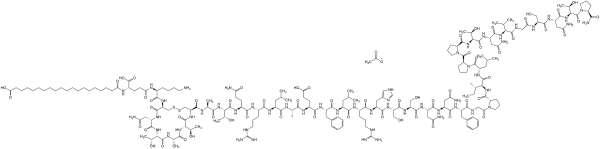
Cagrilintide is a novel long-acting nonselective amylin receptors (AMYR) and calcitonin G protein-coupled receptor (CTR) agonist. Cagrilintide is a stable synthetic peptide acylated amylin analog. Natural amylin is a pancreatic hormone that induces satiety. Cagrilintide binds human, mouse and rat amylin receptors and is used in studies of obesity and type 2 diabetes (T2D) and is designed enhancing energy expenditure and fat metabolism and decreasing food intake. Cagrilintide is now being developed in combination with the GLP-1 agonist semaglutide as "CagriSema" to achieve sustained weight loss in persons with overweight and obesity. Amylin, released with insulin from beta cells in the pancreas, induces its satiating effect via both the homoeostatic and hedonic regions of the brain. Semaglutide, a GLP-1 receptor agonist, reduces appetite via GLP-1 receptors in the hypothalamus and increases the production of insulin, and reduces glucagon secretion, delaying gastric emptying. These separate, but related mechanisms of action of an amylin-analog and a GLP-1 receptor agonist appear to have an additive effect on appetite reduction. Cagrilintide comprises a 37 amino acid linear synthetic peptide conjugated to a C20 fatty diacid through a hydrophilic linker at the lysine residue at position 1. Due to this moiety, the compound is highly bound to albumin in the plasma which prolongs its half-life. The N-terminus of the amylin peptide is predicted to form a loop, stabilized by a disulfide bond, that points out of the TM area, thereby tolerating N-terminal lipidation.
Diese Website benutzt Cookies, die für den technischen Betrieb der Website erforderlich sind und stets gesetzt werden. Andere Cookies, die den Komfort bei Benutzung dieser Website erhöhen, der Direktwerbung dienen oder die Interaktion mit anderen Websites und sozialen Netzwerken vereinfachen sollen, werden nur mit Ihrer Zustimmung gesetzt.
Mehr Informationen