
Cookie-Einstellungen
Diese Website benutzt Cookies, die für den technischen Betrieb der Website erforderlich sind und stets gesetzt werden. Andere Cookies, die den Komfort bei Benutzung dieser Website erhöhen, der Direktwerbung dienen oder die Interaktion mit anderen Websites und sozialen Netzwerken vereinfachen sollen, werden nur mit Ihrer Zustimmung gesetzt.
Konfiguration
Technisch erforderlich
Diese Cookies sind für die Grundfunktionen des Shops notwendig.
"Alle Cookies ablehnen" Cookie
"Alle Cookies annehmen" Cookie
Ausgewählter Shop
CSRF-Token
Cookie-Einstellungen
FACT-Finder Tracking
Individuelle Preise
Kundenspezifisches Caching
Session
Währungswechsel
Komfortfunktionen
Diese Cookies werden genutzt um das Einkaufserlebnis noch ansprechender zu gestalten, beispielsweise für die Wiedererkennung des Besuchers.
Facebook-Seite in der rechten Blog - Sidebar anzeigen
Merkzettel
Statistik & Tracking
Endgeräteerkennung
Kauf- und Surfverhalten mit Google Tag Manager
Partnerprogramm


| Artikelnummer | Größe | Datenblatt | Manual | SDB | Lieferzeit | Menge | Preis |
|---|---|---|---|---|---|---|---|
| NSJ-V6135-20UG | 20 µg | - | - |
7 - 12 Werktage* |
684,00 €
|
||
| NSJ-V6135-100UG | 100 µg | - | - |
7 - 12 Werktage* |
1.265,00 €
|
Bei Fragen nutzen Sie gerne unser Kontaktformular.
Bestellen Sie auch per E-Mail: info@biomol.com
Größere Menge gewünscht? Bulk-Anfrage
Bestellen Sie auch per E-Mail: info@biomol.com
Größere Menge gewünscht? Bulk-Anfrage
Antibody in 1X PBS with 0.05% BSA, 0.05% sodium azide. Histone H3 (HIST1H3A) is a nucleosomal... mehr
Produktinformationen "Anti-phospho-Histone H3 (Ser10), clone MSVA-903M"
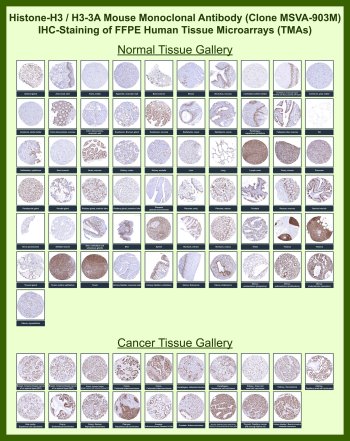
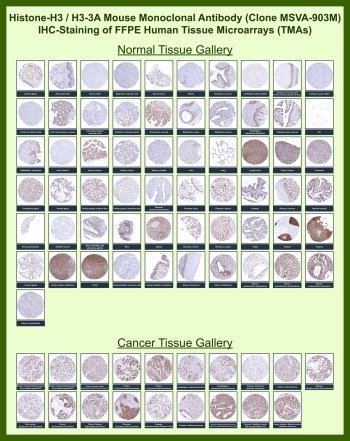
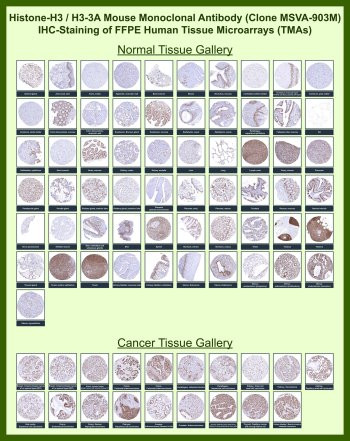
Antibody in 1X PBS with 0.05% BSA, 0.05% sodium azide. Histone H3 (HIST1H3A) is a nucleosomal protein that undergoes phosphorylation at serine 10 during mitosis, marking cells actively undergoing chromatin condensation. Phospho-Histone H3 (pSer10) Antibody for IHC / HIST1H3A Immunohistochemistry Antibody (clone MSVA-903M) is specifically positioned for detection of this modification in formalin-fixed, paraffin-embedded tissue sections and large-scale tissue microarray studies. This antibody is part of a broader collection of Histone H3 antibodies used to study chromatin structure, histone modifications, and epigenetic regulation.HIST1H3A antibody, also referred to as Histone H3 antibody and phospho-H3 Ser10 antibody in the literature, identifies a nuclear phosphorylation event restricted to mitotic cells. In FFPE tissues, this produces strong, sharply defined nuclear staining in mitotic figures, while surrounding non-dividing cells remain largely negative, enabling clear morphological interpretation.This Phospho-Histone H3 (pSer10) Antibody for IHC is uniquely positioned for tissue-based proliferation assessment, with a strong emphasis on histological context rather than biochemical response. In human tissue microarray (TMA) formats, staining highlights mitotically active cells across a wide range of normal and cancer tissues, allowing direct comparison of proliferation patterns across multiple tissue types within a single experiment.The nuclear staining pattern is consistent with chromatin localization, showing dense labeling of condensed chromosomes in mitotic cells. This enables straightforward identification of mitotic figures within complex tissue architecture, including epithelial, stromal, and tumor compartments. Increased staining is commonly observed in rapidly proliferating tumors, while normal tissues show more restricted labeling confined to specific proliferative zones.Unlike phosphorylation assays designed for signaling response studies, this antibody emphasizes tissue performance and interpretability in FFPE sections. The clear nuclear signal, low background, and compatibility with TMA workflows make it well suited for pathology-oriented analysis and large-scale tissue screening applications.Clone MSVA-903M antibody supports reliable detection of phospho-Histone H3 in tissue sections, enabling detailed evaluation of mitotic activity and spatial distribution of proliferating cells in both normal and diseased tissues.This antibody is also part of a broader collection of IHC antibodies validated by tissue microarray analysis, supporting consistent staining across normal and cancer tissues.
| Schlagworte: | Anti-phospho-H3C2, Anti-phospho-H3C6, Anti-phospho-H3C7, Anti-phospho-H3C4, Anti-phospho-H3C8, Anti-phospho-H3C1, Anti-phospho-H3C3, Anti-phospho-H3C10, Anti-phospho-H3C12, Anti-phospho-H3C11, Anti-phospho-Histone H3/f, Anti-phospho-Histone H3.1, Anti-pho |
| Hersteller: | NSJ Bioreagents |
| Hersteller-Nr: | V6135 |
Eigenschaften
| Anwendung: | IHC |
| Antikörper-Typ: | Monoclonal |
| Klon: | MSVA-903M |
| Konjugat: | No |
| Wirt: | Mouse |
| Spezies-Reaktivität: | human |
| Immunogen: | Synthetic peptide corresponding to (ARK-pS-TGGKAPRKQLc) of Phosphohistone H3 (phospho S10) |
| Format: | Purified |
Datenbank Information
| KEGG ID : | K11253 | Passende Produkte |
| UniProt ID : | P68431 | Passende Produkte |
| Gene ID : | GeneID 8350 | Passende Produkte |
Handhabung & Sicherheit
| Lagerung: | -20°C |
| Versand: | -20°C (International: -20°C) |
Achtung
Nur für Forschungszwecke und Laboruntersuchungen: Nicht für die Anwendung im oder am Menschen!
Nur für Forschungszwecke und Laboruntersuchungen: Nicht für die Anwendung im oder am Menschen!
Hier folgen Informationen zur Produktreferenz.
mehr
Hier kriegen Sie ein Zertifikat
Loggen Sie sich ein oder registrieren Sie sich, um Analysenzertifikate anzufordern.
Bewertungen lesen, schreiben und diskutieren... mehr
Kundenbewertungen für "Anti-phospho-Histone H3 (Ser10), clone MSVA-903M"
Bewertung schreiben
Loggen Sie sich ein oder registrieren Sie sich, um eine Produktbewertung abzugeben.
Zuletzt angesehen