
Cookie-Einstellungen
Diese Website benutzt Cookies, die für den technischen Betrieb der Website erforderlich sind und stets gesetzt werden. Andere Cookies, die den Komfort bei Benutzung dieser Website erhöhen, der Direktwerbung dienen oder die Interaktion mit anderen Websites und sozialen Netzwerken vereinfachen sollen, werden nur mit Ihrer Zustimmung gesetzt.
Konfiguration
Technisch erforderlich
Diese Cookies sind für die Grundfunktionen des Shops notwendig.
"Alle Cookies ablehnen" Cookie
"Alle Cookies annehmen" Cookie
Ausgewählter Shop
CSRF-Token
Cookie-Einstellungen
FACT-Finder Tracking
Individuelle Preise
Kundenspezifisches Caching
Session
Währungswechsel
Komfortfunktionen
Diese Cookies werden genutzt um das Einkaufserlebnis noch ansprechender zu gestalten, beispielsweise für die Wiedererkennung des Besuchers.
Facebook-Seite in der rechten Blog - Sidebar anzeigen
Merkzettel
Statistik & Tracking
Endgeräteerkennung
Kauf- und Surfverhalten mit Google Tag Manager
Partnerprogramm


| Artikelnummer | Größe | Datenblatt | Manual | SDB | Lieferzeit | Menge | Preis |
|---|---|---|---|---|---|---|---|
| NSJ-V6151-20UG | 20 µg | - | - |
7 - 12 Werktage* |
684,00 €
|
||
| NSJ-V6151-100UG | 100 µg | - | - |
7 - 12 Werktage* |
1.160,00 €
|
Bei Fragen nutzen Sie gerne unser Kontaktformular.
Bestellen Sie auch per E-Mail: info@biomol.com
Größere Menge gewünscht? Bulk-Anfrage
Bestellen Sie auch per E-Mail: info@biomol.com
Größere Menge gewünscht? Bulk-Anfrage
Antibody in 1X PBS with 0.05% BSA, 0.05% sodium azide. Cytokeratins are a large family of... mehr
Produktinformationen "Anti-Pan Cytokeratin, clone MSVA-000R"
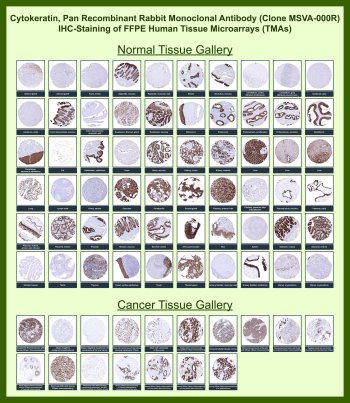
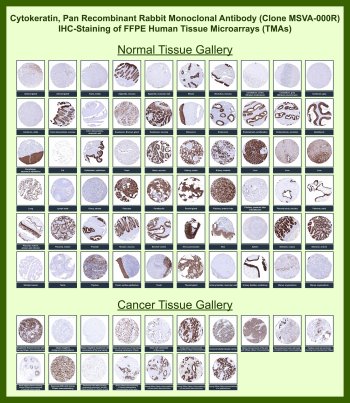
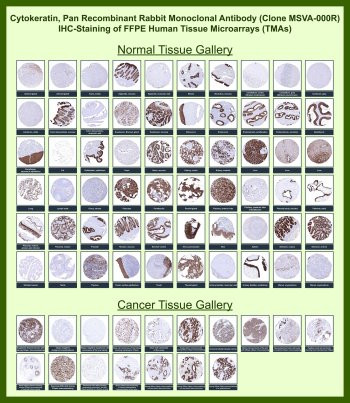
Antibody in 1X PBS with 0.05% BSA, 0.05% sodium azide. Cytokeratins are a large family of intermediate filament proteins expressed in epithelial cells, where they provide structural support, maintain cellular integrity, and help preserve tissue architecture under mechanical stress. These proteins are divided into type I acidic keratins and type II basic keratins, which pair to form heterodimeric filament networks within the cytoplasm. Because epithelial tissues display diverse cytokeratin expression patterns depending on tissue type and differentiation state, antibodies capable of recognizing multiple keratin isoforms are especially valuable for broad identification of epithelial compartments across a wide range of tissues.Pan Cytokeratin Antibody for IHC / Broad Spectrum Epithelial Marker Antibody (clone MSVA-000R) is designed for broad detection of epithelial cytokeratin proteins in formalin-fixed, paraffin-embedded tissues. This antibody functions as a comprehensive epithelial marker by recognizing multiple type I and type II cytokeratins rather than a single keratin isoform. Pan cytokeratin antibody, also referred to as cytokeratin cocktail antibody, broad epithelial marker antibody, or CK pan antibody, is widely used in immunohistochemistry to visualize epithelial structures, define epithelial tumor components, and distinguish epithelial elements from surrounding stromal, mesenchymal, and hematopoietic tissues. This pan cytokeratin antibody is also widely used to identify epithelial cells and distinguish carcinomas from non-epithelial malignancies in immunohistochemistry.Because this antibody recognizes a wide range of keratin proteins, staining is typically strong, cytoplasmic, and filamentous within epithelial cells, reflecting the intermediate filament organization of the cytoskeleton. This broad-spectrum pattern differs fundamentally from isoform-specific keratin antibodies, which are intended to define particular epithelial subsets or differentiation programs. In contrast, a pan cytokeratin antibody is positioned to provide an inclusive view of epithelial distribution, making it especially useful when the goal is to identify epithelial lineage broadly rather than characterize a specific keratin subtype.In tissue microarray analysis, this broad epithelial coverage becomes particularly valuable. Human tissue microarrays allow simultaneous assessment of many normal and cancer tissues under identical staining conditions, making them highly informative for evaluating the scope and consistency of epithelial marker expression. In this setting, pan cytokeratin staining highlights glandular, ductal, mucosal, transitional, and stratified epithelial compartments across multiple organs, while most non-epithelial tissues remain negative or show only limited background. This strong contrast supports rapid recognition of epithelial architecture and enables efficient comparison of epithelial staining patterns across tissue types.In normal tissues, pan cytokeratin staining typically outlines epithelial layers and epithelial-derived glandular structures with high clarity, emphasizing luminal borders, ductal arrangements, and epithelial continuity. This makes the antibody useful for examining tissue organization and confirming epithelial identity in histologic sections. In TMA-based normal tissue profiling, the broad distribution of cytokeratin-positive structures provides a clear map of epithelial localization across organ systems and reinforces the utility of this antibody as a high-coverage epithelial marker.In cancer tissue arrays, pan cytokeratin antibodies are especially important for identifying carcinomas and defining the distribution of epithelial tumor cells within complex malignant lesions. Strong cytoplasmic staining in carcinoma cells helps distinguish epithelial-derived neoplasms from non-epithelial malignancies such as lymphoid, mesenchymal, or many sarcomatous tumors. This broad epithelial labeling is also useful for visualizing invasive tumor architecture, highlighting nests, glands, cords, and sheets of tumor cells embedded within reactive stroma or inflammatory infiltrates. For this reason, pan cytokeratin antibodies remain among the most widely used reagents for epithelial tumor detection in immunohistochemistry.Because this antibody is intended for broad keratin recognition, it should be positioned as a pan-epithelial detection reagent rather than an isoform-specific antibody. Individual keratins such as KRT77, KRT76, CK7, CK19, or other epithelial keratin proteins may be included within its broad reactivity profile, but the primary value of this reagent lies in comprehensive epithelial coverage rather than selective subtype discrimination. This distinction is important when organizing keratin antibody portfolios, since pan cytokeratin antibodies serve a different research purpose than keratin-specific antibodies directed against restricted epithelial subsets.As a recombinant rabbit monoclonal antibody, clone MSVA-000R offers consistent epitope recognition and reliable staining performance across tissue types. Combined with broad cytokeratin reactivity and strong TMA-based epithelial labeling, Pan Cytokeratin Antibody for immunohistochemistry provides a robust tool for epithelial identification, carcinoma visualization, and large-scale assessment of epithelial distribution across normal and cancer tissues.This antibody is part of our Pan Cytokeratin Antibody collection, which enables broad epithelial detection across normal and cancer tissues.This antibody is also part of a broader collection of IHC antibodies validated by tissue microarray analysis, supporting consistent staining across normal and cancer tissues.
| Schlagworte: | Anti-KRT77, Anti-Keratin-77, Anti-Cytokeratin-1B, Anti-Type-II keratin Kb39, Anti-Keratin, type II cytoskeletal 1b, Pan Cytokeratin Antibody |
| Hersteller: | NSJ Bioreagents |
| Hersteller-Nr: | V6151 |
Eigenschaften
| Anwendung: | IHC |
| Antikörper-Typ: | Monoclonal |
| Klon: | MSVA-000R |
| Konjugat: | No |
| Wirt: | Rabbit |
| Spezies-Reaktivität: | human |
| Immunogen: | Recombinant fragments and synthetic peptides derived from human cytokeratin proteins |
| Format: | Purified |
Datenbank Information
| KEGG ID : | K07605 | Passende Produkte |
| UniProt ID : | Q7Z794 | Passende Produkte |
| Gene ID : | GeneID 374454 | Passende Produkte |
Handhabung & Sicherheit
| Lagerung: | -20°C |
| Versand: | -20°C (International: -20°C) |
Achtung
Nur für Forschungszwecke und Laboruntersuchungen: Nicht für die Anwendung im oder am Menschen!
Nur für Forschungszwecke und Laboruntersuchungen: Nicht für die Anwendung im oder am Menschen!
Hier folgen Informationen zur Produktreferenz.
mehr
Hier kriegen Sie ein Zertifikat
Loggen Sie sich ein oder registrieren Sie sich, um Analysenzertifikate anzufordern.
Bewertungen lesen, schreiben und diskutieren... mehr
Kundenbewertungen für "Anti-Pan Cytokeratin, clone MSVA-000R"
Bewertung schreiben
Loggen Sie sich ein oder registrieren Sie sich, um eine Produktbewertung abzugeben.
Zuletzt angesehen