
Cookie-Einstellungen
Diese Website benutzt Cookies, die für den technischen Betrieb der Website erforderlich sind und stets gesetzt werden. Andere Cookies, die den Komfort bei Benutzung dieser Website erhöhen, der Direktwerbung dienen oder die Interaktion mit anderen Websites und sozialen Netzwerken vereinfachen sollen, werden nur mit Ihrer Zustimmung gesetzt.
Konfiguration
Technisch erforderlich
Diese Cookies sind für die Grundfunktionen des Shops notwendig.
"Alle Cookies ablehnen" Cookie
"Alle Cookies annehmen" Cookie
Ausgewählter Shop
CSRF-Token
Cookie-Einstellungen
FACT-Finder Tracking
Individuelle Preise
Kundenspezifisches Caching
Session
Währungswechsel
Komfortfunktionen
Diese Cookies werden genutzt um das Einkaufserlebnis noch ansprechender zu gestalten, beispielsweise für die Wiedererkennung des Besuchers.
Facebook-Seite in der rechten Blog - Sidebar anzeigen
Merkzettel
Statistik & Tracking
Endgeräteerkennung
Kauf- und Surfverhalten mit Google Tag Manager
Partnerprogramm

| Artikelnummer | Größe | Datenblatt | Manual | SDB | Lieferzeit | Menge | Preis |
|---|---|---|---|---|---|---|---|
| ATA-HPA074368.25 | 25 µl |
7 - 10 Werktage* |
369,00 €
|
||||
| ATA-HPA074368.100 | 100 µl |
7 - 10 Werktage* |
491,00 €
|
Bei Fragen nutzen Sie gerne unser Kontaktformular.
Bestellen Sie auch per E-Mail: info@biomol.com
Größere Menge gewünscht? Bulk-Anfrage
Bestellen Sie auch per E-Mail: info@biomol.com
Größere Menge gewünscht? Bulk-Anfrage
Rabbit Polyclonal LPCAT3 Antibody against Human lysophosphatidylcholine acyltransferase 3.... mehr
Produktinformationen "Anti-LPCAT3"
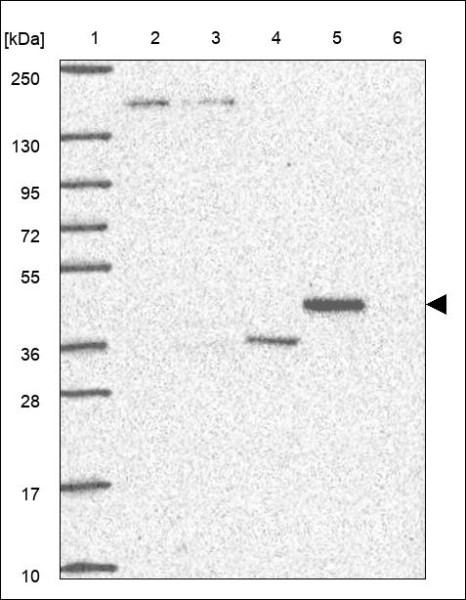
Rabbit Polyclonal LPCAT3 Antibody against Human lysophosphatidylcholine acyltransferase 3. Validated for Western Blot. Buffer: 40% glycerol and PBS (pH 7.2). 0.02% sodium azide is added as preservative. Interspecies information: Highest antigen sequence indentity to the following orthologs: ENSMUSG00000004270: 71%, ENSRNOG00000012269: 74%. Protein function: Lysophospholipid O-acyltransferase (LPLAT) that catalyzes the reacylation step of the phospholipid remodeling process also known as the Lands cycle (PubMed:18782225, PubMed:18195019, PubMed:18772128). Catalyzes transfer of the fatty acyl chain from fatty acyl-CoA to 1- acyl lysophospholipid to form various classes of phospholipids. Converts 1-acyl lysophosphatidylcholine (LPC) into phosphatidylcholine (PC) (LPCAT activity), 1-acyl lysophosphatidylserine (LPS) into phosphatidylserine (PS) (LPSAT activity) and 1-acyl lysophosphatidylethanolamine (LPE) into phosphatidylethanolamine (PE) (LPEAT activity) (PubMed:18782225, PubMed:18195019, PubMed:18772128). Favors polyunsaturated fatty acyl-CoAs as acyl donors compared to saturated fatty acyl-CoAs (PubMed:18195019, PubMed:18772128). Has higher activity for LPC acyl acceptors compared to LPEs and LPSs. Can also transfer the fatty acyl chain from fatty acyl-CoA to 1-O-alkyl lysophospholipid or 1-O-alkenyl lysophospholipid with lower efficiency. Acts as a major LPC O-acyltransferase in liver and intestine. As a component of the liver X receptor/NR1H3 or NR1H2 signaling pathway, mainly catalyzes the incorporation of arachidonate into PCs of endoplasmic reticulum (ER) membranes, increasing membrane dynamics and enabling triacylglycerols transfer to nascent very low- density lipoprotein (VLDL) particles. Promotes processing of sterol regulatory protein SREBF1 in hepatocytes, likely by facilitating the translocation of SREBF1-SCAP complex from ER to the Golgi apparatus. Participates in mechanisms by which the liver X receptor/NR1H3 or NR1H2 signaling pathway counteracts lipid-induced ER stress response and inflammation. Downregulates hepatic inflammation by limiting arachidonic acid availability for synthesis of inflammatory eicosanoids, such as prostaglandins. In enterocytes, acts as a component of a gut-brain feedback loop that coordinates dietary lipid absorption and food intake. Regulates the abundance of PCs containing linoleate and arachidonate in enterocyte membranes, enabling passive diffusion of fatty acids and cholesterol across the membrane for efficient chylomicron assembly. In the intestinal crypt, acts as a component of dietary-responsive phospholipid-cholesterol axis, regulating the biosynthesis of cholesterol and its mitogenic effects on intestinal stem cells. [The UniProt Consortium]
| Schlagworte: | Anti-LPSAT, Anti-LPCAT, Anti-MBOAT5, Anti-LPCAT3, Anti-LPLAT 5, Anti-Lyso-PS acyltransferase, Anti-Lyso-PC acyltransferase, Anti-Lyso-PC acyltransferase 3, Anti-Lysophospholipid acyltransferase 5, Anti-Lysophosphatidylserine acyltransferase |
| Hersteller: | Atlas Antibodies |
| Hersteller-Nr: | HPA074368 |
Eigenschaften
| Anwendung: | WB |
| Antikörper-Typ: | Polyclonal |
| Konjugat: | No |
| Wirt: | Rabbit |
| Spezies-Reaktivität: | human |
| Immunogen: | VIVERQAARL IQESPTLSKL AAITVLQPFY |
| Format: | Affinity Purified |
Datenbank Information
| KEGG ID : | K13515 | Passende Produkte |
| UniProt ID : | Q6P1A2 | Passende Produkte |
| Gene ID : | GeneID 10162 | Passende Produkte |
Handhabung & Sicherheit
| Lagerung: | -20°C (+4 °C for short term storage) |
| Versand: | +20°C (International: +20°C) |
Achtung
Nur für Forschungszwecke und Laboruntersuchungen: Nicht für die Anwendung im oder am Menschen!
Nur für Forschungszwecke und Laboruntersuchungen: Nicht für die Anwendung im oder am Menschen!
Hier folgen Informationen zur Produktreferenz.
mehr
Hier kriegen Sie ein Zertifikat
Loggen Sie sich ein oder registrieren Sie sich, um Analysenzertifikate anzufordern.
Bewertungen lesen, schreiben und diskutieren... mehr
Kundenbewertungen für "Anti-LPCAT3"
Bewertung schreiben
Loggen Sie sich ein oder registrieren Sie sich, um eine Produktbewertung abzugeben.
Zuletzt angesehen