
Diese Website benutzt Cookies, die für den technischen Betrieb der Website erforderlich sind und stets gesetzt werden. Andere Cookies, die den Komfort bei Benutzung dieser Website erhöhen, der Direktwerbung dienen oder die Interaktion mit anderen Websites und sozialen Netzwerken vereinfachen sollen, werden nur mit Ihrer Zustimmung gesetzt.
Konfiguration
Technisch erforderlich
Diese Cookies sind für die Grundfunktionen des Shops notwendig.
"Alle Cookies ablehnen" Cookie
"Alle Cookies annehmen" Cookie
Ausgewählter Shop
CSRF-Token
Cookie-Einstellungen
FACT-Finder Tracking
Individuelle Preise
Kundenspezifisches Caching
Session
Währungswechsel
Komfortfunktionen
Diese Cookies werden genutzt um das Einkaufserlebnis noch ansprechender zu gestalten, beispielsweise für die Wiedererkennung des Besuchers.
Facebook-Seite in der rechten Blog - Sidebar anzeigen
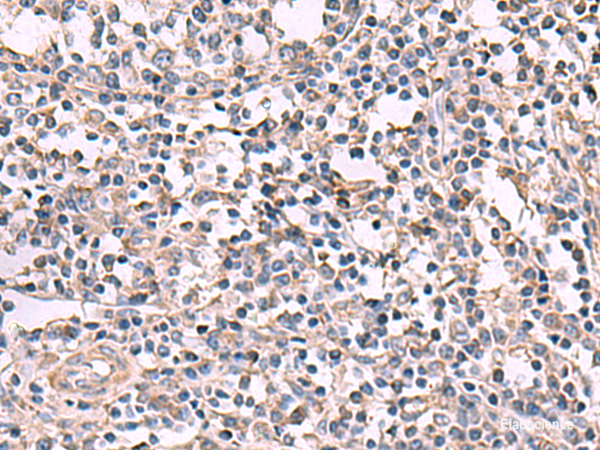
Potassium channels play a role in many cellular processes including maintenance of the action potential, muscle contraction, hormone secretion, osmotic regulation, and ion flow. This gene encodes a member of the superfamily of potassium channel proteins containing two pore-forming P domains and the encoded protein functions as an outward rectifying potassium channel. A mutation in this gene has been found to be associated with migraine with aura. Protein function: Outward rectifying potassium channel. Produces rapidly activating outward rectifier K(+) currents. May function as background potassium channel that sets the resting membrane potential. Channel activity is directly activated by calcium signal. Activated by the G(q)-protein coupled receptor pathway. The calcium signal robustly activates the channel via calcineurin, whereas the anchoring of 14-3- 3/YWHAH interferes with the return of the current to the resting state after activation. Inhibited also by arachidonic acid and other naturally occurring unsaturated free fatty acids. Channel activity is also enhanced by volatile anesthetics, such as isoflurane. Appears to be the primary target of hydroxy-alpha-sanshool, an ingredient of Schezuan pepper. May be involved in the somatosensory function with special respect to pain sensation. [The UniProt Consortium]
Schlagworte:
Anti-TRESK, Anti-KCNK18, Anti-Potassium channel subfamily K member 18, Anti-TWIK-related individual potassium channel, Anti-TWIK-related spinal cord potassium channel, KCNK18 Polyclonal Antibody
Diese Website benutzt Cookies, die für den technischen Betrieb der Website erforderlich sind und stets gesetzt werden. Andere Cookies, die den Komfort bei Benutzung dieser Website erhöhen, der Direktwerbung dienen oder die Interaktion mit anderen Websites und sozialen Netzwerken vereinfachen sollen, werden nur mit Ihrer Zustimmung gesetzt.
Mehr Informationen
