
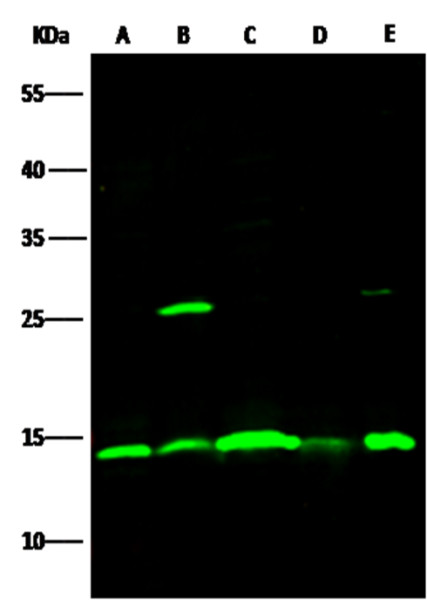
Anti-ISG15 Monoclonal Recombinant Antibody

| Artikelnummer | Größe | Datenblatt | Manual | SDB | Lieferzeit | Menge | Preis |
|---|---|---|---|---|---|---|---|
| E-AN300127P.20 | 20 µl | - |
7 - 16 Werktage* |
182,00 €
|
|||
| E-AN300127P.100 | 100 µl | - |
7 - 16 Werktage* |
462,00 €
|
Bei Fragen nutzen Sie gerne unser Kontaktformular.
Bestellen Sie auch per E-Mail: info@biomol.com
Größere Menge gewünscht? Bulk-Anfrage
Bestellen Sie auch per E-Mail: info@biomol.com
Größere Menge gewünscht? Bulk-Anfrage
ISG15 (interferon-induced 15 kDa protein, also known as IP17) is a 15 kDa ubiquitin family... mehr
Produktinformationen "Anti-ISG15 Monoclonal Recombinant Antibody"
ISG15 (interferon-induced 15 kDa protein, also known as IP17) is a 15 kDa ubiquitin family protein that is expressed by a wide variety of cell types. ISG15 is induced by type-I IFN, and like ubiquitin, becomes conjugated to intracellular proteins. Unlike ubiquitin, it does not target proteins for degradation. Instead, it is part of the antivirus response. Human proISG15 is 165 amino acids (aa) in length. There are two ubiquitin-like domains (aa 2-78 and 79-157) and a propeptide (aa 158-165) that is cleaved intracellularly. Select blood mononuclear cells secrete mature ISG15, which is chemotactic for neutrophils. Mature human ISG15 is 66% aa identical to mouse ISG15. Protein function: Ubiquitin-like protein which plays a key role in the innate immune response to viral infection either via its conjugation to a target protein (ISGylation) or via its action as a free or unconjugated protein (PubMed:27564865, PubMed:39465252). ISGylation involves a cascade of enzymatic reactions involving E1, E2, and E3 enzymes which catalyze the conjugation of ISG15 to a lysine residue in the target protein (PubMed:33727702). Its target proteins include IFIT1, MX1/MxA, PPM1B, UBE2L6, UBA7, CHMP5, CHMP2A, CHMP4B and CHMP6. Isgylation of the viral sensor IFIH1/MDA5 promotes IFIH1/MDA5 oligomerization and triggers activation of innate immunity against a range of viruses, including coronaviruses, flaviviruses and picornaviruses (PubMed:33727702). Can also isgylate: EIF2AK2/PKR which results in its activation, RIGI which inhibits its function in antiviral signaling response, EIF4E2 which enhances its cap structure-binding activity and translation-inhibition activity, UBE2N and UBE2E1 which negatively regulates their activity, IRF3 which inhibits its ubiquitination and degradation and FLNB which prevents its ability to interact with the upstream activators of the JNK cascade thereby inhibiting IFNA-induced JNK signaling. Exhibits antiviral activity towards both DNA and RNA viruses, including influenza A, HIV-1 and Ebola virus. Restricts HIV-1 and ebola virus via disruption of viral budding. Inhibits the ubiquitination of HIV-1 Gag and host TSG101 and disrupts their interaction, thereby preventing assembly and release of virions from infected cells. Inhibits Ebola virus budding mediated by the VP40 protein by disrupting ubiquitin ligase activity of NEDD4 and its ability to ubiquitinate VP40. ISGylates influenza A virus NS1 protein which causes a loss of function of the protein and the inhibition of virus replication. The secreted form of ISG15 can: induce natural killer cell proliferation, act as a chemotactic factor for neutrophils and act as a IFN-gamma-inducing cytokine playing an essential role in antimycobacterial immunity. The secreted form acts through the integrin ITGAL/ITGB2 receptor to initiate activation of SRC family tyrosine kinases including LYN, HCK and FGR which leads to secretion of IFNG and IL10, the interaction is mediated by ITGAL (PubMed:29100055). [The UniProt Consortium]
| Schlagworte: | G1P2, IP17, hUCRP, Ubiquitin-like protein ISG15, Ubiquitin cross-reactive protein, Interferon-induced 17 kDa protein, Interferon-induced 15 kDa protein, Recombinant ISG15 Monoclonal Antibody |
| Hersteller: | Elabscience |
| Hersteller-Nr: | E-AN300127P |
Eigenschaften
| Anwendung: | WB, ICC/IF |
| Antikörper-Typ: | Monoclonal |
| Klon: | 5D9 |
| Konjugat: | No |
| Wirt: | Rabbit |
| Spezies-Reaktivität: | human |
| Immunogen: | Recombinant Human ISG15 protein |
| Format: | Purified |
Datenbank Information
| KEGG ID : | K12159 | Passende Produkte |
| UniProt ID : | P05161 | Passende Produkte |
| Gene ID : | GeneID 9636 | Passende Produkte |
Handhabung & Sicherheit
| Lagerung: | +4°C (avoid repeat freezing and thawing cycles) |
| Versand: | +4°C (International: +4°C) |
| Signalwort: | Warning |
| GHS-Piktogramme: |

|
| H-Sätze: | H317 |
| P-Sätze: | P261, P272, P280, P302+352, P333+313 |
Achtung
Nur für Forschungszwecke und Laboruntersuchungen: Nicht für die Anwendung im oder am Menschen!
Nur für Forschungszwecke und Laboruntersuchungen: Nicht für die Anwendung im oder am Menschen!
Hier folgen Informationen zur Produktreferenz.
mehr
Hier kriegen Sie ein Zertifikat
Loggen Sie sich ein oder registrieren Sie sich, um Analysenzertifikate anzufordern.
Bewertungen lesen, schreiben und diskutieren... mehr
Kundenbewertungen für "Anti-ISG15 Monoclonal Recombinant Antibody"
Bewertung schreiben
Loggen Sie sich ein oder registrieren Sie sich, um eine Produktbewertung abzugeben.
Zuletzt angesehen