
Cookie-Einstellungen
Diese Website benutzt Cookies, die für den technischen Betrieb der Website erforderlich sind und stets gesetzt werden. Andere Cookies, die den Komfort bei Benutzung dieser Website erhöhen, der Direktwerbung dienen oder die Interaktion mit anderen Websites und sozialen Netzwerken vereinfachen sollen, werden nur mit Ihrer Zustimmung gesetzt.
Konfiguration
Technisch erforderlich
Diese Cookies sind für die Grundfunktionen des Shops notwendig.
"Alle Cookies ablehnen" Cookie
"Alle Cookies annehmen" Cookie
Ausgewählter Shop
CSRF-Token
Cookie-Einstellungen
FACT-Finder Tracking
Individuelle Preise
Kundenspezifisches Caching
Session
Währungswechsel
Komfortfunktionen
Diese Cookies werden genutzt um das Einkaufserlebnis noch ansprechender zu gestalten, beispielsweise für die Wiedererkennung des Besuchers.
Facebook-Seite in der rechten Blog - Sidebar anzeigen
Merkzettel
Statistik & Tracking
Endgeräteerkennung
Kauf- und Surfverhalten mit Google Tag Manager
Partnerprogramm

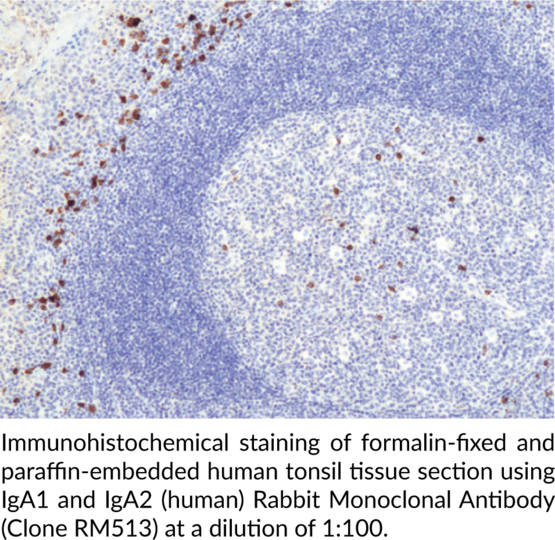
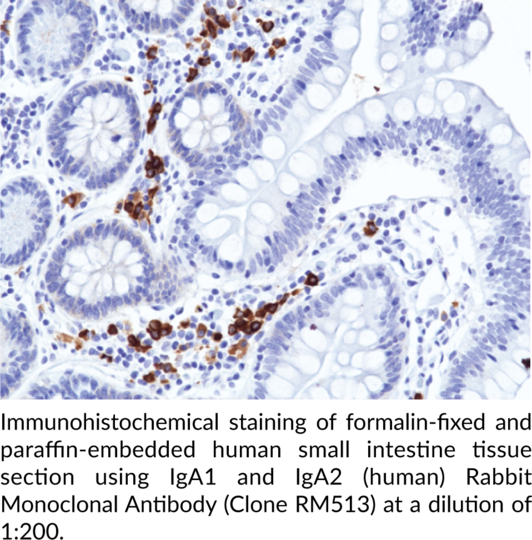
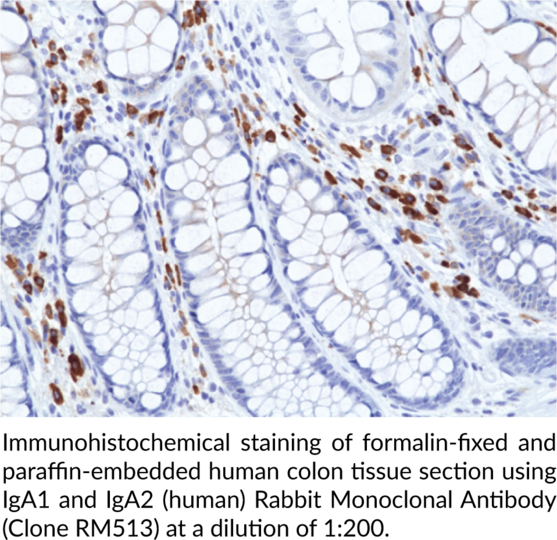
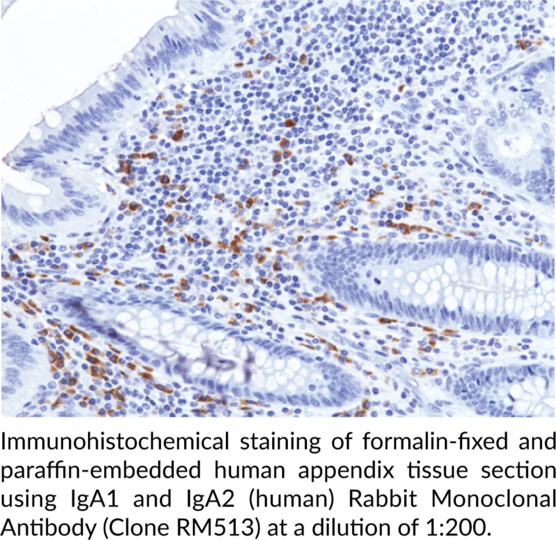


| Artikelnummer | Größe | Datenblatt | Manual | SDB | Lieferzeit | Menge | Preis |
|---|---|---|---|---|---|---|---|
| Cay42779-100 | 100 µl | - |
6 - 10 Werktage* |
554,00 €
|
Bei Fragen nutzen Sie gerne unser Kontaktformular.
Bestellen Sie auch per E-Mail: info@biomol.com
Größere Menge gewünscht? Bulk-Anfrage
Bestellen Sie auch per E-Mail: info@biomol.com
Größere Menge gewünscht? Bulk-Anfrage
Immunoglobulin A (IgA) is a member of the immunoglobulin superfamily of glycoproteins with roles... mehr
Produktinformationen "Anti-IgA1 and IgA2 (human) Rabbit (Clone RM51"
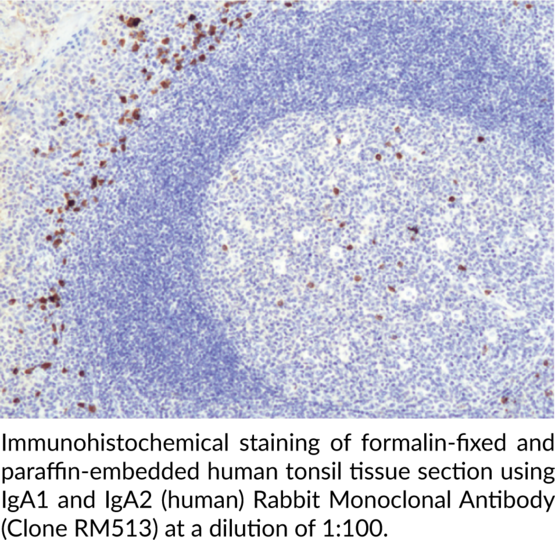
Immunoglobulin A (IgA) is a member of the immunoglobulin superfamily of glycoproteins with roles in host defense against intestinal pathogens and both quantitative and qualitative control of host commensal microbiota composition. Human IgA consists of two identical light chains of approximately 25 kDa each, as well as two heavy chains of approximately 60 kDa each that contain C-terminal extensions, known as tailpieces, which allow for IgA oligomerization. There are two IgA subclasses, IgA1 and IgA2, which are encoded by IGHA1/alpha1 and IGHA2/alpha2, respectively, and have differences primarily in the hinge and heavy chain constant regions. IgA is produced by B cells and later secreted by plasma cells and is the most abundant antibody on mucosal surfaces that comprises at least 70% of all Ig produced in mice. Monomeric IgA1 is predominant in the serum, but dimeric secretory IgA (SIgA) is the predominant form in mucosal surfaces and secretions with the ratio of subclasses varying based on the IgA-secreting cell types present. Dimeric and polymeric IgA bind to Igalpha Fc receptor I (FcalphaRI) and the IgM- and IgA-binding high affinity Igalpha and Igµ Fc receptor (Fcalpha/µ-R), which are both involved in mediating immune responses. Production of IgA is induced in the gut only in animals containing intestinal microbes, and the number of IgA-producing plasma cells is reduced in germ-free mice. Serum levels of IgA are decreased in patients with IgA deficiency, who are typically asymptomatic but may have allergy or autoimmune disorders or experience recurrent infections. IgA deposits in vessels and, in certain cases, the glomerulus in children with IgA vasculitis (IgAV), a disorder characterized by vascular inflammation, purpura, joint pain, gastrointestinal disturbances, and, in severe cases, glomerulonephritis. Cayman's IgA1 and IgA2 (human) Rabbit Monoclonal Antibody (Clone RM513) can be used for immunohistochemistry (IHC).. Cross reactivity: (+) IgA1: (+) IgA2, (-) Human IgG, (-) Human IgM, (-) Human IgD, (-) Human IgE. (+) Human: .. Protein function: Constant region of immunoglobulin heavy chains. Immunoglobulins, also known as antibodies, are membrane-bound or secreted glycoproteins produced by B lymphocytes. In the recognition phase of humoral immunity, the membrane-bound immunoglobulins serve as receptors which, upon binding of a specific antigen, trigger the clonal expansion and differentiation of B lymphocytes into immunoglobulins- secreting plasma cells. Secreted immunoglobulins mediate the effector phase of humoral immunity, which results in the elimination of bound antigens (PubMed:22158414, PubMed:20176268). The antigen binding site is formed by the variable domain of one heavy chain, together with that of its associated light chain. Thus, each immunoglobulin has two antigen binding sites with remarkable affinity for a particular antigen. The variable domains are assembled by a process called V-(D)-J rearrangement and can then be subjected to somatic hypermutations which, after exposure to antigen and selection, allow affinity maturation for a particular antigen (PubMed:17576170, PubMed:20176268). Ig alpha is the major immunoglobulin class in body secretions (PubMed:2241915). [The UniProt Consortium]
| Schlagworte: | Immunoglobulin A1 and A2 |
| Hersteller: | Cayman Chemical |
| Hersteller-Nr: | 42779 |
Eigenschaften
| Anwendung: | IHC |
| Antikörper-Typ: | Monoclonal |
| Klon: | RM513 |
| Konjugat: | No |
| Wirt: | Rabbit |
| Spezies-Reaktivität: | human |
| Immunogen: | Human plasma IgA |
| Format: | Purified |
Datenbank Information
| UniProt ID : | P01876 | Passende Produkte |
Handhabung & Sicherheit
| Lagerung: | -20°C |
| Versand: | -20°C (International: -20°C) |
Achtung
Nur für Forschungszwecke und Laboruntersuchungen: Nicht für die Anwendung im oder am Menschen!
Nur für Forschungszwecke und Laboruntersuchungen: Nicht für die Anwendung im oder am Menschen!
Hier folgen Informationen zur Produktreferenz.
mehr
Hier kriegen Sie ein Zertifikat
Loggen Sie sich ein oder registrieren Sie sich, um Analysenzertifikate anzufordern.
Bewertungen lesen, schreiben und diskutieren... mehr
Kundenbewertungen für "Anti-IgA1 and IgA2 (human) Rabbit (Clone RM51"
Bewertung schreiben
Loggen Sie sich ein oder registrieren Sie sich, um eine Produktbewertung abzugeben.
Zuletzt angesehen