
Cookie-Einstellungen
Diese Website benutzt Cookies, die für den technischen Betrieb der Website erforderlich sind und stets gesetzt werden. Andere Cookies, die den Komfort bei Benutzung dieser Website erhöhen, der Direktwerbung dienen oder die Interaktion mit anderen Websites und sozialen Netzwerken vereinfachen sollen, werden nur mit Ihrer Zustimmung gesetzt.
Konfiguration
Technisch erforderlich
Diese Cookies sind für die Grundfunktionen des Shops notwendig.
"Alle Cookies ablehnen" Cookie
"Alle Cookies annehmen" Cookie
Ausgewählter Shop
CSRF-Token
Cookie-Einstellungen
FACT-Finder Tracking
Individuelle Preise
Kundenspezifisches Caching
Session
Währungswechsel
Komfortfunktionen
Diese Cookies werden genutzt um das Einkaufserlebnis noch ansprechender zu gestalten, beispielsweise für die Wiedererkennung des Besuchers.
Facebook-Seite in der rechten Blog - Sidebar anzeigen
Merkzettel
Statistik & Tracking
Endgeräteerkennung
Kauf- und Surfverhalten mit Google Tag Manager
Partnerprogramm

| Artikelnummer | Größe | Datenblatt | Manual | SDB | Lieferzeit | Menge | Preis |
|---|---|---|---|---|---|---|---|
| NSJ-F40893-0.08ML | 80 µl | - | - |
7 - 12 Werktage* |
361,00 €
|
||
| NSJ-F40893-0.4ML | 400 µl | - | - |
7 - 12 Werktage* |
772,00 €
|
Bei Fragen nutzen Sie gerne unser Kontaktformular.
Bestellen Sie auch per E-Mail: info@biomol.com
Größere Menge gewünscht? Bulk-Anfrage
Bestellen Sie auch per E-Mail: info@biomol.com
Größere Menge gewünscht? Bulk-Anfrage
In 1X PBS, pH 7.4, with 0.09% sodium azide. The ETS family of transcription factors,... mehr
Produktinformationen "Anti-ETV5"
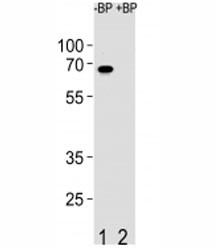
In 1X PBS, pH 7.4, with 0.09% sodium azide. The ETS family of transcription factors, characterized by an evolutionarily conserved DNA-binding domain, regulates expression of more than 300 target genes by binding to a purine-rich GGAA/T core sequence. Depending on the cellular context, they can function as transactivators or transrepressors. Ets proteins have been implicated in regulation of gene expression during a variety of biological processes, including growth control, transformation, T-cell activation, and developmental programs in many organisms. Signals regulating cell growth are transmitted from outside the cell to the nucleus by growth factors and their receptors, G-proteins, kinases and transcription factors. It was shown that ETS signal transduction is implicated in hematopoiesis and angiogenesis at the earliest stages of embryogenesis, and is later involved in tissue development. Deregulated expression and/or formation of chimeric fusion proteins of the ETS family due to proviral insertion or chromosome translocation is associated with leukemias and with specific types of solid tumors.1 Among the multiple Ets proteins, the PEA3 group consists of ETV1 (Ets variant gene 1, also called ER81), ETV4 (also called PEA3) and ETV5 (also called ERM). All three members are 95% identical in the ETS domain and more than 85% in the acidic transactivation domain. Several studies suggest that the PEA3 group proteins are involved in intestinal tumors, gastric cancer, and breast cancer metastasis. In nearly all Ewing?s sarcoma tumors, EWS, which encodes a RNA-binding protein, is fused by chromosomal translocation to an Ets gene, including FLI, ERG, ETV4, and ETV1. This results in the expression of chimeric proteins that may be important in tumor cell transformation.2 Recently, it was reported that TMPRSS2, an AR-regulated gene, is fused by translocation to the ETV1, ERG, or ETV4 gene in a subset of prostate cancers. These findings suggest an important role for PEA3 proteins in prostate cancer.3 In addition Ets family members have been correlated to tumor progression by upregulating the expression of matrix-degrading proteases. The acquisition of a migratory phenotype by the epithelial tumor cells together with the remodeling of the extracellular matrix must accompany the process of cancer cell invasion. Indeed, ETV5 has been shown to act through matrix metalloproteinase-2 gelatinolytic activity to confer invasive capabilities, associated with an initial switch to myometrial infiltration.4 Protein function: Binds to DNA sequences containing the consensus nucleotide core sequence 5'-GGAA.-3'. [The UniProt Consortium]
| Schlagworte: | Anti-ERM, Anti-ETV5, Anti-Ets-related protein ERM, Anti-ETS translocation variant 5, ETV5 Antibody |
| Hersteller: | NSJ Bioreagents |
| Hersteller-Nr: | F40893 |
Eigenschaften
| Anwendung: | FC, WB, ELISA |
| Antikörper-Typ: | Polyclonal |
| Konjugat: | No |
| Wirt: | Rabbit |
| Spezies-Reaktivität: | human |
| Immunogen: | A portion of amino acids 8-36 from the human protein was used as the immunogen for this ETV5 antibody. |
| Format: | Purified |
Datenbank Information
| KEGG ID : | K15593 | Passende Produkte |
| UniProt ID : | P41161 | Passende Produkte |
| Gene ID : | GeneID 2119 | Passende Produkte |
Handhabung & Sicherheit
| Lagerung: | -20°C |
| Versand: | +4°C (International: +4°C) |
Achtung
Nur für Forschungszwecke und Laboruntersuchungen: Nicht für die Anwendung im oder am Menschen!
Nur für Forschungszwecke und Laboruntersuchungen: Nicht für die Anwendung im oder am Menschen!
Hier folgen Informationen zur Produktreferenz.
mehr
Hier kriegen Sie ein Zertifikat
Loggen Sie sich ein oder registrieren Sie sich, um Analysenzertifikate anzufordern.
Bewertungen lesen, schreiben und diskutieren... mehr
Kundenbewertungen für "Anti-ETV5"
Bewertung schreiben
Loggen Sie sich ein oder registrieren Sie sich, um eine Produktbewertung abzugeben.


Zuletzt angesehen