
Cookie-Einstellungen
Diese Website benutzt Cookies, die für den technischen Betrieb der Website erforderlich sind und stets gesetzt werden. Andere Cookies, die den Komfort bei Benutzung dieser Website erhöhen, der Direktwerbung dienen oder die Interaktion mit anderen Websites und sozialen Netzwerken vereinfachen sollen, werden nur mit Ihrer Zustimmung gesetzt.
Konfiguration
Technisch erforderlich
Diese Cookies sind für die Grundfunktionen des Shops notwendig.
"Alle Cookies ablehnen" Cookie
"Alle Cookies annehmen" Cookie
Ausgewählter Shop
CSRF-Token
Cookie-Einstellungen
FACT-Finder Tracking
Individuelle Preise
Kundenspezifisches Caching
Session
Währungswechsel
Komfortfunktionen
Diese Cookies werden genutzt um das Einkaufserlebnis noch ansprechender zu gestalten, beispielsweise für die Wiedererkennung des Besuchers.
Facebook-Seite in der rechten Blog - Sidebar anzeigen
Merkzettel
Statistik & Tracking
Endgeräteerkennung
Kauf- und Surfverhalten mit Google Tag Manager
Partnerprogramm

| Artikelnummer | Größe | Datenblatt | Manual | SDB | Lieferzeit | Menge | Preis |
|---|---|---|---|---|---|---|---|
| NSJ-FY12278 | 100 µg | - | - |
7 - 12 Werktage* |
790,00 €
|
Bei Fragen nutzen Sie gerne unser Kontaktformular.
Bestellen Sie auch per E-Mail: info@biomol.com
Größere Menge gewünscht? Bulk-Anfrage
Bestellen Sie auch per E-Mail: info@biomol.com
Größere Menge gewünscht? Bulk-Anfrage
Adding 0.2 ml of distilled water will yield a concentration of 500 ug/ml. CD69 antibody detects... mehr
Produktinformationen "Anti-CD69"
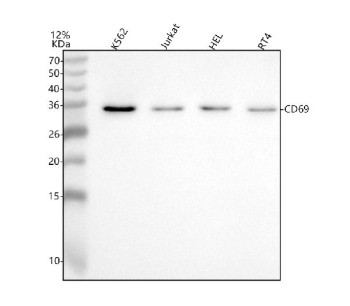
Adding 0.2 ml of distilled water will yield a concentration of 500 ug/ml. CD69 antibody detects Early activation antigen CD69, encoded by the CD69 gene on chromosome 12p13.31. CD69 antibody is widely used in immunology research as CD69 is one of the earliest markers of lymphocyte activation. CD69 is a type II transmembrane C-type lectin receptor expressed on T cells, B cells, NK cells, and other leukocytes shortly after stimulation. It functions in immune regulation, signaling, and tissue retention of lymphocytes, making it a key marker of immune activation and inflammation.Structurally, CD69 is a ~28-32 kDa disulfide-linked homodimer composed of an extracellular C-type lectin-like domain, a transmembrane region, and a short cytoplasmic tail. The lectin domain mediates protein interactions, while the transmembrane region associates with signaling molecules. CD69 is rapidly upregulated at the cell surface following antigen recognition or cytokine stimulation, making it a sensitive marker of early activation.Functionally, CD69 regulates immune cell proliferation, cytokine production, and migration. It modulates signaling pathways downstream of the T cell receptor and integrins. Importantly, CD69 binds sphingosine-1-phosphate receptor 1 (S1PR1) and promotes its internalization, reducing lymphocyte egress from lymphoid organs. Through this mechanism, CD69 contributes to tissue retention of immune cells during immune responses. Researchers use CD69 antibody to study lymphocyte activation, tissue homing, and inflammation.Clinically, CD69 is an important biomarker of immune activation in infection, autoimmune disease, and cancer. Elevated CD69 expression is associated with autoimmune pathologies such as lupus and rheumatoid arthritis. It has also been used to monitor immune responses in HIV infection and cancer immunotherapy. In oncology, tumor-infiltrating lymphocytes expressing CD69 often indicate active immune engagement. NSJ Bioreagents provides CD69 antibody for immunology, oncology, and translational research applications.Experimentally, CD69 antibody is widely used in flow cytometry to monitor lymphocyte activation, in immunohistochemistry to study tissue infiltration, and in western blotting to confirm expression. Functional assays using CD69 antibody help evaluate lymphocyte responses to antigenic or cytokine stimuli.
| Schlagworte: | Anti-EA1, Anti-CD69, Anti-MLR-3, Anti-GP32/28, Anti-BL-AC/P26, Anti-Activation inducer molecule, Anti-Early activation antigen CD69, Anti-Leukocyte surface antigen Leu-23, Anti-Early T-cell activation antigen p60, Anti-C-type lectin domain family 2 member |
| Hersteller: | NSJ Bioreagents |
| Hersteller-Nr: | FY12278 |
Eigenschaften
| Anwendung: | WB, ELISA |
| Antikörper-Typ: | Polyclonal |
| Konjugat: | No |
| Wirt: | Rabbit |
| Spezies-Reaktivität: | human |
| Immunogen: | E.coli-derived human CD69 recombinant protein (Position: M1-K199) |
| Format: | Purified |
Datenbank Information
| KEGG ID : | K06502 | Passende Produkte |
| UniProt ID : | Q07108 | Passende Produkte |
| Gene ID : | GeneID 969 | Passende Produkte |
Handhabung & Sicherheit
| Lagerung: | +4°C |
| Versand: | +4°C (International: +4°C) |
Achtung
Nur für Forschungszwecke und Laboruntersuchungen: Nicht für die Anwendung im oder am Menschen!
Nur für Forschungszwecke und Laboruntersuchungen: Nicht für die Anwendung im oder am Menschen!
Hier folgen Informationen zur Produktreferenz.
mehr
Hier kriegen Sie ein Zertifikat
Loggen Sie sich ein oder registrieren Sie sich, um Analysenzertifikate anzufordern.
Bewertungen lesen, schreiben und diskutieren... mehr
Kundenbewertungen für "Anti-CD69"
Bewertung schreiben
Loggen Sie sich ein oder registrieren Sie sich, um eine Produktbewertung abzugeben.
Zuletzt angesehen