
Cookie-Einstellungen
Diese Website benutzt Cookies, die für den technischen Betrieb der Website erforderlich sind und stets gesetzt werden. Andere Cookies, die den Komfort bei Benutzung dieser Website erhöhen, der Direktwerbung dienen oder die Interaktion mit anderen Websites und sozialen Netzwerken vereinfachen sollen, werden nur mit Ihrer Zustimmung gesetzt.
Konfiguration
Technisch erforderlich
Diese Cookies sind für die Grundfunktionen des Shops notwendig.
"Alle Cookies ablehnen" Cookie
"Alle Cookies annehmen" Cookie
Ausgewählter Shop
CSRF-Token
Cookie-Einstellungen
FACT-Finder Tracking
Individuelle Preise
Kundenspezifisches Caching
Session
Währungswechsel
Komfortfunktionen
Diese Cookies werden genutzt um das Einkaufserlebnis noch ansprechender zu gestalten, beispielsweise für die Wiedererkennung des Besuchers.
Facebook-Seite in der rechten Blog - Sidebar anzeigen
Merkzettel
Statistik & Tracking
Endgeräteerkennung
Kauf- und Surfverhalten mit Google Tag Manager
Partnerprogramm


| Artikelnummer | Größe | Datenblatt | Manual | SDB | Lieferzeit | Menge | Preis |
|---|---|---|---|---|---|---|---|
| NSJ-V6144-20UG | 20 µg | - | - |
7 - 12 Werktage* |
684,00 €
|
||
| NSJ-V6144-100UG | 100 µg | - | - |
7 - 12 Werktage* |
1.265,00 €
|
Bei Fragen nutzen Sie gerne unser Kontaktformular.
Bestellen Sie auch per E-Mail: info@biomol.com
Größere Menge gewünscht? Bulk-Anfrage
Bestellen Sie auch per E-Mail: info@biomol.com
Größere Menge gewünscht? Bulk-Anfrage
Antibody in 1X PBS with 0.05% BSA, 0.05% sodium azide. Cluster of Differentiation 163 (CD163),... mehr
Produktinformationen "Anti-CD163, clone MSVA-163M"
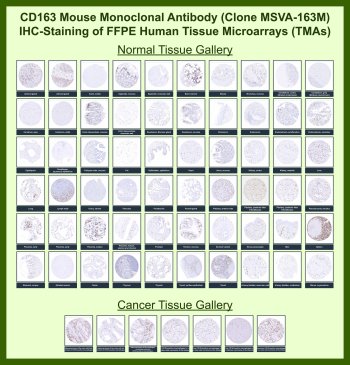
Antibody in 1X PBS with 0.05% BSA, 0.05% sodium azide. Cluster of Differentiation 163 (CD163), encoded by the CD163 gene, is a hemoglobin scavenger receptor expressed predominantly on monocytes and tissue-resident macrophages. CD163 is widely recognized as a marker of alternatively activated macrophages and plays a central role in clearance of hemoglobin-haptoglobin complexes, regulation of inflammation, and tissue remodeling. CD163 expression is particularly enriched in macrophage populations associated with anti-inflammatory and immunoregulatory functions and is commonly used to identify M2-like macrophages in tissue sections.CD163 Antibody for IHC, also referred to as CD163 immunohistochemistry antibody or macrophage marker antibody in the literature, is specifically optimized for detecting CD163-positive cells in formalin-fixed, paraffin-embedded tissues. This CD163 Antibody for IHC / CD163 Immunohistochemistry Antibody is uniquely positioned for high-confidence identification of macrophage populations within intact tissue architecture, enabling detailed evaluation of immune cell infiltration and spatial distribution. Clone MSVA-163M antibody has been tested on human tissue microarrays (TMA), supporting consistent staining performance across a broad range of normal and cancer tissues and reinforcing its suitability for comparative tissue analysis.In immunohistochemistry applications, CD163 is typically observed as strong membranous and cytoplasmic HRP-DAB brown staining in macrophages localized within stromal regions, perivascular niches, and sites of active inflammation. Tissue microarray (TMA) analysis demonstrates robust and reproducible labeling of macrophage populations across multiple organ systems, including spleen, liver, lung, and lymphoid tissues, while most non-hematopoietic parenchymal cells remain negative. This consistent staining pattern supports reliable identification of macrophage lineage cells across diverse tissue contexts.Within tumor tissues, CD163-positive tumor-associated macrophages are frequently enriched in the tumor microenvironment, where they localize around tumor nests, invasive fronts, and vascular structures. TMA-based evaluation highlights variability in macrophage density and distribution across different tumor types, providing insight into tumor microenvironment composition and immune infiltration patterns. These macrophages are associated with immunosuppressive signaling, extracellular matrix remodeling, and promotion of tumor growth and angiogenesis.A major advantage of using a CD163 antibody for IHC is its ability to distinguish macrophage subsets with anti-inflammatory and pro-tumorigenic characteristics. CD163-positive macrophages are often correlated with poor prognosis in multiple cancer types, including breast, lung, and colorectal carcinomas. Tissue microarray analysis further enables high-throughput comparison of macrophage infiltration across large sample sets, supporting biomarker studies and translational research.CD163 expression is regulated by cytokines such as IL10, glucocorticoids, and other anti-inflammatory mediators, and is upregulated in conditions associated with chronic inflammation, tissue repair, and immune modulation. Detection of CD163 by immunohistochemistry therefore provides insight into macrophage activation states and the balance between pro-inflammatory and anti-inflammatory signaling within tissues.In addition to its role in hemoglobin clearance, CD163 contributes to modulation of oxidative stress and cytokine signaling pathways that support resolution of inflammation and maintenance of tissue homeostasis. These functional roles make CD163 a valuable marker for studying macrophage biology in both physiological and pathological contexts.The CD163 gene is located on chromosome 12p13 and encodes a transmembrane protein belonging to the scavenger receptor cysteine-rich superfamily. Its restricted expression pattern and strong association with macrophage lineage cells make it a highly specific and reliable marker for immunohistochemical detection.This CD163 antibody for IHC is suitable for detecting CD163 expression in formalin-fixed tissue sections, with demonstrated performance in tissue microarray (TMA) analysis supporting studies of tumor microenvironment composition, macrophage infiltration, and inflammatory disease processes.This antibody is part of a broader collection of CD Antibodies designed for detecting immune cell markers and profiling leukocyte populations across tissue-based and cellular assays.This antibody is also part of a broader collection of IHC antibodies validated by tissue microarray analysis, supporting consistent staining across normal and cancer tissues.
| Schlagworte: | Anti-CD163, Anti-Hemoglobin scavenger receptor, Anti-Scavenger receptor cysteine-rich type 1 protein M130, CD163 Antibody |
| Hersteller: | NSJ Bioreagents |
| Hersteller-Nr: | V6144 |
Eigenschaften
| Anwendung: | IHC |
| Antikörper-Typ: | Monoclonal |
| Klon: | MSVA-163M |
| Konjugat: | No |
| Wirt: | Mouse |
| Spezies-Reaktivität: | human |
| Immunogen: | Recombinant fragment of human CD163 protein (around amino acids 43-196) (exact sequence is proprietary) |
| Format: | Purified |
Datenbank Information
| KEGG ID : | K06545 | Passende Produkte |
| UniProt ID : | Q86VB7 | Passende Produkte |
| Gene ID : | GeneID 9332 | Passende Produkte |
Handhabung & Sicherheit
| Lagerung: | -20°C |
| Versand: | -20°C (International: -20°C) |
Achtung
Nur für Forschungszwecke und Laboruntersuchungen: Nicht für die Anwendung im oder am Menschen!
Nur für Forschungszwecke und Laboruntersuchungen: Nicht für die Anwendung im oder am Menschen!
Hier folgen Informationen zur Produktreferenz.
mehr
Hier kriegen Sie ein Zertifikat
Loggen Sie sich ein oder registrieren Sie sich, um Analysenzertifikate anzufordern.
Bewertungen lesen, schreiben und diskutieren... mehr
Kundenbewertungen für "Anti-CD163, clone MSVA-163M"
Bewertung schreiben
Loggen Sie sich ein oder registrieren Sie sich, um eine Produktbewertung abzugeben.
Zuletzt angesehen