

Diese Website benutzt Cookies, die für den technischen Betrieb der Website erforderlich sind und stets gesetzt werden. Andere Cookies, die den Komfort bei Benutzung dieser Website erhöhen, der Direktwerbung dienen oder die Interaktion mit anderen Websites und sozialen Netzwerken vereinfachen sollen, werden nur mit Ihrer Zustimmung gesetzt.
Konfiguration
Technisch erforderlich
Diese Cookies sind für die Grundfunktionen des Shops notwendig.
"Alle Cookies ablehnen" Cookie
"Alle Cookies annehmen" Cookie
Ausgewählter Shop
CSRF-Token
Cookie-Einstellungen
FACT-Finder Tracking
Individuelle Preise
Kundenspezifisches Caching
Session
Währungswechsel
Komfortfunktionen
Diese Cookies werden genutzt um das Einkaufserlebnis noch ansprechender zu gestalten, beispielsweise für die Wiedererkennung des Besuchers.
Facebook-Seite in der rechten Blog - Sidebar anzeigen
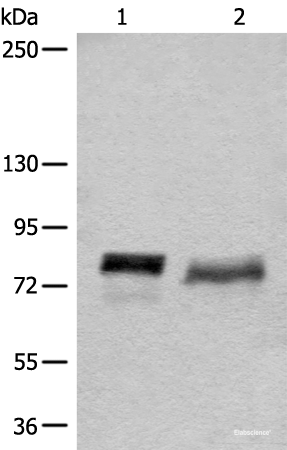
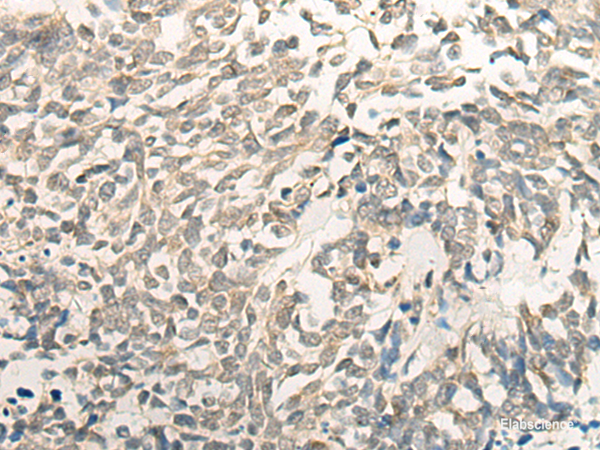
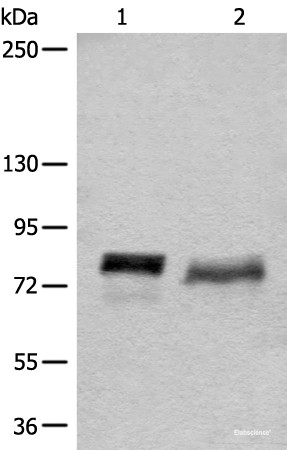
BCAS3 (breast carcinoma amplified sequence 3), also designated MAAB or GAOB1, is a 913 amino acid protein that is believed to be involved in breast cancer progression. The gene is regulated by ER (estrogen receptor alpha) and expressed in multiple tissues, including malignant human brain lesions. It is overexpressed and amplified in breast cancer cell lines. BCAS3 contains three WD40 repeat regions, a bromodomain, a rare zinc-finger motif, four probable DNA-binding domains, and two kinase-inducible phosphorylation domains. Five variants are produced due to alternative splicing. BCAS3 interacts with histone H3 and PCAF, which is indicative of histone acetyltransferase activity. BCAS3 also exhibits ER transactiviation activity by acting as a coactivator with PELP1 or MTA1. The amplification and translocation between the BCAS3 gene and the BCAS4 gene results in a fusion transcript is overexpressed in MCF-7 cells. Protein function: Plays a role in angiogenesis. Participates in the regulation of cell polarity and directional endothelial cell migration by mediating both the activation and recruitment of CDC42 and the reorganization of the actin cytoskeleton at the cell leading edge. Promotes filipodia formation. Functions synergistically with PELP1 as a transcriptional coactivator of estrogen receptor- responsive genes. Stimulates histone acetyltransferase activity. Binds to chromatin. [The UniProt Consortium]
Diese Website benutzt Cookies, die für den technischen Betrieb der Website erforderlich sind und stets gesetzt werden. Andere Cookies, die den Komfort bei Benutzung dieser Website erhöhen, der Direktwerbung dienen oder die Interaktion mit anderen Websites und sozialen Netzwerken vereinfachen sollen, werden nur mit Ihrer Zustimmung gesetzt.
Mehr Informationen