
Cookie-Einstellungen
Diese Website benutzt Cookies, die für den technischen Betrieb der Website erforderlich sind und stets gesetzt werden. Andere Cookies, die den Komfort bei Benutzung dieser Website erhöhen, der Direktwerbung dienen oder die Interaktion mit anderen Websites und sozialen Netzwerken vereinfachen sollen, werden nur mit Ihrer Zustimmung gesetzt.
Konfiguration
Technisch erforderlich
Diese Cookies sind für die Grundfunktionen des Shops notwendig.
"Alle Cookies ablehnen" Cookie
"Alle Cookies annehmen" Cookie
Ausgewählter Shop
CSRF-Token
Cookie-Einstellungen
FACT-Finder Tracking
Individuelle Preise
Kundenspezifisches Caching
Session
Währungswechsel
Komfortfunktionen
Diese Cookies werden genutzt um das Einkaufserlebnis noch ansprechender zu gestalten, beispielsweise für die Wiedererkennung des Besuchers.
Facebook-Seite in der rechten Blog - Sidebar anzeigen
Merkzettel
Statistik & Tracking
Endgeräteerkennung
Kauf- und Surfverhalten mit Google Tag Manager
Partnerprogramm

| Artikelnummer | Größe | Datenblatt | Manual | SDB | Lieferzeit | Menge | Preis |
|---|---|---|---|---|---|---|---|
| ATA-HPA011385.100 | 100 µl |
7 - 10 Werktage* |
463,00 €
|
Bei Fragen nutzen Sie gerne unser Kontaktformular.
Bestellen Sie auch per E-Mail: info@biomol.com
Größere Menge gewünscht? Bulk-Anfrage
Bestellen Sie auch per E-Mail: info@biomol.com
Größere Menge gewünscht? Bulk-Anfrage
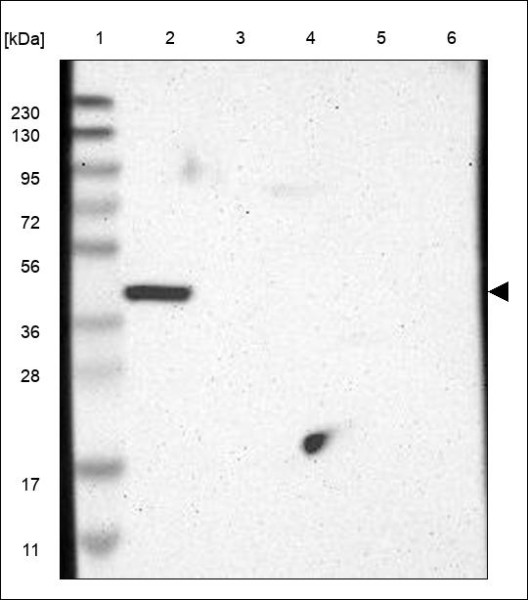
Rabbit Polyclonal ATF4 Antibody against Human activating transcription factor 4. Validated for... mehr
Produktinformationen "Anti-ATF4"
Rabbit Polyclonal ATF4 Antibody against Human activating transcription factor 4. Validated for Western Blot. Buffer: 40% glycerol and PBS (pH 7.2). 0.02% sodium azide is added as preservative. Interspecies information: Highest antigen sequence indentity to the following orthologs: ENSMUSG00000042406: 86%, ENSRNOG00000017801: 88%. Protein function: Transcription factor that binds the cAMP response element (CRE) (consensus: 5'-GTGACGT[AC][AG]-3') and acts both as a regulator of normal metabolic and redox processes, and as a master transcription factor during the integrated stress response (ISR) (PubMed:1847461, PubMed:16682973, PubMed:31444471, PubMed:32132707). Binds to asymmetric CRE's as a heterodimer and to palindromic CRE's as a homodimer. Core effector of the ISR, which is required for adaptation to various stress, such as endoplasmic reticulum (ER) stress, amino acid starvation, mitochondrial stress or oxidative stress (PubMed:32132707). During the ISR, ATF4 protein is translated in response to eIF-2-alpha/EIF2S1 phosphorylation caused by stress, and acts as a master transcription factor of stress-responsive genes in order to promote cell recovery (PubMed:32132707). Protects cells against metabolic consequences of ER oxidation by promoting expression of genes linked to amino acid sufficiency and resistance to oxidative stress. Regulates the induction of DDIT3/CHOP and asparagine synthetase (ASNS) in response to amino acid deprivation or endoplasmic reticulum (ER) stress (PubMed:11960987). Together with DDIT3/CHOP, mediates ER-mediated cell death by promoting expression of genes involved in cellular amino acid metabolic processes, mRNA translation and the unfolded protein response (UPR) in response to ER stress. ATF4 and DDIT3/CHOP activate the transcription of TRIB3 and promote ER stress-induced neuronal cell-death by regulating the expression of BBC3/PUMA (PubMed:15775988, PubMed:18940792). During ER stress response, activates the transcription of NLRP1, possibly in concert with other factors (PubMed:26086088). Activates expression of genes required to promote cell recovery in response to mitochondrial stress (PubMed:32132706, PubMed:32132707). Independently of the ISR, also required for normal metabolic processes: plays a key role in embryonic lens formation, fetal liver hematopoiesis, bone development and synaptic plasticity. Acts as a regulator of osteoblast differentiation in response to phosphorylation by RPS6KA3/RSK2: phosphorylation in osteoblasts enhances transactivation activity and promotes expression of osteoblast-specific genes and post-transcriptionally regulates the synthesis of Type I collagen, the main constituent of the bone matrix (PubMed:15109498). Cooperates with FOXO1 in osteoblasts to regulate glucose homeostasis through suppression of beta-cell production and decrease in insulin production. Activates transcription of SIRT4. Regulates the circadian expression of the core clock component PER2 and the serotonin transporter SLC6A4. Binds in a circadian time-dependent manner to the cAMP response elements (CRE) in the SLC6A4 and PER2 promoters and periodically activates the transcription of these genes. Mainly acts as a transcriptional activator in cellular stress adaptation, but it can also act as a transcriptional repressor: acts as a regulator of synaptic plasticity by repressing transcription, thereby inhibiting induction and maintenance of long-term memory. Regulates synaptic functions via interaction with DISC1 in neurons, which inhibits ATF4 transcription factor activity by disrupting ATF4 dimerization and DNA-binding (PubMed:31444471). [The UniProt Consortium]
| Schlagworte: | Anti-CREB-2, Anti-TaxREB67, Anti-Activating transcription factor 4, Anti-cAMP-responsive element-binding protein 2, Anti-cAMP-dependent transcription factor ATF-4, Anti-Cyclic AMP-dependent transcription factor ATF-4 |
| Hersteller: | Atlas Antibodies |
| Hersteller-Nr: | HPA011385 |
Eigenschaften
| Anwendung: | WB |
| Antikörper-Typ: | Polyclonal |
| Konjugat: | No |
| Wirt: | Rabbit |
| Spezies-Reaktivität: | human |
| Immunogen: | FDQSGLGAEE SLGLLDDYLE VAKHFKPHGF SSDKAKAGSS EWLAVDGLVS PSNNSKEDAF SGTDWMLEKM DLKEFDLDAL LGIDDLETMP DDLLTTLDDT CDLFAPLVQE TNKQPPQTVN PIGHLPESLT |
| Format: | Affinity Purified |
Datenbank Information
| KEGG ID : | K04374 | Passende Produkte |
| UniProt ID : | P18848 | Passende Produkte |
| Gene ID : | GeneID 468 | Passende Produkte |
Handhabung & Sicherheit
| Lagerung: | -20°C (+4 °C for short term storage) |
| Versand: | +20°C (International: +20°C) |
Achtung
Nur für Forschungszwecke und Laboruntersuchungen: Nicht für die Anwendung im oder am Menschen!
Nur für Forschungszwecke und Laboruntersuchungen: Nicht für die Anwendung im oder am Menschen!
Hier folgen Informationen zur Produktreferenz.
mehr
Hier kriegen Sie ein Zertifikat
Loggen Sie sich ein oder registrieren Sie sich, um Analysenzertifikate anzufordern.
Bewertungen lesen, schreiben und diskutieren... mehr
Kundenbewertungen für "Anti-ATF4"
Bewertung schreiben
Loggen Sie sich ein oder registrieren Sie sich, um eine Produktbewertung abzugeben.
Zuletzt angesehen