
Cookie-Einstellungen
Diese Website benutzt Cookies, die für den technischen Betrieb der Website erforderlich sind und stets gesetzt werden. Andere Cookies, die den Komfort bei Benutzung dieser Website erhöhen, der Direktwerbung dienen oder die Interaktion mit anderen Websites und sozialen Netzwerken vereinfachen sollen, werden nur mit Ihrer Zustimmung gesetzt.
Konfiguration
Technisch erforderlich
Diese Cookies sind für die Grundfunktionen des Shops notwendig.
"Alle Cookies ablehnen" Cookie
"Alle Cookies annehmen" Cookie
Ausgewählter Shop
CSRF-Token
Cookie-Einstellungen
FACT-Finder Tracking
Individuelle Preise
Kundenspezifisches Caching
Session
Währungswechsel
Komfortfunktionen
Diese Cookies werden genutzt um das Einkaufserlebnis noch ansprechender zu gestalten, beispielsweise für die Wiedererkennung des Besuchers.
Facebook-Seite in der rechten Blog - Sidebar anzeigen
Merkzettel
Statistik & Tracking
Endgeräteerkennung
Kauf- und Surfverhalten mit Google Tag Manager
Partnerprogramm



| Artikelnummer | Größe | Datenblatt | Manual | SDB | Lieferzeit | Menge | Preis |
|---|---|---|---|---|---|---|---|
| ABS-PP-26037.20 | 20 µg | - | - |
10 - 14 Werktage* |
90,00 €
|
||
| ABS-PP-26037.100 | 100 µg | - | - |
10 - 14 Werktage* |
180,00 €
|
Bei Fragen nutzen Sie gerne unser Kontaktformular.
Bestellen Sie auch per E-Mail: info@biomol.com
Größere Menge gewünscht? Bulk-Anfrage
Bestellen Sie auch per E-Mail: info@biomol.com
Größere Menge gewünscht? Bulk-Anfrage
Tag: C-His. Modification: unmodified. Start Site: Val131. End Site: Gly320. Coverage: 0.18.... mehr
Produktinformationen "Recombinant Human PI3 Kinase p110 alpha Protein"
Tag: C-His. Modification: unmodified. Start Site: Val131. End Site: Gly320. Coverage: 0.18. Isoelectric Point: 9. Core Sequence: VKDPEVQDFR RNILNVCKEA VDLRDLNSPH SRAMYVYPPN VESSPELPKH IYNKLDKGQI IVVIWVIVSP NNDKQKYTLK INHDCVPEQV IAEAIRKKTR SMLLSSEQLK LCVLEYQGKY ILKVCGCDEY FLEKYPLSQY KYIRSCIMLG RMPNLMLMAK ESLYSQLPMD CFTMPSYSRR ISTATPYMNG. Homologies: Highest protein sequence identity to the following orthologs: Mouse - 99%, Rat - 99%, Pig - 100%, Cynomolgus monkey - 100%, Protein Function: Phosphoinositide-3-kinase (PI3K) phosphorylates phosphatidylinositol (PI) and its phosphorylated derivatives at position 3 of the inositol ring to produce 3-phosphoinositides (PubMed:15135396, PubMed:23936502, PubMed:28676499). Uses ATP and PtdIns(4,5)P2 (phosphatidylinositol 4,5-bisphosphate) to generate phosphatidylinositol 3,4,5-trisphosphate (PIP3) (PubMed:15135396, PubMed:28676499). PIP3 plays a key role by recruiting PH domain-containing proteins to the membrane, including AKT1 and PDPK1, activating signaling cascades involved in cell growth, survival, proliferation, motility and morphology. Participates in cellular signaling in response to various growth factors. Involved in the activation of AKT1 upon stimulation by receptor tyrosine kinases ligands such as EGF, insulin, IGF1, VEGFA and PDGF. Involved in signaling via insulin-receptor substrate (IRS) proteins. Essential in endothelial cell migration during vascular development through VEGFA signaling, possibly by regulating RhoA activity. Required for lymphatic vasculature development, possibly by binding to RAS and by activation by EGF and FGF2, but not by PDGF. Regulates invadopodia formation through the PDPK1-AKT1 pathway. Participates in cardiomyogenesis in embryonic stem cells through a AKT1 pathway. Participates in vasculogenesis in embryonic stem cells through PDK1 and protein kinase C pathway. In addition to its lipid kinase activity, it displays a serine-protein kinase activity that results in the autophosphorylation of the p85alpha regulatory subunit as well as phosphorylation of other proteins such as 4EBP1, H-Ras, the IL-3 beta c receptor and possibly others (PubMed:23936502, PubMed:28676499). Plays a role in the positive regulation of phagocytosis and pinocytosis (By similarity) [The Uniprot Consortium]
| Schlagworte: | PIK3CA, Phosphoinositide 3-kinase alpha, Serine/threonine protein kinase PIK3CA, Phosphoinositide-3-kinase catalytic alpha polypeptide, Phosphatidylinositol 4,5-bisphosphate 3-kinase catalytic subunit alpha isoform, Phosphatidylinositol 4,5-bisphosphate 3 |
| Hersteller: | Absea |
| Hersteller-Nr: | PP-26037 |
Eigenschaften
| Konjugat: | No |
| Wirt: | E.coli |
| Spezies-Reaktivität: | human |
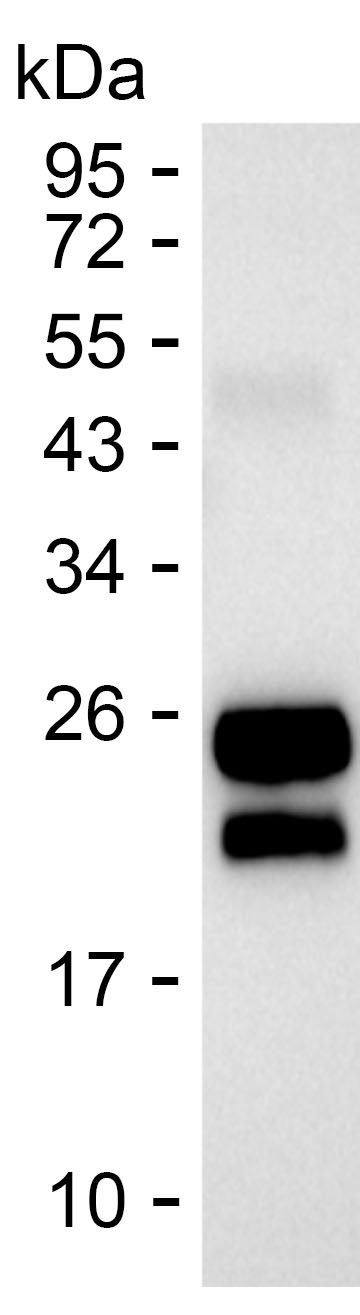
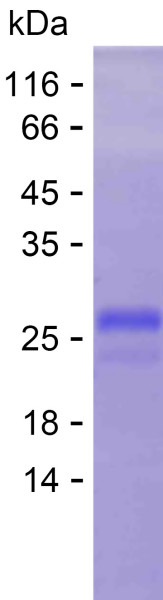
| MW: | 24.5 kD |
| Format: | Solution |
Datenbank Information
| KEGG ID : | K00922 | Passende Produkte |
| UniProt ID : | P42336 | Passende Produkte |
| Gene ID : | GeneID 5290 | Passende Produkte |
Handhabung & Sicherheit
| Lagerung: | -20°C (avoid repeat freezing and thawing cycles) |
| Versand: | -20°C (International: +4°C) |
Achtung
Nur für Forschungszwecke und Laboruntersuchungen: Nicht für die Anwendung im oder am Menschen!
Nur für Forschungszwecke und Laboruntersuchungen: Nicht für die Anwendung im oder am Menschen!
Hier kriegen Sie ein Zertifikat
Loggen Sie sich ein oder registrieren Sie sich, um Analysenzertifikate anzufordern.
Bewertungen lesen, schreiben und diskutieren... mehr
Kundenbewertungen für "Recombinant Human PI3 Kinase p110 alpha Protein"
Bewertung schreiben
Loggen Sie sich ein oder registrieren Sie sich, um eine Produktbewertung abzugeben.
Zuletzt angesehen