
Cookie-Einstellungen
Diese Website benutzt Cookies, die für den technischen Betrieb der Website erforderlich sind und stets gesetzt werden. Andere Cookies, die den Komfort bei Benutzung dieser Website erhöhen, der Direktwerbung dienen oder die Interaktion mit anderen Websites und sozialen Netzwerken vereinfachen sollen, werden nur mit Ihrer Zustimmung gesetzt.
Konfiguration
Technisch erforderlich
Diese Cookies sind für die Grundfunktionen des Shops notwendig.
"Alle Cookies ablehnen" Cookie
"Alle Cookies annehmen" Cookie
Ausgewählter Shop
CSRF-Token
Cookie-Einstellungen
FACT-Finder Tracking
Individuelle Preise
Kundenspezifisches Caching
Session
Währungswechsel
Komfortfunktionen
Diese Cookies werden genutzt um das Einkaufserlebnis noch ansprechender zu gestalten, beispielsweise für die Wiedererkennung des Besuchers.
Facebook-Seite in der rechten Blog - Sidebar anzeigen
Merkzettel
Statistik & Tracking
Endgeräteerkennung
Kauf- und Surfverhalten mit Google Tag Manager
Partnerprogramm

NEU
Bei Fragen nutzen Sie gerne unser Kontaktformular.
Bestellen Sie auch per E-Mail: info@biomol.com
Größere Menge gewünscht? Bulk-Anfrage
Bestellen Sie auch per E-Mail: info@biomol.com
Größere Menge gewünscht? Bulk-Anfrage
The test principle applied in this kit is Sandwich enzyme immunoassay. The microtiter plate... mehr
Produktinformationen "Human NLRP3 (NLR Family, Pyrin Domain Containing Protein 3) Microsample ELISA Kit"
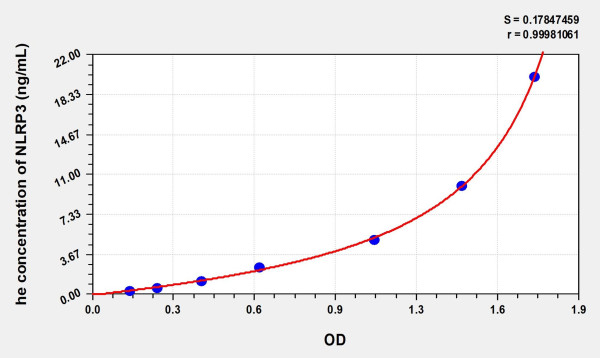
The test principle applied in this kit is Sandwich enzyme immunoassay. The microtiter plate provided in this kit has been pre-coated with an antibody specific to Human NLRP3. Standards or samples are added to the appropriate microtiter plate wells then with a biotin-conjugated antibody specific to Human NLRP3. Next, Avidin conjugated to Horseradish Peroxidase (HRP) is added to each microplate well and incubated. After TMB substrate solution is added, only those wells that contain Human NLRP3, biotin-conjugated antibody and enzyme-conjugated Avidin will exhibit a change in color. The enzyme-substrate reaction is terminated by the addition of sulphuric acid solution and the color change is measured spectrophotometrically at a wavelength of 450nm ± 10nm. The concentration of Human NLRP3 in the samples is then determined by comparing the OD of the samples to the standard curve.Detection Range: 0.32-20 ng/mL. Sensitivity: 0.113 ng/mL. Assay Type: Sandwich. Standard: 20 ng/mL. Sample Type: stissue homogenates, cell lysates and other biological fluids. Assay duration: 3.5h. Protein Function: Sensor component of the NLRP3 inflammasome, which mediates inflammasome activation in response to defects in membrane integrity, leading to secretion of inflammatory cytokines IL1B and IL18 and pyroptosis (PubMed:16407889, PubMed:18403674, PubMed:18604214, PubMed:23582325, PubMed:25686105, PubMed:27929086, PubMed:28656979, PubMed:28847925, PubMed:30487600, PubMed:30612879, PubMed:31086327, PubMed:31086329, PubMed:31189953, PubMed:33231615, PubMed:34133077, PubMed:34341353, PubMed:34512673, PubMed:36442502). In response to pathogens and other damage-associated signals that affect the integrity of membranes, initiates the formation of the inflammasome polymeric complex composed of NLRP3, CASP1 and PYCARD/ASC (PubMed:16407889, PubMed:18403674, PubMed:27432880, PubMed:28847925, PubMed:31189953, PubMed:33231615, PubMed:34133077, PubMed:34341353, PubMed:36142182, PubMed:36442502). Recruitment of pro-caspase-1 (proCASP1) to the NLRP3 inflammasome promotes caspase-1 (CASP1) activation, which subsequently cleaves and activates inflammatory cytokines IL1B and IL18 and gasdermin-D (GSDMD), promoting cytokine secretion and pyroptosis (PubMed:23582325, PubMed:28847925, PubMed:31189953, PubMed:33231615, PubMed:34133077, PubMed:34341353). Activation of NLRP3 inflammasome is also required for HMGB1 secretion, stimulating inflammatory responses (PubMed:22801494). Under resting conditions, ADP-bound NLRP3 is autoinhibited (PubMed:35114687). NLRP3 activation stimuli include extracellular ATP, nigericin, reactive oxygen species, crystals of monosodium urate or cholesterol, amyloid-beta fibers, environmental or industrial particles and nanoparticles, such as asbestos, silica, aluminum salts, cytosolic dsRNA, etc (PubMed:16407889, PubMed:18403674, PubMed:18604214, PubMed:19414800, PubMed:23871209). Almost all stimuli trigger intracellular K(+) efflux (By similarity). These stimuli lead to membrane perturbation and activation of NLRP3 (By similarity). Upon activation, NLRP3 is transported to microtubule organizing center (MTOC), where it is unlocked by NEK7, leading to its relocalization to dispersed trans-Golgi network (dTGN) vesicle membranes and formation of an active inflammasome complex (PubMed:36442502, PubMed:39173637). Associates with dTGN vesicle membranes by binding to phosphatidylinositol 4-phosphate (PtdIns4P) (PubMed:30487600, PubMed:34554188). Shows ATPase activity (PubMed:17483456) , Independently of inflammasome activation, regulates the differentiation of T helper 2 (Th2) cells and has a role in Th2 cell-dependent asthma and tumor growth (By similarity). During Th2 differentiation, required for optimal IRF4 binding to IL4 promoter and for IRF4-dependent IL4 transcription (By similarity). Binds to the consensus DNA sequence 5'-GRRGGNRGAG-3' (By similarity). May also participate in the transcription of IL5, IL13, GATA3, CCR3, CCR4 and MAF (By similarity) [The Uniprot Consortium]
| Schlagworte: | NLRP3, Cryopyrin, Caterpiller protein 1.1, PYRIN-containing APAF1-like protein 1, Angiotensin/vasopressin receptor AII/AVP-like, NACHT, LRR and PYD domains-containing protein 3, Cold-induced autoinflammatory syndrome 1 protein |
| Hersteller: | ELK Biotechnology |
| Hersteller-Nr: | ELK5399MS |
Eigenschaften
| Anwendung: | ELISA |
| Spezies-Reaktivität: | human |
| Format: | Solid Phase |
Datenbank Information
| KEGG ID : | K12800 | Passende Produkte |
| UniProt ID : | Q96P20 | Passende Produkte |
| Gene ID : | GeneID 114548 | Passende Produkte |
Handhabung & Sicherheit
| Lagerung: | vT |
| Versand: | +4°C (International: +4°C) |
Achtung
Nur für Forschungszwecke und Laboruntersuchungen: Nicht für die Anwendung im oder am Menschen!
Nur für Forschungszwecke und Laboruntersuchungen: Nicht für die Anwendung im oder am Menschen!
Hier kriegen Sie ein Zertifikat
Loggen Sie sich ein oder registrieren Sie sich, um Analysenzertifikate anzufordern.
Bewertungen lesen, schreiben und diskutieren... mehr
Kundenbewertungen für "Human NLRP3 (NLR Family, Pyrin Domain Containing Protein 3) Microsample ELISA Kit"
Bewertung schreiben
Loggen Sie sich ein oder registrieren Sie sich, um eine Produktbewertung abzugeben.
Zuletzt angesehen