
Cookie-Einstellungen
Diese Website benutzt Cookies, die für den technischen Betrieb der Website erforderlich sind und stets gesetzt werden. Andere Cookies, die den Komfort bei Benutzung dieser Website erhöhen, der Direktwerbung dienen oder die Interaktion mit anderen Websites und sozialen Netzwerken vereinfachen sollen, werden nur mit Ihrer Zustimmung gesetzt.
Konfiguration
Technisch erforderlich
Diese Cookies sind für die Grundfunktionen des Shops notwendig.
"Alle Cookies ablehnen" Cookie
"Alle Cookies annehmen" Cookie
Ausgewählter Shop
CSRF-Token
Cookie-Einstellungen
FACT-Finder Tracking
Individuelle Preise
Kundenspezifisches Caching
Session
Währungswechsel
Komfortfunktionen
Diese Cookies werden genutzt um das Einkaufserlebnis noch ansprechender zu gestalten, beispielsweise für die Wiedererkennung des Besuchers.
Facebook-Seite in der rechten Blog - Sidebar anzeigen
Merkzettel
Statistik & Tracking
Endgeräteerkennung
Kauf- und Surfverhalten mit Google Tag Manager
Partnerprogramm

NEU
Bei Fragen nutzen Sie gerne unser Kontaktformular.
Bestellen Sie auch per E-Mail: info@biomol.com
Größere Menge gewünscht? Bulk-Anfrage
Bestellen Sie auch per E-Mail: info@biomol.com
Größere Menge gewünscht? Bulk-Anfrage
The test principle applied in this kit is Sandwich enzyme immunoassay. The microtiter plate... mehr
Produktinformationen "Human mTOR (MammalianTarget of Rapamycin) Microsample ELISA Kit"
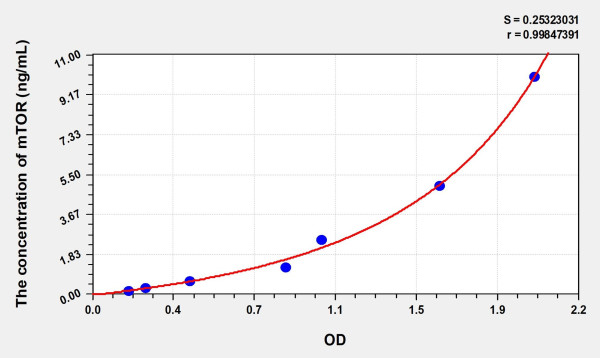
The test principle applied in this kit is Sandwich enzyme immunoassay. The microtiter plate provided in this kit has been pre-coated with an antibody specific to Human mTOR. Standards or samples are added to the appropriate microtiter plate wells then with a biotin-conjugated antibody specific to Human mTOR. Next, Avidin conjugated to Horseradish Peroxidase (HRP) is added to each microplate well and incubated. After TMB substrate solution is added, only those wells that contain Human mTOR, biotin-conjugated antibody and enzyme-conjugated Avidin will exhibit a change in color. The enzyme-substrate reaction is terminated by the addition of sulphuric acid solution and the color change is measured spectrophotometrically at a wavelength of 450nm ± 10nm. The concentration of Human mTOR in the samples is then determined by comparing the OD of the samples to the standard curve.Detection Range: 0.16-10 ng/mL. Sensitivity: 0.1 ng/mL. Assay Type: Sandwich. Standard: 10 ng/mL. Sample Type: sserum, plasma, tissue homogenates, cell lysates, cell culture supernates and other biological fluids. Assay duration: 3.5h. Protein Function: Serine/threonine protein kinase which is a central regulator of cellular metabolism, growth and survival in response to hormones, growth factors, nutrients, energy and stress signals (PubMed:12087098, PubMed:12150925, PubMed:12150926, PubMed:12231510, PubMed:12718876, PubMed:14651849, PubMed:15268862, PubMed:15467718, PubMed:15545625, PubMed:15718470, PubMed:18497260, PubMed:18762023, PubMed:18925875, PubMed:20516213, PubMed:20537536, PubMed:21659604, PubMed:23429703, PubMed:23429704, PubMed:25799227, PubMed:26018084, PubMed:29150432, PubMed:29236692, PubMed:31112131, PubMed:31601708, PubMed:32561715, PubMed:34519269, PubMed:37751742). MTOR directly or indirectly regulates the phosphorylation of at least 800 proteins (PubMed:15268862, PubMed:15467718, PubMed:17517883, PubMed:18372248, PubMed:18497260, PubMed:18925875, PubMed:20516213, PubMed:21576368, PubMed:21659604, PubMed:23429704, PubMed:30171069, PubMed:29236692, PubMed:37751742). Functions as part of 2 structurally and functionally distinct signaling complexes mTORC1 and mTORC2 (mTOR complex 1 and 2) (PubMed:15268862, PubMed:15467718, PubMed:18497260, PubMed:18925875, PubMed:20516213, PubMed:21576368, PubMed:21659604, PubMed:23429704, PubMed:29424687, PubMed:29567957, PubMed:35926713). In response to nutrients, growth factors or amino acids, mTORC1 is recruited to the lysosome membrane and promotes protein, lipid and nucleotide synthesis by phosphorylating key regulators of mRNA translation and ribosome synthesis (PubMed:12087098, PubMed:12150925, PubMed:12150926, PubMed:12231510, PubMed:12718876, PubMed:14651849, PubMed:15268862, PubMed:15467718, PubMed:15545625, PubMed:15718470, PubMed:18497260, PubMed:18762023, PubMed:18925875, PubMed:20516213, PubMed:20537536, PubMed:21659604, PubMed:23429703, PubMed:23429704, PubMed:25799227, PubMed:26018084, PubMed:29150432, PubMed:29236692, PubMed:31112131, PubMed:34519269). This includes phosphorylation of EIF4EBP1 and release of its inhibition toward the elongation initiation factor 4E (eiF4E) (PubMed:24403073, PubMed:29236692). Moreover, phosphorylates and activates RPS6KB1 and RPS6KB2 that promote protein synthesis by modulating the activity of their downstream targets including ribosomal protein S6, eukaryotic translation initiation factor EIF4B, and the inhibitor of translation initiation PDCD4 (PubMed:12087098, PubMed:12150925, PubMed:18925875, PubMed:29150432, PubMed:29236692). Stimulates the pyrimidine biosynthesis pathway, both by acute regulation through RPS6KB1-mediated phosphorylation of the biosynthetic enzyme CAD, and delayed regulation, through transcriptional enhancement of the pentose phosphate pathway which produces 5-phosphoribosyl-1-pyrophosphate (PRPP), an allosteric activator of CAD at a later step in synthesis, this function is dependent on the mTORC1 complex (PubMed:23429703, PubMed:23429704). Regulates ribosome synthesis by activating RNA polymerase III-dependent transcription through phosphorylation and inhibition of MAF1 an RNA polymerase III-repressor (PubMed:20516213). Activates dormant ribosomes by mediating phosphorylation of SERBP1, leading to SERBP1 inactivation and reactivation of translation (PubMed:36691768). In parallel to protein synthesis, also regulates lipid synthesis through SREBF1/SREBP1 and LPIN1 (PubMed:23426360). To maintain energy homeostasis mTORC1 may also regulate mitochondrial biogenesis through regulation of PPARGC1A (By similarity). In the same time, mTORC1 inhibits catabolic pathways: negatively regulates autophagy through phosphorylation of ULK1 (PubMed:32561715). Under nutrient sufficiency, phosphorylates ULK1 at 'Ser-758', disrupting the interaction with AMPK and preventing activation of ULK1 (PubMed:32561715). Also prevents autophagy through phosphorylation of the autophagy inhibitor DAP (PubMed:20537536). Also prevents autophagy by phosphorylating RUBCNL/Pacer under nutrient-rich conditions (PubMed:30704899). Prevents autophagy by mediating phosphorylation of AMBRA1, thereby inhibiting AMBRA1 ability to mediate ubiquitination of ULK1 and interaction between AMBRA1 and PPP2CA (PubMed:23524951, PubMed:25438055). mTORC1 exerts a feedback control on upstream growth factor signaling that includes phosphorylation and activation of GRB10 a INSR-dependent signaling suppressor (PubMed:21659604). Among other potential targets mTORC1 may phosphorylate CLIP1 and regulate microtubules (PubMed:12231510). The mTORC1 complex is inhibited in response to starvation and amino acid depletion (PubMed:12150925, PubMed:12150926, PubMed:24403073, PubMed:31695197). The non-canonical mTORC1 complex, which acts independently of RHEB, specifically mediates phosphorylation of MiT/TFE factors MITF, TFEB and TFE3 in the presence of nutrients, promoting their cytosolic retention and inactivation (PubMed:22343943, PubMed:22576015, PubMed:22692423, PubMed:24448649, PubMed:32612235, PubMed:36608670, PubMed:36697823). Upon starvation or lysosomal stress, inhibition of mTORC1 induces dephosphorylation and nuclear translocation of TFEB and TFE3, promoting their transcription factor activity (PubMed:22343943, PubMed:22576015, PubMed:22692423, PubMed:24448649, PubMed:32612235, PubMed:36608670). The mTORC1 complex regulates pyroptosis in macrophages by promoting GSDMD oligomerization (PubMed:34289345). MTOR phosphorylates RPTOR which in turn inhibits mTORC1 (By similarity). As part of the mTORC2 complex, MTOR transduces signals from growth factors to pathways involved in proliferation, cytoskeletal organization, lipogenesis and anabolic output (PubMed:15268862, PubMed:15467718, PubMed:24670654, PubMed:29424687, PubMed:29567957, PubMed:35926713). In response to growth factors, mTORC2 phosphorylates and activates AGC protein kinase family members, including AKT (AKT1, AKT2 and AKT3), PKC (PRKCA, PRKCB and PRKCE) and SGK1 (PubMed:15268862, PubMed:15467718, PubMed:21376236, PubMed:24670654, PubMed:29424687, PubMed:29567957, PubMed:35926713). In contrast to mTORC1, mTORC2 is nutrient-insensitive (PubMed:15467718). mTORC2 plays a critical role in AKT1 activation by mediating phosphorylation of different sites depending on the context, such as 'Thr-450', 'Ser-473', 'Ser-477' or 'Thr-479', facilitating the phosphorylation of the activation loop of AKT1 on 'Thr-308' by PDPK1/PDK1 which is a prerequisite for full activation (PubMed:15718470, PubMed:21376236, PubMed:24670654, PubMed:29424687, PubMed:29567957). mTORC2 also regulates the phosphorylation of SGK1 at 'Ser-422' (PubMed:18925875). mTORC2 may regulate the actin cytoskeleton, through phosphorylation of PRKCA, PXN and activation of the Rho-type guanine nucleotide exchange factors RHOA and RAC1A or RAC1B (PubMed:15268862). The mTORC2 complex also phosphorylates various proteins involved in insulin signaling, such as FBXW8 and IGF2BP1 (By similarity). May also regulate insulin signaling by acting as a tyrosine protein kinase that catalyzes phosphorylation of IGF1R and INSR, additional evidence are however required to confirm this result in vivo (PubMed:26584640). Regulates osteoclastogenesis by adjusting the expression of CEBPB isoforms (By similarity). Plays an important regulatory role in the circadian clock function, regulates period length and rhythm amplitude of the suprachiasmatic nucleus (SCN) and liver clocks (By similarity) [The Uniprot Consortium]
| Schlagworte: | MTOR, Rapamycin target protein 1, Tyrosine-protein kinase mTOR, Rapamycin and FKBP12 target 1, Mammalian target of rapamycin, Mechanistic target of rapamycin, Serine/threonine-protein kinase mTOR, FKBP12-rapamycin complex-associated protein, FK506-binding |
| Hersteller: | ELK Biotechnology |
| Hersteller-Nr: | ELK9591MS |
Eigenschaften
| Anwendung: | ELISA |
| Spezies-Reaktivität: | human |
| Format: | Solid Phase |
Datenbank Information
| KEGG ID : | K07203 | Passende Produkte |
| UniProt ID : | P42345 | Passende Produkte |
| Gene ID : | GeneID 2475 | Passende Produkte |
Handhabung & Sicherheit
| Lagerung: | vT |
| Versand: | +4°C (International: +4°C) |
Achtung
Nur für Forschungszwecke und Laboruntersuchungen: Nicht für die Anwendung im oder am Menschen!
Nur für Forschungszwecke und Laboruntersuchungen: Nicht für die Anwendung im oder am Menschen!
Hier kriegen Sie ein Zertifikat
Loggen Sie sich ein oder registrieren Sie sich, um Analysenzertifikate anzufordern.
Bewertungen lesen, schreiben und diskutieren... mehr
Kundenbewertungen für "Human mTOR (MammalianTarget of Rapamycin) Microsample ELISA Kit"
Bewertung schreiben
Loggen Sie sich ein oder registrieren Sie sich, um eine Produktbewertung abzugeben.
Zuletzt angesehen