
Cookie-Einstellungen
Diese Website benutzt Cookies, die für den technischen Betrieb der Website erforderlich sind und stets gesetzt werden. Andere Cookies, die den Komfort bei Benutzung dieser Website erhöhen, der Direktwerbung dienen oder die Interaktion mit anderen Websites und sozialen Netzwerken vereinfachen sollen, werden nur mit Ihrer Zustimmung gesetzt.
Konfiguration
Technisch erforderlich
Diese Cookies sind für die Grundfunktionen des Shops notwendig.
"Alle Cookies ablehnen" Cookie
"Alle Cookies annehmen" Cookie
Ausgewählter Shop
CSRF-Token
Cookie-Einstellungen
FACT-Finder Tracking
Individuelle Preise
Kundenspezifisches Caching
Session
Währungswechsel
Komfortfunktionen
Diese Cookies werden genutzt um das Einkaufserlebnis noch ansprechender zu gestalten, beispielsweise für die Wiedererkennung des Besuchers.
Facebook-Seite in der rechten Blog - Sidebar anzeigen
Merkzettel
Statistik & Tracking
Endgeräteerkennung
Kauf- und Surfverhalten mit Google Tag Manager
Partnerprogramm

Bei Fragen nutzen Sie gerne unser Kontaktformular.
Bestellen Sie auch per E-Mail: info@biomol.com
Größere Menge gewünscht? Bulk-Anfrage
Bestellen Sie auch per E-Mail: info@biomol.com
Größere Menge gewünscht? Bulk-Anfrage
Organism: Mus musculus (Mouse). Source: Yeast. Expression Region: 1-155aa. Protein Length: Full... mehr
Produktinformationen "Ubiquitin-like protein ISG15 (Isg15), mouse, recombinant"
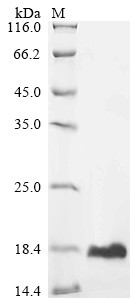
Organism: Mus musculus (Mouse). Source: Yeast. Expression Region: 1-155aa. Protein Length: Full Length. Tag Info: C-terminal 6xHis-tagged. Target Protein Sequence: MAWDLKVKML GGNDFLVSVT NSMTVSELKK QIAQKIGVPA FQQRLAHQTA VLQDGLTLSS LGLGPSSTVM LVVQNCSEPL SILVRNERGH SNIYEVFLTQ TVDTLKKKVS QREQVHEDQF WLSFEGRPME DKELLGEYGL KPQCTVIKHL RLRGG. Purity: Greater than 90% as determined by SDS-PAGE. Endotoxin: Not test. Biological Activity: n/a. Form: Liquid or Lyophilized powder. Buffer: If the delivery form is liquid, the default storage buffer is Tris/PBS-based buffer, 5%-50% glycerol. If the delivery form is lyophilized powder, the buffer before lyophilization is Tris/PBS-based buffer, 6% Trehalose, pH 8.0. Reconstitution: We recommend that this vial be briefly centrifuged prior to opening to bring the contents to the bottom. Please reconstitute protein in deionized sterile water to a concentration of 0.1-1.0 mg/mL.We recommend to add 5-50% of glycerol (final concentration) and aliquot for long-term storage at -20 °C/-80 °C. Our default final concentration of glycerol is 50%. Customers could use it as reference. Storage: The shelf life is related to many factors, storage state, buffer ingredients, storage temperature and the stability of the protein itself. Generally, the shelf life of liquid form is 6 months at -20 °C/-80 °C. The shelf life of lyophilized form is 12 months at -20 °C/-80 °C. Notes: Repeated freezing and thawing is not recommended. Store working aliquots at 4 °C for up to one week. Relevance: Ubiquitin-like protein which plays a key role in the innate immune response to viral infection either via its conjugation to a target protein (ISGylation) or via its action as a free or unconjugated protein. ISGylation involves a cascade of enzymatic reactions involving E1, E2, and E3 enzymes which catalyze the conjugation of ISG15 to a lysine residue in the target protein. Its target proteins include SERPINA3G/SPI2A, JAK1, MAPK3/ERK1, PLCG1, TRIM25, STAT5A, MAPK1/ERK2 and globin. Isgylation of the viral sensor IFIH1/MDA5 promotes IFIH1/MDA5 oligomerization and triggers activation of innate immunity against a range of viruses, including coronaviruses, flaviviruses and picornaviruses. Can also isgylate: DDX58/RIG-I which inhibits its function in antiviral signaling response, IRF3 which inhibits its ubiquitination and degradation as well as EIF4E2 which enhances its cap structure-binding activity and translation-inhibition activity. Exhibits antiviral activity towards both DNA and RNA viruses, including influenza A and B virus, sindbis virus (SV) and herpes simplex type-1 (HHV-1). Plays a significant role in the control of neonatal Chikungunya virus (CHIKV) infection by acting as a putative immunomodulator of pro-inflammatory cytokines. Protects mice against the consequences of Chikungunya virus infection by down-regulating the pathogenic cytokine response, often denoted as the cytokine storm. Plays a role in erythroid differentiation. The secreted form of ISG15 can: induce natural killer cell proliferation, act as a chemotactic factor for neutrophils and act as a IFN-gamma-inducing cytokine playing an essential role in antimycobacterial immunity. The secreted form acts through the integrin ITGAL/ITGB2 receptor to initiate activation of SRC family tyrosine kinases including LYN, HCK and FGR which leads to secretion of IFNG and IL10, the interaction is mediated by ITGAL. Reference: "Identification of interferon-stimulated gene 15 as an antiviral molecule during Sindbis virus infection in vivo." Lenschow D.J., Giannakopoulos N.V., Gunn L.J., Johnston C., O'Guin A.K., Schmidt R.E., Levine B., Virgin H.W. IV J. Virol. 79:13974-13983(2005). Function: nan
| Schlagworte: | G1p2, IP17, Isg15, Ubiquitin-like protein ISG15, Ubiquitin cross-reactive protein, Interferon-induced 15 kDa protein, Interferon-induced 17 kDa protein, Recombinant Mouse Ubiquitin-like protein ISG15 (Isg15) |
| Hersteller: | Cusabio |
| Hersteller-Nr: | YP723739MO |
Eigenschaften
| Anwendung: | Activity not tested |
| Konjugat: | No |
| Wirt: | Yeast |
| Spezies-Reaktivität: | mouse |
| MW: | 18.9 kD |
| Reinheit: | >90% (SDS-PAGE) |
Datenbank Information
| KEGG ID : | K12159 | Passende Produkte |
| UniProt ID : | Q64339 | Passende Produkte |
| Gene ID : | GeneID 100038882 | Passende Produkte |
Handhabung & Sicherheit
| Lagerung: | -20°C |
| Versand: | +4°C (International: +4°C) |
Achtung
Nur für Forschungszwecke und Laboruntersuchungen: Nicht für die Anwendung im oder am Menschen!
Nur für Forschungszwecke und Laboruntersuchungen: Nicht für die Anwendung im oder am Menschen!
Hier kriegen Sie ein Zertifikat
Loggen Sie sich ein oder registrieren Sie sich, um Analysenzertifikate anzufordern.
Bewertungen lesen, schreiben und diskutieren... mehr
Kundenbewertungen für "Ubiquitin-like protein ISG15 (Isg15), mouse, recombinant"
Bewertung schreiben
Loggen Sie sich ein oder registrieren Sie sich, um eine Produktbewertung abzugeben.
Zuletzt angesehen