
Cookie-Einstellungen
Diese Website benutzt Cookies, die für den technischen Betrieb der Website erforderlich sind und stets gesetzt werden. Andere Cookies, die den Komfort bei Benutzung dieser Website erhöhen, der Direktwerbung dienen oder die Interaktion mit anderen Websites und sozialen Netzwerken vereinfachen sollen, werden nur mit Ihrer Zustimmung gesetzt.
Konfiguration
Technisch erforderlich
Diese Cookies sind für die Grundfunktionen des Shops notwendig.
"Alle Cookies ablehnen" Cookie
"Alle Cookies annehmen" Cookie
Ausgewählter Shop
CSRF-Token
Cookie-Einstellungen
FACT-Finder Tracking
Individuelle Preise
Kundenspezifisches Caching
Session
Währungswechsel
Komfortfunktionen
Diese Cookies werden genutzt um das Einkaufserlebnis noch ansprechender zu gestalten, beispielsweise für die Wiedererkennung des Besuchers.
Facebook-Seite in der rechten Blog - Sidebar anzeigen
Merkzettel
Statistik & Tracking
Endgeräteerkennung
Kauf- und Surfverhalten mit Google Tag Manager
Partnerprogramm

Bei Fragen nutzen Sie gerne unser Kontaktformular.
Bestellen Sie auch per E-Mail: info@biomol.com
Größere Menge gewünscht? Bulk-Anfrage
Bestellen Sie auch per E-Mail: info@biomol.com
Größere Menge gewünscht? Bulk-Anfrage
Organism: Mus musculus (Mouse). Source: E.coli. Expression Region: 579-952aa. Protein Length:... mehr
Produktinformationen "Ubiquitin carboxyl-terminal hydrolase CYLD (Cyld), partial, mouse, recombinant"
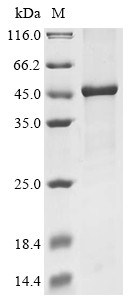
Organism: Mus musculus (Mouse). Source: E.coli. Expression Region: 579-952aa. Protein Length: Partial. Tag Info: N-terminal 10xHis-tagged and C-terminal Myc-tagged. Target Protein Sequence: GLEIMIGKKK GIQGHYNSCY LDSTLFCLFA FSSALDTVLL RPKEKNDIEY YSETQELLRT EIVNPLRIYG YVCATKIMKL RKILEKVEAA SGFTSEEKDP EEFLNILFHD ILRVEPLLKI RSAGQKVQDC NFYQIFMEKN EKVGVPTIQQ LLEWSFINSN LKFAEAPSCL IIQMPRFGKD FKLFKKIFPS LELNITDLLE DTPRQCRICG GLAMYECREC YDDPDISAGK IKQFCKTCST QVHLHPRRLN HSYHPVSLPK DLPDWDWRHG CIPCQKMELF AVLCIETSHY VAFVKYGKDD SAWLFFDSMA DRDGGQNGFN IPQVTPCPEV GEYLKMSLED LHSLDSRRIQ GCARRLLCDA YMCMYQSPTM SLYK. Purity: Greater than 90% as determined by SDS-PAGE. Endotoxin: Not test. Biological Activity: n/a. Form: Liquid or Lyophilized powder. Buffer: If the delivery form is liquid, the default storage buffer is Tris/PBS-based buffer, 5%-50% glycerol. If the delivery form is lyophilized powder, the buffer before lyophilization is Tris/PBS-based buffer, 6% Trehalose, pH 8.0. Reconstitution: We recommend that this vial be briefly centrifuged prior to opening to bring the contents to the bottom. Please reconstitute protein in deionized sterile water to a concentration of 0.1-1.0 mg/mL.We recommend to add 5-50% of glycerol (final concentration) and aliquot for long-term storage at -20 °C/-80 °C. Our default final concentration of glycerol is 50%. Customers could use it as reference. Storage: The shelf life is related to many factors, storage state, buffer ingredients, storage temperature and the stability of the protein itself. Generally, the shelf life of liquid form is 6 months at -20 °C/-80 °C. The shelf life of lyophilized form is 12 months at -20 °C/-80 °C. Notes: Repeated freezing and thawing is not recommended. Store working aliquots at 4 °C for up to one week. Relevance: Deubiquitinase that specifically cleaves 'Lys-63'- and linear 'Met-1'-linked polyubiquitin chains and is involved in NF-kappa-B activation and TNF-alpha-induced necroptosis. Negatively regulates NF-kappa-B activation by deubiquitinating upstream signaling factors. Contributes to the regulation of cell survival, proliferation and differentiation via its effects on NF-kappa-B activation. Negative regulator of Wnt signaling. Inhibits HDAC6 and thereby promotes acetylation of alpha-tubulin and stabilization of microtubules. Plays a role in the regulation of microtubule dynamics, and thereby contributes to the regulation of cell proliferation, cell polarization, cell migration, and angiogenesis. Required for normal cell cycle progress and normal cytokinesis. Inhibits nuclear translocation of NF-kappa-B. Plays a role in the regulation of inflammation and the innate immune response, via its effects on NF-kappa-B activation. Dispensable for the maturation of intrathymic natural killer cells, but required for the continued survival of immature natural killer cells. Negatively regulates TNFRSF11A signaling and osteoclastogenesis. Involved in the regulation of ciliogenesis, allowing ciliary basal bodies to migrate and dock to the plasma membrane, this process does not depend on NF-kappa-B activation. Ability to remove linear ('Met-1'-linked) polyubiquitin chains regulates innate immunity and TNF-alpha-induced necroptosis: recruited to the LUBAC complex via interaction with SPATA2 and restricts linear polyubiquitin formation on target proteins. Regulates innate immunity by restricting linear polyubiquitin formation on RIPK2 in response to NOD2 stimulation. Involved in TNF-alpha-induced necroptosis by removing linear ('Met-1'-linked) polyubiquitin chains from RIPK1, thereby regulating the kinase activity of RIPK1. Negatively regulates intestinal inflammation by removing 'Lys-63' linked polyubiquitin chain of NLRP6, thereby reducing the interaction between NLRP6 and PYCARD/ASC and formation of the NLRP6 inflammasome. Removes 'Lys-63' linked polyubiquitin chain of MAP3K7, which inhibits phosphorylation and blocks downstream activation of the JNK-p38 kinase cascades. Reference: "Deubiquitination of NLRP6 inflammasome by Cyld critically regulates intestinal inflammation." Mukherjee S., Kumar R., Tsakem Lenou E., Basrur V., Kontoyiannis D.L., Ioakeimidis F., Mosialos G., Theiss A.L., Flavell R.A., Venuprasad K. Nat. Immunol. 21:626-635(2020). Function: nan
| Schlagworte: | Cyld, Cyld1, Ubiquitin thioesterase CYLD, Deubiquitinating enzyme CYLD, Ubiquitin carboxyl-terminal hydrolase CYLD, Ubiquitin-specific-processing protease CYLD, Recombinant Mouse Ubiquitin carboxyl-terminal hydrolase CYLD (Cyld), partial |
| Hersteller: | Cusabio |
| Hersteller-Nr: | EP773899MO |
Eigenschaften
| Anwendung: | Activity not tested |
| Konjugat: | No |
| Wirt: | E.coli |
| Spezies-Reaktivität: | mouse |
| MW: | 50.6 kD |
| Reinheit: | >90% (SDS-PAGE) |
Datenbank Information
| KEGG ID : | K08601 | Passende Produkte |
| UniProt ID : | Q80TQ2 | Passende Produkte |
| Gene ID : | GeneID 74256 | Passende Produkte |
Handhabung & Sicherheit
| Lagerung: | -20°C |
| Versand: | +4°C (International: +4°C) |
Achtung
Nur für Forschungszwecke und Laboruntersuchungen: Nicht für die Anwendung im oder am Menschen!
Nur für Forschungszwecke und Laboruntersuchungen: Nicht für die Anwendung im oder am Menschen!
Hier kriegen Sie ein Zertifikat
Loggen Sie sich ein oder registrieren Sie sich, um Analysenzertifikate anzufordern.
Bewertungen lesen, schreiben und diskutieren... mehr
Kundenbewertungen für "Ubiquitin carboxyl-terminal hydrolase CYLD (Cyld), partial, mouse, recombinant"
Bewertung schreiben
Loggen Sie sich ein oder registrieren Sie sich, um eine Produktbewertung abzugeben.
Zuletzt angesehen