
Cookie-Einstellungen
Diese Website benutzt Cookies, die für den technischen Betrieb der Website erforderlich sind und stets gesetzt werden. Andere Cookies, die den Komfort bei Benutzung dieser Website erhöhen, der Direktwerbung dienen oder die Interaktion mit anderen Websites und sozialen Netzwerken vereinfachen sollen, werden nur mit Ihrer Zustimmung gesetzt.
Konfiguration
Technisch erforderlich
Diese Cookies sind für die Grundfunktionen des Shops notwendig.
"Alle Cookies ablehnen" Cookie
"Alle Cookies annehmen" Cookie
Ausgewählter Shop
CSRF-Token
Cookie-Einstellungen
FACT-Finder Tracking
Individuelle Preise
Kundenspezifisches Caching
Session
Währungswechsel
Komfortfunktionen
Diese Cookies werden genutzt um das Einkaufserlebnis noch ansprechender zu gestalten, beispielsweise für die Wiedererkennung des Besuchers.
Facebook-Seite in der rechten Blog - Sidebar anzeigen
Merkzettel
Statistik & Tracking
Endgeräteerkennung
Kauf- und Surfverhalten mit Google Tag Manager
Partnerprogramm
| Artikelnummer | Größe | Datenblatt | Manual | SDB | Lieferzeit | Menge | Preis |
|---|---|---|---|---|---|---|---|
| Cay32049-100 | 100 µg | - |
5 - 10 Werktage* |
586,00 €
|
|||
| Cay32049-1 | 1 mg | - |
5 - 10 Werktage* |
3.801,00 €
|
Bei Fragen nutzen Sie gerne unser Kontaktformular.
Bestellen Sie auch per E-Mail: info@biomol.com
Größere Menge gewünscht? Bulk-Anfrage
Bestellen Sie auch per E-Mail: info@biomol.com
Größere Menge gewünscht? Bulk-Anfrage
TNF-related apoptosis-inducing ligand (TRAIL) is a protein encoded by the TNFSF10 gene in humans... mehr
Produktinformationen "TRAIL Intracellular Domain (human, recombinant)"
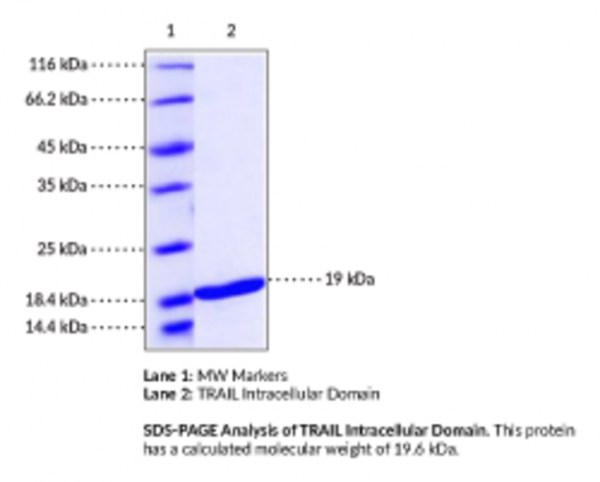
TNF-related apoptosis-inducing ligand (TRAIL) is a protein encoded by the TNFSF10 gene in humans and a member of the TNF superfamily of proteins. TRAIL contains an N-terminal cytoplasmic domain, a transmembrane domain, and a C-terminal extracellular receptor binding domain. It is produced in immune effector cells as a transmembrane precursor protein from which mature, soluble TRAIL is formed by proteolysis. Soluble TRAIL is cleaved from the precursor protein on the extracellular side of the membrane in response to stimulation by cytokines, such as IFN-gamma (Cay-32008). TRAIL monomers form trimers with a single zinc atom bound at the trimer interface, which is required for its structural stability and function. The trimer binds to the pro-apoptotic death receptors DR4 and DR5 and the decoy receptors DcR1 and DcR2, which lack functional intracellular domains. The intracellular death domains of DR4 or DR5 colocalize upon TRAIL binding, which recruits Fas-associated death domain (FADD) and pro-caspase-8 and initiates either the extrinsic or intrinsic apoptotic pathways depending on the cell type. DR4 and DR5 are highly expressed on a variety of cancer cells while DcR1 and DcR1 are primarily expressed on non-cancerous cells, which allows TRAIL to selectively induce apoptosis in cancer cells. Recombinant human TRAIL induces apoptosis in a variety of cancer cell lines and reduces tumor growth in mouse xenograft models. However, it increases proliferation in certain cancer cells in vitro, and other cells lines develop resistance, which can sometimes be partially mitigated by combining it with other agents. A cysteine-to-threonine mutation at position 723 of TNFSF10 is associated with sporadic breast cancer, and SNPs in TNFSF10 are associated with fatty liver disease, multiple sclerosis, and asthma. TNFSF10 expression is decreased in breast cancer patients with brain metastases and increased in patients with multiple sclerosis. In addition, protein levels of TRAIL are increased in patients with systemic lupus erythematosus (SLE) and multiple sclerosis. Cayman's TRAIL Intracellular Domain (human, recombinant) protein consists of 169 amino acids and has a calculated molecular weight of 19.6 kDa.Synonyms: Apo-2L, Apo-2 Ligand, CD253, TNF Ligand Superfamily Member 10, TNFSF10. Purity: >97% estimated by SDS-PAGE. Source: Recombinant human TNFSF10 expressed in E. coli. Amino Acids: 114-281. MW: 19.6 kDa. Formulation: (Request formulation change), Lyophilized from sterile 40 mM Tris, pH 7.0 and 0.3 M sodium chloride. UniProt Accession #: P50591.
| Schlagworte: | APO2L, CD253, CD253, Apo-2L, Apo-2L, TNFSF10, Apo-2 ligand, Apo-2 ligand, Protein TRAIL, Protein TRAIL, TNF-related apoptosis-inducing ligand, TNF-related apoptosis-inducing ligand, Tumor necrosis factor ligand superfamily member 10, Tumor necrosis factor |
| Hersteller: | Cayman Chemical |
| Hersteller-Nr: | 32049 |
Eigenschaften
| Konjugat: | No |
| Reinheit: | >97% estimated by SDS-PAGE |
| Format: | Lyophilized |
Datenbank Information
| KEGG ID : | K04721 | Passende Produkte |
| UniProt ID : | P50591 | Passende Produkte |
| Gene ID : | GeneID 8743 | Passende Produkte |
Handhabung & Sicherheit
| Lagerung: | -80°C |
| Versand: | -80°C (International: -80°C) |
Achtung
Nur für Forschungszwecke und Laboruntersuchungen: Nicht für die Anwendung im oder am Menschen!
Nur für Forschungszwecke und Laboruntersuchungen: Nicht für die Anwendung im oder am Menschen!
Hier folgen Informationen zur Produktreferenz.
mehr
Hier kriegen Sie ein Zertifikat
Loggen Sie sich ein oder registrieren Sie sich, um Analysenzertifikate anzufordern.
Bewertungen lesen, schreiben und diskutieren... mehr
Kundenbewertungen für "TRAIL Intracellular Domain (human, recombinant)"
Bewertung schreiben
Loggen Sie sich ein oder registrieren Sie sich, um eine Produktbewertung abzugeben.
Zuletzt angesehen