
Cookie-Einstellungen
Diese Website benutzt Cookies, die für den technischen Betrieb der Website erforderlich sind und stets gesetzt werden. Andere Cookies, die den Komfort bei Benutzung dieser Website erhöhen, der Direktwerbung dienen oder die Interaktion mit anderen Websites und sozialen Netzwerken vereinfachen sollen, werden nur mit Ihrer Zustimmung gesetzt.
Konfiguration
Technisch erforderlich
Diese Cookies sind für die Grundfunktionen des Shops notwendig.
"Alle Cookies ablehnen" Cookie
"Alle Cookies annehmen" Cookie
Ausgewählter Shop
CSRF-Token
Cookie-Einstellungen
FACT-Finder Tracking
Individuelle Preise
Kundenspezifisches Caching
Session
Währungswechsel
Komfortfunktionen
Diese Cookies werden genutzt um das Einkaufserlebnis noch ansprechender zu gestalten, beispielsweise für die Wiedererkennung des Besuchers.
Facebook-Seite in der rechten Blog - Sidebar anzeigen
Merkzettel
Statistik & Tracking
Endgeräteerkennung
Kauf- und Surfverhalten mit Google Tag Manager
Partnerprogramm

Bei Fragen nutzen Sie gerne unser Kontaktformular.
Bestellen Sie auch per E-Mail: info@biomol.com
Größere Menge gewünscht? Bulk-Anfrage
Bestellen Sie auch per E-Mail: info@biomol.com
Größere Menge gewünscht? Bulk-Anfrage
Organism: Homo sapiens (Human). Source: E.coli. Expression Region: 18-493aa. Protein Length: Full... mehr
Produktinformationen "Phospholipid transfer protein (PLTP), human, recombinant"
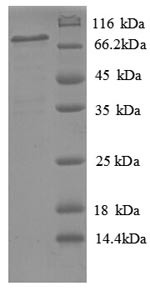
Organism: Homo sapiens (Human). Source: E.coli. Expression Region: 18-493aa. Protein Length: Full Length of Mature Protein. Tag Info: N-terminal GST-tagged. Target Protein Sequence: EFPGCKIRVT SKALELVKQE GLRFLEQELE TITIPDLRGK EGHFYYNISE VKVTELQLTS SELDFQPQQE LMLQITNASL GLRFRRQLLY WFFYDGGYIN ASAEGVSIRT GLELSRDPAG RMKVSNVSCQ ASVSRMHAAF GGTFKKVYDF LSTFITSGMR FLLNQQICPV LYHAGTVLLN SLLDTVPVRS SVDELVGIDY SLMKDPVAST SNLDMDFRGA FFPLTERNWS LPNRAVEPQL QEEERMVYVA FSEFFFDSAM ESYFRAGALQ LLLVGDKVPH DLDMLLRATY FGSIVLLSPA VIDSPLKLEL RVLAPPRCTI KPSGTTISVT ASVTIALVPP DQPEVQLSSM TMDARLSAKM ALRGKALRTQ LDLRRFRIYS NHSALESLAL IPLQAPLKTM LQIGVMPMLN ERTWRGVQIP LPEGINFVHE VVTNHAGFLT IGADLHFAKG LREVIEKNRP ADVRASTAPT PSTAAV. Purity: Greater than 90% as determined by SDS-PAGE. Endotoxin: Not test. Biological Activity: n/a. Form: Liquid or Lyophilized powder. Buffer: If the delivery form is liquid, the default storage buffer is Tris/PBS-based buffer, 5%-50% glycerol. If the delivery form is lyophilized powder, the buffer before lyophilization is Tris/PBS-based buffer, 6% Trehalose, pH 8.0. Reconstitution: We recommend that this vial be briefly centrifuged prior to opening to bring the contents to the bottom. Please reconstitute protein in deionized sterile water to a concentration of 0.1-1.0 mg/mL.We recommend to add 5-50% of glycerol (final concentration) and aliquot for long-term storage at -20 °C/-80 °C. Our default final concentration of glycerol is 50%. Customers could use it as reference. Storage: The shelf life is related to many factors, storage state, buffer ingredients, storage temperature and the stability of the protein itself. Generally, the shelf life of liquid form is 6 months at -20 °C/-80 °C. The shelf life of lyophilized form is 12 months at -20 °C/-80 °C. Notes: Repeated freezing and thawing is not recommended. Store working aliquots at 4 °C for up to one week. Relevance: Facilitates the transfer of a spectrum of different lipid molecules, including diacylglycerol, phosphatidic acid, sphingomyelin, phosphatidylcholine, phosphatidylglycerol, cerebroside and phosphatidyl ethanolamine. Essential for the transfer of excess surface lipids from triglyceride-rich lipoproteins to HDL, thereby facilitating the formation of smaller lipoprotein rnants, contributing to the formation of LDL, and assisting in the maturation of HDL particles. PLTP also plays a key role in the uptake of cholesterol from peripheral cells and tissues that is subsequently transported to the liver for degradation and excretion. Two distinct forms of PLTP exist in plasma: an active form that can transfer PC from phospholipid vesicles to high-density lipoproteins (HDL), and an inactive form that lacks this capability. Reference: The DNA sequence and comparative analysis of human chromosome 20.Deloukas P., Matthews L.H., Ashurst J.L., Burton J., Gilbert J.G.R., Jones M., Stavrides G., Almeida J.P., Babbage A.K., Bagguley C.L., Bailey J., Barlow K.F., Bates K.N., Beard L.M., Beare D.M., Beasley O.P., Bird C.P., Blakey S.E. , Bridgeman A.M., Brown A.J., Buck D., Burrill W.D., Butler A.P., Carder C., Carter N.P., Chapman J.C., Clamp M., Clark G., Clark L.N., Clark S.Y., Clee C.M., Clegg S., Cobley V.E., Collier R.E., Connor R.E., Corby N.R., Coulson A., Coville G.J., Deadman R., Dhami P.D., Dunn M., Ellington A.G., Frankland J.A., Fraser A., French L., Garner P., Grafham D.V., Griffiths C., Griffiths M.N.D., Gwilliam R., Hall R.E., Hammond S., Harley J.L., Heath P.D., Ho S., Holden J.L., Howden P.J., Huckle E., Hunt A.R., Hunt S.E., Jekosch K., Johnson C.M., Johnson D., Kay M.P., Kimberley A.M., King A., Knights A., Laird G.K., Lawlor S., Lehvaeslaiho M.H., Leversha M.A., Lloyd C., Lloyd D.M., Lovell J.D., Marsh V.L., Martin S.L., McConnachie L.J., McLay K., McMurray A.A., Milne S.A., Mistry D., Moore M.J.F., Mullikin J.C., Nickerson T., Oliver K., Parker A., Patel R., Pearce T.A.V., Peck A.I., Phillimore B.J.C.T., Prathalingam S.R., Plumb R.W., Ramsay H., Rice C.M., Ross M.T., Scott C.E., Sehra H.K., Shownkeen R., Sims S., Skuce C.D., Smith M.L., Soderlund C., Steward C.A., Sulston J.E., Swann R.M., Sycamore N., Taylor R., Tee L., Thomas D.W., Thorpe A., Tracey A., Tromans A.C., Vaudin M., Wall M., Wallis J.M., Whitehead S.L., Whittaker P., Willey D.L., Williams L., Williams S.A., Wilming L., Wray P.W., Hubbard T., Durbin R.M., Bentley D.R., Beck S., Rogers J.Nature 414:865-871(2001). Function: Facilitates the transfer of a spectrum of different lipid molecules, including diacylglycerol, phosphatidic acid, sphingomyelin, phosphatidylcholine, phosphatidylglycerol, cerebroside and phosphatidyl ethanolamine. Essential for the transfer of excess surface lipids from triglyceride-rich lipoproteins to HDL, thereby facilitating the formation of smaller lipoprotein remnants, contributing to the formation of LDL, and assisting in the maturation of HDL particles. PLTP also plays a key role in the uptake of cholesterol from peripheral cells and tissues that is subsequently transported to the liver for degradation and excretion. Two distinct forms of PLTP exist in plasma
| Schlagworte: | PLTP, Lipid transfer protein II, Phospholipid transfer protein, Recombinant Human Phospholipid transfer protein (PLTP) |
| Hersteller: | Cusabio |
| Hersteller-Nr: | EP018212HU |
Eigenschaften
| Anwendung: | Activity not tested |
| Konjugat: | No |
| Wirt: | E.coli |
| Spezies-Reaktivität: | human |
| MW: | 80.1 kD |
| Reinheit: | >90% (SDS-PAGE) |
Datenbank Information
| KEGG ID : | K08761 | Passende Produkte |
| UniProt ID : | P55058 | Passende Produkte |
| Gene ID : | GeneID 5360 | Passende Produkte |
Handhabung & Sicherheit
| Lagerung: | -20°C |
| Versand: | +4°C (International: +4°C) |
Achtung
Nur für Forschungszwecke und Laboruntersuchungen: Nicht für die Anwendung im oder am Menschen!
Nur für Forschungszwecke und Laboruntersuchungen: Nicht für die Anwendung im oder am Menschen!
Hier kriegen Sie ein Zertifikat
Loggen Sie sich ein oder registrieren Sie sich, um Analysenzertifikate anzufordern.
Bewertungen lesen, schreiben und diskutieren... mehr
Kundenbewertungen für "Phospholipid transfer protein (PLTP), human, recombinant"
Bewertung schreiben
Loggen Sie sich ein oder registrieren Sie sich, um eine Produktbewertung abzugeben.
Zuletzt angesehen