
Cookie-Einstellungen
Diese Website benutzt Cookies, die für den technischen Betrieb der Website erforderlich sind und stets gesetzt werden. Andere Cookies, die den Komfort bei Benutzung dieser Website erhöhen, der Direktwerbung dienen oder die Interaktion mit anderen Websites und sozialen Netzwerken vereinfachen sollen, werden nur mit Ihrer Zustimmung gesetzt.
Konfiguration
Technisch erforderlich
Diese Cookies sind für die Grundfunktionen des Shops notwendig.
"Alle Cookies ablehnen" Cookie
"Alle Cookies annehmen" Cookie
Ausgewählter Shop
CSRF-Token
Cookie-Einstellungen
FACT-Finder Tracking
Individuelle Preise
Kundenspezifisches Caching
Session
Währungswechsel
Komfortfunktionen
Diese Cookies werden genutzt um das Einkaufserlebnis noch ansprechender zu gestalten, beispielsweise für die Wiedererkennung des Besuchers.
Facebook-Seite in der rechten Blog - Sidebar anzeigen
Merkzettel
Statistik & Tracking
Endgeräteerkennung
Kauf- und Surfverhalten mit Google Tag Manager
Partnerprogramm

| Artikelnummer | Größe | Datenblatt | Manual | SDB | Lieferzeit | Menge | Preis |
|---|---|---|---|---|---|---|---|
| Cay32074-100 | 100 µg | - |
5 - 10 Werktage* |
502,00 €
|
|||
| Cay32074-1 | 1 mg | - |
5 - 10 Werktage* |
3.256,00 €
|
Bei Fragen nutzen Sie gerne unser Kontaktformular.
Bestellen Sie auch per E-Mail: info@biomol.com
Größere Menge gewünscht? Bulk-Anfrage
Bestellen Sie auch per E-Mail: info@biomol.com
Größere Menge gewünscht? Bulk-Anfrage
Nectin-2, also known as CD112, is a member of the nectin family of adhesion molecules that... mehr
Produktinformationen "Nectin-2 Extracellular Domain (mouse, recombinant)"
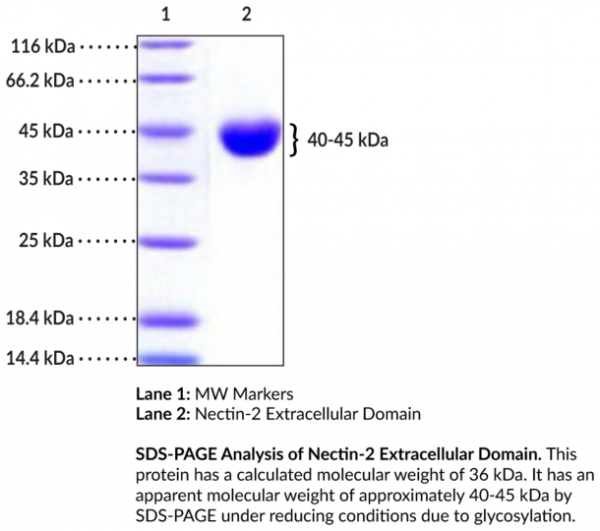
Nectin-2, also known as CD112, is a member of the nectin family of adhesion molecules that mediates the formation of adherens junctions and regulates immune cell activation. It contains an N-terminal extracellular domain with three immunoglobulin-like (Ig-like) loops, C1-like and C2 domains that mediate dimerization, a transmembrane segment, and a C-terminal cytoplasmic tail that binds to the actin filament-binding protein afadin. Nectin-2 is expressed by a variety of cell types, including epithelial cells, neurons, fibroblasts, Sertoli cells, and cancer cells, and is upregulated by TGF-beta1 (Cay-30606) or IFN-beta stimulation. It localizes to the cell surface where it forms cis-homodimers that associate by trans-interactions with cis-homodimers of other nectins and nectin-like molecules (Necls) expressed on adjacent cells, resulting in cell-cell adhesion. Nectin-2 binds the co-stimulatory receptor CD226/DNAM-1, which is widely expressed by most immune cells, including T cells, B cells, natural killer (NK) cells, and monocytes, and the inhibitory receptors TIGIT and CD96, which are expressed by NK cells and T cells, thus regulating both the activation or inhibition of immune cells in a receptor-specific manner. It is also the receptor for herpesvirus entry into cells. Sperm isolated from Nectin2-/- mice have decreased motility and maturation and fail to fuse with oocytes, resulting in male-specific infertility. Neutralization of nectin-2 with a monoclonal antibody decreases tumor growth and reduces metastasis in OV-90 or MDA-MB-231 mouse xenograft models, respectively. Cayman's Nectin-2 Extracellular Domain (mouse, recombinant) protein can be used for binding assay applications. This protein consists of 331 amino acids, has a calculated molecular weight of 36 kDa, and a predicted N-terminus of Gln32 after signal peptide cleavage. By SDS-PAGE, under reducing conditions, the apparent molecular mass of the protein is 40 to 45 kDa due to glycosylation.Synonyms: CD112, Herpesvirus Entry Mediator B, HveB, Nectin Cell Adhesion Molecule 2, Poliovirus Receptor-related Protein 2, PRR2. Purity: >98% estimated by SDS-PAGE. Endotoxin Testing: <1.0 EU/µg, determined by the LAL endotoxin assay. Source: Active recombinant mouse C-terminal His-tagged nectin-2 expressed in HEK293 cells. Amino Acids: 32-351. MW: 36 kDa. Formulation: (Request formulation change), Lyophilized from sterile PBS, pH 7.4. UniProt Accession #: P32507.
| Schlagworte: | Mph, HveB, HveB, mHveB, CD112, mHveB, CD112, Nectin-2, Nectin-2, Poliovirus receptor homolog, Poliovirus receptor homolog, Herpesvirus entry mediator B, Herpesvirus entry mediator B, Herpes virus entry mediator B, Herpes virus entry mediator B, Murine her |
| Hersteller: | Cayman Chemical |
| Hersteller-Nr: | 32074 |
Eigenschaften
| Konjugat: | No |
| Reinheit: | >98% estimated by SDS-PAGE |
| Format: | Lyophilized |
Datenbank Information
| KEGG ID : | K06531 | Passende Produkte |
| UniProt ID : | P32507 | Passende Produkte |
| Gene ID : | GeneID 19294 | Passende Produkte |
Handhabung & Sicherheit
| Lagerung: | -80°C |
| Versand: | -80°C (International: -80°C) |
Achtung
Nur für Forschungszwecke und Laboruntersuchungen: Nicht für die Anwendung im oder am Menschen!
Nur für Forschungszwecke und Laboruntersuchungen: Nicht für die Anwendung im oder am Menschen!
Hier folgen Informationen zur Produktreferenz.
mehr
Hier kriegen Sie ein Zertifikat
Loggen Sie sich ein oder registrieren Sie sich, um Analysenzertifikate anzufordern.
Bewertungen lesen, schreiben und diskutieren... mehr
Kundenbewertungen für "Nectin-2 Extracellular Domain (mouse, recombinant)"
Bewertung schreiben
Loggen Sie sich ein oder registrieren Sie sich, um eine Produktbewertung abzugeben.
Zuletzt angesehen