
Cookie-Einstellungen
Diese Website benutzt Cookies, die für den technischen Betrieb der Website erforderlich sind und stets gesetzt werden. Andere Cookies, die den Komfort bei Benutzung dieser Website erhöhen, der Direktwerbung dienen oder die Interaktion mit anderen Websites und sozialen Netzwerken vereinfachen sollen, werden nur mit Ihrer Zustimmung gesetzt.
Konfiguration
Technisch erforderlich
Diese Cookies sind für die Grundfunktionen des Shops notwendig.
"Alle Cookies ablehnen" Cookie
"Alle Cookies annehmen" Cookie
Ausgewählter Shop
CSRF-Token
Cookie-Einstellungen
FACT-Finder Tracking
Individuelle Preise
Kundenspezifisches Caching
Session
Währungswechsel
Komfortfunktionen
Diese Cookies werden genutzt um das Einkaufserlebnis noch ansprechender zu gestalten, beispielsweise für die Wiedererkennung des Besuchers.
Facebook-Seite in der rechten Blog - Sidebar anzeigen
Merkzettel
Statistik & Tracking
Endgeräteerkennung
Kauf- und Surfverhalten mit Google Tag Manager
Partnerprogramm

Bei Fragen nutzen Sie gerne unser Kontaktformular.
Bestellen Sie auch per E-Mail: info@biomol.com
Größere Menge gewünscht? Bulk-Anfrage
Bestellen Sie auch per E-Mail: info@biomol.com
Größere Menge gewünscht? Bulk-Anfrage
Organism: Homo sapiens (Human). Source: E.Coli. Expression Region: 1-270aa. Protein Length: Full... mehr
Produktinformationen "Fructose-2,6-bisphosphatase TIGAR protein (TIGAR) (Active), human, recombinant"
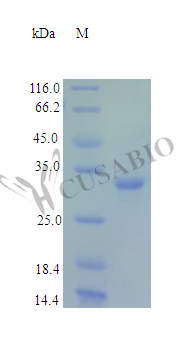
Organism: Homo sapiens (Human). Source: E.Coli. Expression Region: 1-270aa. Protein Length: Full Length. Tag Info: C-terminal TAT-tagged. Target Protein Sequence: MARFALTVVR HGETRFNKEK IIQGQGVDEP LSETGFKQAA AAGIFLNNVK FTHAFSSDLM RTKQTMHGIL ERSKFCKDMT VKYDSRLRER KYGVVEGKAL SELRAMAKAA REECPVFTPP GGETLDQVKM RGIDFFEFLC QLILKEADQK EQFSQGSPSN CLETSLAEIF PLGKNHSSKV NSDSGIPGLA ASVLVVSHGA YMRSLFDYFL TDLKCSLPAT LSRSELMSVT PNTGMSLFII NFEEGREVKP TVQCICMNLQ DHLNGLTETR+GGYGRKKRRQ. Purity: >96% as determined by SDS-PAGE. Endotoxin: Less than 1.0 EU/µg as determined by LAL method. Biological Activity: Fully biologically active when compared to standard. The biological activity determined by its ability to protect U2OS cells from apoptosis induced by hydrogen peroxide is in a concentration range of 0.1-5.0 µg/ml, after pretreating with rHuTIGAR-TAT for 4 hours. Form: Lyophilized powder. Buffer: Lyophilized from a 0.2 µm filtered 30 % Acetonitrile, 0.1% TFA. Reconstitution: We recommend that this vial be briefly centrifuged prior to opening to bring the contents to the bottom. Please reconstitute protein in deionized sterile water to a concentration of 0.1-1.0 mg/mL.We recommend to add 5-50% of glycerol (final concentration) and aliquot for long-term storage at -20 °C/-80 °C. Our default final concentration of glycerol is 50%. Customers could use it as reference. Storage: The shelf life is related to many factors, storage state, buffer ingredients, storage temperature and the stability of the protein itself. Generally, the shelf life of liquid form is 6 months at -20 °C/-80 °C. The shelf life of lyophilized form is 12 months at -20 °C/-80 °C. Notes: Repeated freezing and thawing is not recommended. Store working aliquots at 4 °C for up to one week. Relevance: Fructose-bisphosphatase hydrolyzing fructose-2,6-bisphosphate as well as fructose-1,6-bisphosphate (PubMed:19015259). Acts as a negative regulator of glycolysis by lowering intracellular levels of fructose-2,6-bisphosphate in a p53/TP53-dependent manner, resulting in the pentose phosphate pathway (PPP) activation and NADPH production (PubMed:16839880, PubMed:22887998). Contributes to the generation of reduced glutathione to cause a decrease in intracellular reactive oxygen species (ROS) content, correlating with its ability to protect cells from oxidative or metabolic stress-induced cell death (PubMed:16839880, PubMed:19713938, PubMed:23726973, PubMed:22887998, PubMed:23817040). Plays a role in promoting protection against cell death during hypoxia by decreasing mitochondria ROS levels in a HK2-dependent manner through a mechanism that is independent of its fructose-bisphosphatase activity (PubMed:23185017). In response to cardiac damage stress, mediates p53-induced inhibition of myocyte mitophagy through ROS levels reduction and the subsequent inactivation of BNIP3. Reduced mitophagy results in an enhanced apoptotic myocyte cell death, and exacerbates cardiac damage (By similarity). Plays a role in adult intestinal regeneration, contributes to the growth, proliferation and survival of intestinal crypts following tissue ablation (PubMed:23726973). Plays a neuroprotective role against ischemic brain damage by enhancing PPP flux and preserving mitochondria functions (By similarity). Protects glioma cells from hypoxia- and ROS-induced cell death by inhibiting glycolysis and activating mitochondrial energy metabolism and oxygen consumption in a TKTL1-dependent and p53/TP53-independent manner (PubMed:22887998). Plays a role in cancer cell survival by promoting DNA repair through activating PPP flux in a CDK5-ATM-dependent signaling pathway during hypoxia and/or genome stress-induced DNA damage responses (PubMed:25928429). Involved in intestinal tumor progression (PubMed:23726973). {ECO:0000250, UniProtKB:Q8BZA9, ECO:0000269, PubMed:16839880, ECO:0000269, PubMed:19015259, ECO:0000269, PubMed:19713938, ECO:0000269, PubMed:22887998, ECO:0000269, PubMed:23185017, ECO:0000269, PubMed:23726973, ECO:0000269, PubMed:23817040, ECO:0000269, PubMed:25928429}. Reference: n/a. Function: Fructose-bisphosphatase hydrolyzing fructose-2,6-bisphosphate as well as fructose-1,6-bisphosphate
| Schlagworte: | C12orf5, Fructose-2,6-bisphosphatase TIGAR, TP53-induced glycolysis regulatory phosphatase, TP53-induced glycolysis and apoptosis regulator, Recombinant Human Fructose-2,6-bisphosphatase TIGAR protein (TIGAR) (Active) |
| Hersteller: | Cusabio |
| Hersteller-Nr: | AP000111HU |
Eigenschaften
| Anwendung: | Active protein |
| Konjugat: | No |
| Spezies-Reaktivität: | human |
| MW: | 31.7 kD |
| Reinheit: | >96% (SDS-PAGE) |
| Format: | Lyophilized |
Datenbank Information
| KEGG ID : | K14634 | Passende Produkte |
| UniProt ID : | Q9NQ88 | Passende Produkte |
| Gene ID : | GeneID 57103 | Passende Produkte |
Handhabung & Sicherheit
| Lagerung: | -20°C |
| Versand: | +4°C (International: +4°C) |
Achtung
Nur für Forschungszwecke und Laboruntersuchungen: Nicht für die Anwendung im oder am Menschen!
Nur für Forschungszwecke und Laboruntersuchungen: Nicht für die Anwendung im oder am Menschen!
Hier kriegen Sie ein Zertifikat
Loggen Sie sich ein oder registrieren Sie sich, um Analysenzertifikate anzufordern.
Bewertungen lesen, schreiben und diskutieren... mehr
Kundenbewertungen für "Fructose-2,6-bisphosphatase TIGAR protein (TIGAR) (Active), human, recombinant"
Bewertung schreiben
Loggen Sie sich ein oder registrieren Sie sich, um eine Produktbewertung abzugeben.
Zuletzt angesehen