
Cookie-Einstellungen
Diese Website benutzt Cookies, die für den technischen Betrieb der Website erforderlich sind und stets gesetzt werden. Andere Cookies, die den Komfort bei Benutzung dieser Website erhöhen, der Direktwerbung dienen oder die Interaktion mit anderen Websites und sozialen Netzwerken vereinfachen sollen, werden nur mit Ihrer Zustimmung gesetzt.
Konfiguration
Technisch erforderlich
Diese Cookies sind für die Grundfunktionen des Shops notwendig.
"Alle Cookies ablehnen" Cookie
"Alle Cookies annehmen" Cookie
Ausgewählter Shop
CSRF-Token
Cookie-Einstellungen
FACT-Finder Tracking
Individuelle Preise
Kundenspezifisches Caching
Session
Währungswechsel
Komfortfunktionen
Diese Cookies werden genutzt um das Einkaufserlebnis noch ansprechender zu gestalten, beispielsweise für die Wiedererkennung des Besuchers.
Facebook-Seite in der rechten Blog - Sidebar anzeigen
Merkzettel
Statistik & Tracking
Endgeräteerkennung
Kauf- und Surfverhalten mit Google Tag Manager
Partnerprogramm

Bei Fragen nutzen Sie gerne unser Kontaktformular.
Bestellen Sie auch per E-Mail: info@biomol.com
Größere Menge gewünscht? Bulk-Anfrage
Bestellen Sie auch per E-Mail: info@biomol.com
Größere Menge gewünscht? Bulk-Anfrage
Organism: Homo sapiens (Human). Source: Baculovirus. Expression Region: 1-593aa. Protein Length:... mehr
Produktinformationen "Cryptochrome-2 (CRY2), human, recombinant"
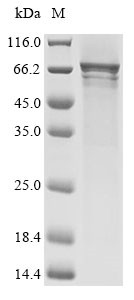
Organism: Homo sapiens (Human). Source: Baculovirus. Expression Region: 1-593aa. Protein Length: Full Length. Tag Info: N-terminal 10xHis-tagged and C-terminal Myc-tagged. Target Protein Sequence: MAATVATAAA VAPAPAPGTD SASSVHWFRK GLRLHDNPAL LAAVRGARCV RCVYILDPWF AASSSVGINR WRFLLQSLED LDTSLRKLNS RLFVVRGQPA DVFPRLFKEW GVTRLTFEYD SEPFGKERDA AIMKMAKEAG VEVVTENSHT LYDLDRIIEL NGQKPPLTYK RFQAIISRME LPKKPVGLVT SQQMESCRAE IQENHDETYG VPSLEELGFP TEGLGPAVWQ GGETEALARL DKHLERKAWV ANYERPRMNA NSLLASPTGL SPYLRFGCLS CRLFYYRLWD LYKKVKRNST PPLSLFGQLL WREFFYTAAT NNPRFDRMEG NPICIQIPWD RNPEALAKWA EGKTGFPWID AIMTQLRQEG WIHHLARHAV ACFLTRGDLW VSWESGVRVF DELLLDADFS VNAGSWMWLS CSAFFQQFFH CYCPVGFGRR TDPSGDYIRR YLPKLKAFPS RYIYEPWNAP ESIQKAAKCI IGVDYPRPIV NHAETSRLNI ERMKQIYQQL SRYRGLCLLA SVPSCVEDLS HPVAEPSSSQ AGSMSSAGPR PLPSGPASPK RKLEAAEEPP GEELSKRARV AELPTPELPS KDA. Purity: Greater than 85% as determined by SDS-PAGE. Endotoxin: Not test. Biological Activity: n/a. Form: Liquid or Lyophilized powder. Buffer: If the delivery form is liquid, the default storage buffer is Tris/PBS-based buffer, 5%-50% glycerol. If the delivery form is lyophilized powder, the buffer before lyophilization is Tris/PBS-based buffer, 6% Trehalose, pH 8.0. Reconstitution: We recommend that this vial be briefly centrifuged prior to opening to bring the contents to the bottom. Please reconstitute protein in deionized sterile water to a concentration of 0.1-1.0 mg/mL.We recommend to add 5-50% of glycerol (final concentration) and aliquot for long-term storage at -20 °C/-80 °C. Our default final concentration of glycerol is 50%. Customers could use it as reference. Storage: The shelf life is related to many factors, storage state, buffer ingredients, storage temperature and the stability of the protein itself. Generally, the shelf life of liquid form is 6 months at -20 °C/-80 °C. The shelf life of lyophilized form is 12 months at -20 °C/-80 °C. Notes: Repeated freezing and thawing is not recommended. Store working aliquots at 4 °C for up to one week. Relevance: Transcriptional repressor which forms a core component of the circadian clock. The circadian clock, an internal time-keeping system, regulates various physiological processes through the generation of approximately 24 hour circadian rhythms in gene expression, which are translated into rhythms in metabolism and behavior. It is derived from the Latin roots 'circa' (about) and 'diem' (day) and acts as an important regulator of a wide array of physiological functions including metabolism, sleep, body temperature, blood pressure, endocrine, immune, cardiovascular, and renal function. Consists of two major components: the central clock, residing in the suprachiasmatic nucleus of the brain, and the peripheral clocks that are present in nearly every tissue and organ system. Both the central and peripheral clocks can be reset by environmental cues, also known as Zeitgebers. The predominant Zeitgeber for the central clock is light, which is sensed by retina and signals directly to the SCN. The central clock entrains the peripheral clocks through neuronal and hormonal signals, body temperature and feeding-related cues, aligning all clocks with the external light/dark cycle. Circadian rhythms allow an organism to achieve temporal homeostasis with its environment at the molecular level by regulating gene expression to create a peak of protein expression once every 24 hours to control when a particular physiological process is most active with respect to the solar day. Transcription and translation of core clock components plays a critical role in rhythm generation, whereas delays imposed by post-translational modifications are important for determining the period (tau) of the rhythms (tau refers to the period of a rhythm and is the length, in time, of one complete cycle). A diurnal rhythm is synchronized with the day/night cycle, while the ultradian and infradian rhythms have a period shorter and longer than 24 hours, respectively. Disruptions in the circadian rhythms contribute to the pathology of cardiovascular diseases, cancer, metabolic syndromes and aging. A transcription/translation feedback loop (TTFL) forms the core of the molecular circadian clock mechanism. Transcription factors, CLOCK or NPAS2 and ARNTL/BMAL1 or ARNTL2/BMAL2, form the positive limb of the feedback loop, act in the form of a heterodimer and activate the transcription of core clock genes and clock-controlled genes, harboring E-box elements within their promoters. The core clock genes: PER1/2/3 and CRY1/2 which are transcriptional repressors form the negative limb of the feedback loop and interact with the CLOCK, NPAS2-ARNTL/BMAL1, ARNTL2/BMAL2 heterodimer inhibiting its activity and thereby negatively regulating their own expression. This heterodimer also activates nuclear receptors NR1D1/2 and RORA/B/G, which form a second feedback loop and which activate and repress ARNTL/BMAL1 transcription, respectively. CRY1 and CRY2 have redundant functions but also differential and selective contributions at least in defining the pace of the SCN circadian clock and its circadian transcriptional outputs. Less potent transcriptional repressor in cerebellum and liver than CRY1, though less effective in lengthening the period of the SCN oscillator. Seems to play a critical role in tuning SCN circadian period by opposing the action of CRY1. With CRY1, dispensable for circadian rhythm generation but necessary for the development of intercellular networks for rhythm synchrony. May mediate circadian regulation of cAMP signaling and gluconeogenesis by blocking glucagon-mediated increases in intracellular cAMP concentrations and in CREB1 phosphorylation. Besides its role in the maintenance of the circadian clock, is also involved in the regulation of other processes. Plays a key role in glucose and lipid metabolism modulation, in part, through the transcriptional regulation of genes involved in these pathways, such as LEP or ACSL4. Represses glucocorticoid receptor NR3C1/GR-induced transcriptional activity by binding to glucocorticoid response elements (GREs). Represses the CLOCK-ARNTL/BMAL1 induced transcription of BHLHE40/DEC1. Represses the CLOCK-ARNTL/BMAL1 induced transcription of NAMPT (By similarity). Represses PPARD and its target genes in the skeletal muscle and limits exercise capacity (By similarity). Represses the transcriptional activity of NR1I2. Reference: "Human chromosome 11 DNA sequence and analysis including novel gene identification." Taylor T.D., Noguchi H., Totoki Y., Toyoda A., Kuroki Y., Dewar K., Lloyd C., Itoh T., Takeda T., Kim D.-W., She X., Barlow K.F., Bloom T., Bruford E., Chang J.L., Cuomo C.A., Eichler E., FitzGerald M.G. Sakaki Y. Nature 440:497-500(2006). Function: nan
| Schlagworte: | CRY2, KIAA0658, Cryptochrome-2, Recombinant Human Cryptochrome-2 (CRY2) |
| Hersteller: | Cusabio |
| Hersteller-Nr: | BP673229HU |
Eigenschaften
| Anwendung: | Activity not tested |
| Konjugat: | No |
| Wirt: | Insect cells |
| Spezies-Reaktivität: | human |
| MW: | 70.8 kD |
| Reinheit: | >85% (SDS-PAGE) |
Datenbank Information
| KEGG ID : | K11642 | Passende Produkte |
| UniProt ID : | Q49AN0 | Passende Produkte |
| Gene ID : | GeneID 1408 | Passende Produkte |
Handhabung & Sicherheit
| Lagerung: | -20°C |
| Versand: | +4°C (International: +4°C) |
Achtung
Nur für Forschungszwecke und Laboruntersuchungen: Nicht für die Anwendung im oder am Menschen!
Nur für Forschungszwecke und Laboruntersuchungen: Nicht für die Anwendung im oder am Menschen!
Hier kriegen Sie ein Zertifikat
Loggen Sie sich ein oder registrieren Sie sich, um Analysenzertifikate anzufordern.
Bewertungen lesen, schreiben und diskutieren... mehr
Kundenbewertungen für "Cryptochrome-2 (CRY2), human, recombinant"
Bewertung schreiben
Loggen Sie sich ein oder registrieren Sie sich, um eine Produktbewertung abzugeben.
Zuletzt angesehen