
Cookie-Einstellungen
Diese Website benutzt Cookies, die für den technischen Betrieb der Website erforderlich sind und stets gesetzt werden. Andere Cookies, die den Komfort bei Benutzung dieser Website erhöhen, der Direktwerbung dienen oder die Interaktion mit anderen Websites und sozialen Netzwerken vereinfachen sollen, werden nur mit Ihrer Zustimmung gesetzt.
Konfiguration
Technisch erforderlich
Diese Cookies sind für die Grundfunktionen des Shops notwendig.
"Alle Cookies ablehnen" Cookie
"Alle Cookies annehmen" Cookie
Ausgewählter Shop
CSRF-Token
Cookie-Einstellungen
FACT-Finder Tracking
Individuelle Preise
Kundenspezifisches Caching
Session
Währungswechsel
Komfortfunktionen
Diese Cookies werden genutzt um das Einkaufserlebnis noch ansprechender zu gestalten, beispielsweise für die Wiedererkennung des Besuchers.
Facebook-Seite in der rechten Blog - Sidebar anzeigen
Merkzettel
Statistik & Tracking
Endgeräteerkennung
Kauf- und Surfverhalten mit Google Tag Manager
Partnerprogramm

Bei Fragen nutzen Sie gerne unser Kontaktformular.
Bestellen Sie auch per E-Mail: info@biomol.com
Größere Menge gewünscht? Bulk-Anfrage
Bestellen Sie auch per E-Mail: info@biomol.com
Größere Menge gewünscht? Bulk-Anfrage
The test principle applied in this kit is Sandwich enzyme immunoassay. The microtiter plate... mehr
Produktinformationen "Mouse GP4 (Platelet Membrane Glycoprotein IV) ELISA Kit"
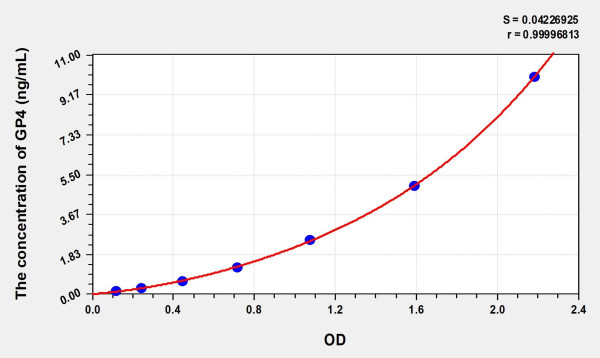
The test principle applied in this kit is Sandwich enzyme immunoassay. The microtiter plate provided in this kit has been pre-coated with an antibody specific to Mouse GP4. Standards or samples are added to the appropriate microtiter plate wells then with a biotin-conjugated antibody specific to Mouse GP4. Next, Avidin conjugated to Horseradish Peroxidase (HRP) is added to each microplate well and incubated. After TMB substrate solution is added, only those wells that contain Mouse GP4, biotin-conjugated antibody and enzyme-conjugated Avidin will exhibit a change in color. The enzyme-substrate reaction is terminated by the addition of sulphuric acid solution and the color change is measured spectrophotometrically at a wavelength of 450nm ± 10nm. The concentration of Mouse GP4 in the samples is then determined by comparing the OD of the samples to the standard curve.Detection Range: 0.16-10 ng/mL. Sensitivity: 0.058 ng/mL. Assay Type: Sandwich. Standard: 10 ng/mL. Sample Type: sSerum, plasma, tissue homogenates and other biological fluids. Assay duration: 3.5h. Protein Function: Multifunctional glycoprotein that acts as a receptor for a broad range of ligands. Ligands can be of proteinaceous nature like thrombospondin, fibronectin, collagen or amyloid-beta as well as of lipidic nature such as oxidized low-density lipoprotein (oxLDL), anionic phospholipids, long-chain fatty acids and bacterial diacylated lipopeptides (PubMed:7685021). They are generally multivalent and can therefore engage multiple receptors simultaneously, the resulting formation of CD36 clusters initiates signal transduction and internalization of receptor-ligand complexes. The dependency on coreceptor signaling is strongly ligand specific. Cellular responses to these ligands are involved in angiogenesis, inflammatory response, fatty acid metabolism, taste and dietary fat processing in the intestine (Probable) (PubMed:19847289, PubMed:20037584, PubMed:23395392). Binds long-chain fatty acids and facilitates their transport into cells, thus participating in muscle lipid utilization, adipose energy storage, and gut fat absorption (PubMed:30605677). Mechanistically, binding of fatty acids activates downstream kinase LYN, which phosphorylates the palmitoyltransferase ZDHHC5 and inactivates it, resulting in the subsequent depalmitoylation of CD36 and caveolar endocytosis (By similarity). In the small intestine, plays a role in proximal absorption of dietary fatty acid and cholesterol for optimal chylomicron formation, possibly through the activation of MAPK1/3 (ERK1/2) signaling pathway (By similarity) (PubMed:17507371, PubMed:18753675, PubMed:21610069). Involved in oral fat perception and preferences (PubMed:16276419). Detection into the tongue of long-chain fatty acids leads to a rapid and sustained rise in flux and protein content of pancreatobiliary secretions (By similarity) (PubMed:16276419). In taste receptor cells, mediates the induction of an increase in intracellular calcium levels by long-chain fatty acids, leading to the activation of the gustatory neurons in the nucleus of the solitary tract (PubMed:18162488). Important factor in both ventromedial hypothalamus neuronal sensing of long-chain fatty acid and the regulation of energy and glucose homeostasis (By similarity) (PubMed:23557700). Receptor for thrombospondins, THBS1 and THBS2, mediating their antiangiogenic effects (PubMed:15748999). Involved in inducing apoptosis in podocytes in response to elevated free fatty acids, acting together with THBS1 (PubMed:25835637). As a coreceptor for TLR4:TLR6 heterodimer, promotes inflammation in monocytes/macrophages. Upon ligand binding, such as oxLDL or amyloid-beta 42, interacts with the heterodimer TLR4:TLR6, the complex is internalized and triggers inflammatory response, leading to NF-kappa-B-dependent production of CXCL1, CXCL2 and CCL9 cytokines, via MYD88 signaling pathway, and CCL5 cytokine, via TICAM1 signaling pathway, as well as IL1B secretion, through the priming and activation of the NLRP3 inflammasome (PubMed:20037584, PubMed:23812099). Selective and nonredundant sensor of microbial diacylated lipopeptide that signal via TLR2:TLR6 heterodimer, this cluster triggers signaling from the cell surface, leading to the NF-kappa-B-dependent production of TNF, via MYD88 signaling pathway and subsequently is targeted to the Golgi in a lipid-raft dependent pathway (By similarity) (PubMed:15690042, PubMed:19847289) , (Microbial infection) Acts as an accessory receptor for M.tuberculosis lipoprotein LprA, in conjunction with coreceptors TLR2 and TLR1, the lipoprotein acts as an agonist to modulate antigen presenting cell functions in response to the pathogen (PubMed:19362712). Directly mediates cytoadherence of Plasmodium falciparum parasitized erythrocytes and the internalization of particles independently of TLR signaling (PubMed:19864601, PubMed:23395392). Mediates uptake of E.coli and S.aureus but has no effect on uptake of M.fortuitum (PubMed:16020694) [The Uniprot Consortium]
| Schlagworte: | Cd36, PAS-4, PAS IV, Glycoprotein IIIb, Platelet glycoprotein 4, Platelet glycoprotein IV |
| Hersteller: | ELK Biotechnology |
| Hersteller-Nr: | ELK11257 |
Eigenschaften
| Anwendung: | ELISA |
| Spezies-Reaktivität: | mouse |
| Format: | Solid Phase |
Datenbank Information
| KEGG ID : | K06259 | Passende Produkte |
| UniProt ID : | Q08857 | Passende Produkte |
| Gene ID : | GeneID 12491 | Passende Produkte |
Handhabung & Sicherheit
| Lagerung: | vT |
| Versand: | +4°C (International: +4°C) |
Achtung
Nur für Forschungszwecke und Laboruntersuchungen: Nicht für die Anwendung im oder am Menschen!
Nur für Forschungszwecke und Laboruntersuchungen: Nicht für die Anwendung im oder am Menschen!
Hier kriegen Sie ein Zertifikat
Loggen Sie sich ein oder registrieren Sie sich, um Analysenzertifikate anzufordern.
Bewertungen lesen, schreiben und diskutieren... mehr
Kundenbewertungen für "Mouse GP4 (Platelet Membrane Glycoprotein IV) ELISA Kit"
Bewertung schreiben
Loggen Sie sich ein oder registrieren Sie sich, um eine Produktbewertung abzugeben.
Zuletzt angesehen