
Cookie-Einstellungen
Diese Website benutzt Cookies, die für den technischen Betrieb der Website erforderlich sind und stets gesetzt werden. Andere Cookies, die den Komfort bei Benutzung dieser Website erhöhen, der Direktwerbung dienen oder die Interaktion mit anderen Websites und sozialen Netzwerken vereinfachen sollen, werden nur mit Ihrer Zustimmung gesetzt.
Konfiguration
Technisch erforderlich
Diese Cookies sind für die Grundfunktionen des Shops notwendig.
"Alle Cookies ablehnen" Cookie
"Alle Cookies annehmen" Cookie
Ausgewählter Shop
CSRF-Token
Cookie-Einstellungen
FACT-Finder Tracking
Individuelle Preise
Kundenspezifisches Caching
Session
Währungswechsel
Komfortfunktionen
Diese Cookies werden genutzt um das Einkaufserlebnis noch ansprechender zu gestalten, beispielsweise für die Wiedererkennung des Besuchers.
Facebook-Seite in der rechten Blog - Sidebar anzeigen
Merkzettel
Statistik & Tracking
Endgeräteerkennung
Kauf- und Surfverhalten mit Google Tag Manager
Partnerprogramm

NEU
Bei Fragen nutzen Sie gerne unser Kontaktformular.
Bestellen Sie auch per E-Mail: info@biomol.com
Größere Menge gewünscht? Bulk-Anfrage
Bestellen Sie auch per E-Mail: info@biomol.com
Größere Menge gewünscht? Bulk-Anfrage
The test principle applied in this kit is Sandwich enzyme immunoassay. The microtiter plate... mehr
Produktinformationen "Human Slc26a5 (Prestin) Microsample ELISA Kit"
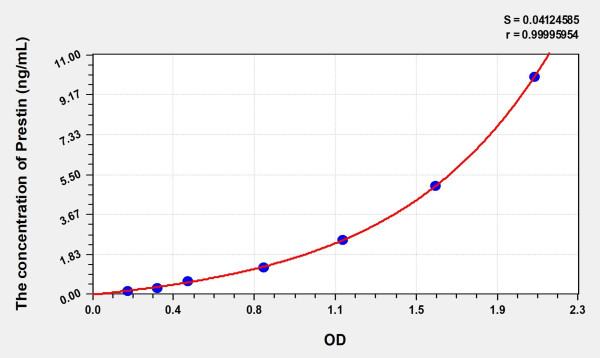
The test principle applied in this kit is Sandwich enzyme immunoassay. The microtiter plate provided in this kit has been pre-coated with an antibody specific to Human prestin. Standards or samples are added to the appropriate microtiter plate wells then with a biotin-conjugated antibody specific to Human prestin. Next, Avidin conjugated to Horseradish Peroxidase (HRP) is added to each microplate well and incubated. After TMB substrate solution is added, only those wells that contain Human prestin, biotin-conjugated antibody and enzyme-conjugated Avidin will exhibit a change in color. The enzyme-substrate reaction is terminated by the addition of sulphuric acid solution and the color change is measured spectrophotometrically at a wavelength of 450nm ± 10nm. The concentration of Human prestin in the samples is then determined by comparing the OD of the samples to the standard curve.Detection Range: 0.16-10 ng/mL. Sensitivity: 0.064 ng/mL. Assay Type: Sandwich. Standard: 10 ng/mL. Sample Type: sTissue homogenates and other biological fluids.. Assay duration: 3.5h. Protein Function: Voltage-sensitive motor protein that drives outer hair cell (OHC) electromotility (eM) and participates in sound amplification in the hearing organ (By similarity). Converts changes in the transmembrane electric potential into mechanical displacements resulting in the coupling of its expansion to movement of a charged voltage sensor across the lipid membrane (By similarity). The nature of the voltage sensor is not completely clear, and two models compete. In the first model, acts as an incomplete transporter where intracellular chloride anion acts as extrinsic voltage sensor that drives conformational change in the protein which is sufficient to produce a length change in the plane of the membrane and hence in the length of the OHC (By similarity). The second model in which multiple charged amino acid residues are distributed at the intracellular and extracellular membrane interfaces that form an intrinsic voltage sensor, whose movement produces the non-linear capacitance (NLC) (PubMed:34390643). However, the effective voltage sensor may be the result of a hybrid voltage sensor, assembled from intrinsic charge (charged residues) and extrinsic charge (bound anion) (By similarity). Notably, binding of anions to the anion-binding pocket partially neutralizes the intrinsic positive charge rather than to form an electrically negative sensor, therefore remaining charge may serve as voltage sensor that, after depolarization, moves from down (expanded state) to up (contracted) conformation, which is accompanied by an eccentric contraction of the intermembrane cross-sectional area of the protein as well as a major increase in the hydrophobic thickness of the protein having as consequences the plasma membrane thickening and the cell contraction after membrane depolarization (PubMed:34390643). The anion-binding pocket transits from the inward-open (Down) state, where it is exposed toward the intracellular solvent in the absence of anion, to the occluded (Up) state upon anion binding (PubMed:34390643). Salicylate competes for the anion-binding site and inhibits the voltage-sensor movement, and therefore inhibits the charge transfer and electromotility by displacing Cl(-) from the anion-binding site and by preventing the structural transitions to the contracted state (PubMed:34390643). In addition, can act as a weak Cl(-)/HCO3(-) antiporter across the cell membrane and so regulate the intracellular pH of the outer hair cells (OHCs), while firstly found as being unable to mediate electrogenic anion transport (By similarity). Moreover, supports a role in cardiac mechanical amplification serving as an elastic element to enhance the actomyosin- based sarcomere contraction system (By similarity) [The Uniprot Consortium]
| Schlagworte: | Prestin, SLC26A5, Solute carrier family 26 member 5 |
| Hersteller: | ELK Biotechnology |
| Hersteller-Nr: | ELK9105MS |
Eigenschaften
| Anwendung: | ELISA |
| Spezies-Reaktivität: | human |
| Format: | Solid Phase |
Datenbank Information
| KEGG ID : | K14703 | Passende Produkte |
| UniProt ID : | P58743 | Passende Produkte |
| Gene ID : | GeneID 375611 | Passende Produkte |
Handhabung & Sicherheit
| Lagerung: | vT |
| Versand: | +4°C (International: +4°C) |
Achtung
Nur für Forschungszwecke und Laboruntersuchungen: Nicht für die Anwendung im oder am Menschen!
Nur für Forschungszwecke und Laboruntersuchungen: Nicht für die Anwendung im oder am Menschen!
Hier kriegen Sie ein Zertifikat
Loggen Sie sich ein oder registrieren Sie sich, um Analysenzertifikate anzufordern.
Bewertungen lesen, schreiben und diskutieren... mehr
Kundenbewertungen für "Human Slc26a5 (Prestin) Microsample ELISA Kit"
Bewertung schreiben
Loggen Sie sich ein oder registrieren Sie sich, um eine Produktbewertung abzugeben.
Zuletzt angesehen