
Cookie-Einstellungen
Diese Website benutzt Cookies, die für den technischen Betrieb der Website erforderlich sind und stets gesetzt werden. Andere Cookies, die den Komfort bei Benutzung dieser Website erhöhen, der Direktwerbung dienen oder die Interaktion mit anderen Websites und sozialen Netzwerken vereinfachen sollen, werden nur mit Ihrer Zustimmung gesetzt.
Konfiguration
Technisch erforderlich
Diese Cookies sind für die Grundfunktionen des Shops notwendig.
"Alle Cookies ablehnen" Cookie
"Alle Cookies annehmen" Cookie
Ausgewählter Shop
CSRF-Token
Cookie-Einstellungen
FACT-Finder Tracking
Individuelle Preise
Kundenspezifisches Caching
Session
Währungswechsel
Komfortfunktionen
Diese Cookies werden genutzt um das Einkaufserlebnis noch ansprechender zu gestalten, beispielsweise für die Wiedererkennung des Besuchers.
Facebook-Seite in der rechten Blog - Sidebar anzeigen
Merkzettel
Statistik & Tracking
Endgeräteerkennung
Kauf- und Surfverhalten mit Google Tag Manager
Partnerprogramm

Bei Fragen nutzen Sie gerne unser Kontaktformular.
Bestellen Sie auch per E-Mail: info@biomol.com
Größere Menge gewünscht? Bulk-Anfrage
Bestellen Sie auch per E-Mail: info@biomol.com
Größere Menge gewünscht? Bulk-Anfrage
The test principle applied in this kit is Sandwich enzyme immunoassay. The microtiter plate... mehr
Produktinformationen "Human PARK2 (Parkinson Disease Protein 2) Microsample ELISA Kit"
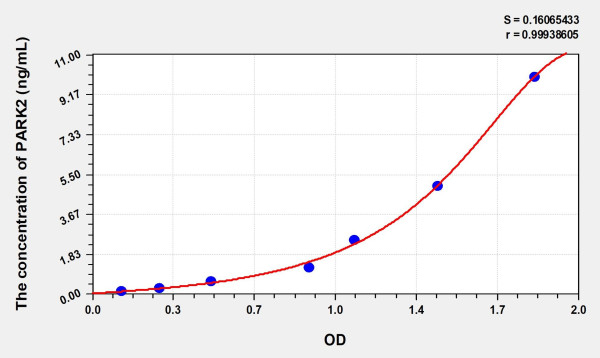
The test principle applied in this kit is Sandwich enzyme immunoassay. The microtiter plate provided in this kit has been pre-coated with an antibody specific to Human PARK2. Standards or samples are added to the appropriate microtiter plate wells then with a biotin-conjugated antibody specific to Human PARK2. Next, Avidin conjugated to Horseradish Peroxidase (HRP) is added to each microplate well and incubated. After TMB substrate solution is added, only those wells that contain Human PARK2, biotin-conjugated antibody and enzyme-conjugated Avidin will exhibit a change in color. The enzyme-substrate reaction is terminated by the addition of sulphuric acid solution and the color change is measured spectrophotometrically at a wavelength of 450nm ± 10nm. The concentration of Human PARK2 in the samples is then determined by comparing the OD of the samples to the standard curve.Detection Range: 0.16-10 ng/mL. Sensitivity: 0.055 ng/mL. Assay Type: Sandwich. Standard: 10 ng/mL. Sample Type: sTissue homogenates and other biological fluids.. Assay duration: 3.5h. Protein Function: Functions within a multiprotein E3 ubiquitin ligase complex, catalyzing the covalent attachment of ubiquitin moieties onto substrate proteins (PubMed:10888878, PubMed:10973942, PubMed:11431533, PubMed:12150907, PubMed:12628165, PubMed:15105460, PubMed:16135753, PubMed:21376232, PubMed:21532592, PubMed:22396657, PubMed:23620051, PubMed:23754282, PubMed:24660806, PubMed:24751536, PubMed:29311685, PubMed:32047033). Substrates include SYT11 and VDAC1 (PubMed:29311685, PubMed:32047033). Other substrates are BCL2, CCNE1, GPR37, RHOT1/MIRO1, MFN1, MFN2, STUB1, SNCAIP, SEPTIN5, TOMM20, USP30, ZNF746, MIRO1 and AIMP2 (PubMed:10888878, PubMed:10973942, PubMed:11431533, PubMed:12150907, PubMed:12628165, PubMed:15105460, PubMed:16135753, PubMed:21376232, PubMed:21532592, PubMed:22396657, PubMed:23620051, PubMed:23754282, PubMed:24660806, PubMed:24751536). Mediates monoubiquitination as well as 'Lys-6', 'Lys-11', 'Lys-48'-linked and 'Lys-63'-linked polyubiquitination of substrates depending on the context (PubMed:19229105, PubMed:20889974, PubMed:25474007, PubMed:25621951, PubMed:32047033). Participates in the removal and/or detoxification of abnormally folded or damaged protein by mediating 'Lys-63'-linked polyubiquitination of misfolded proteins such as PARK7: 'Lys-63'-linked polyubiquitinated misfolded proteins are then recognized by HDAC6, leading to their recruitment to aggresomes, followed by degradation (PubMed:17846173, PubMed:19229105). Mediates 'Lys-63'-linked polyubiquitination of a 22 kDa O-linked glycosylated isoform of SNCAIP, possibly playing a role in Lewy-body formation (PubMed:11431533, PubMed:11590439, PubMed:15105460, PubMed:15728840, PubMed:19229105). Mediates monoubiquitination of BCL2, thereby acting as a positive regulator of autophagy (PubMed:20889974). Protects against mitochondrial dysfunction during cellular stress, by acting downstream of PINK1 to coordinate mitochondrial quality control mechanisms that remove and replace dysfunctional mitochondrial components (PubMed:11439185, PubMed:18957282, PubMed:19029340, PubMed:19966284, PubMed:21376232, PubMed:22082830, PubMed:22396657, PubMed:23620051, PubMed:23933751, PubMed:24660806, PubMed:24784582, PubMed:24896179, PubMed:25474007, PubMed:25527291, PubMed:32047033). Depending on the severity of mitochondrial damage and/or dysfunction, activity ranges from preventing apoptosis and stimulating mitochondrial biogenesis to regulating mitochondrial dynamics and eliminating severely damaged mitochondria via mitophagy (PubMed:11439185, PubMed:19029340, PubMed:19801972, PubMed:19966284, PubMed:21376232, PubMed:22082830, PubMed:22396657, PubMed:23620051, PubMed:23685073, PubMed:23933751, PubMed:24896179, PubMed:25527291, PubMed:32047033, PubMed:33499712). Activation and recruitment onto the outer membrane of damaged/dysfunctional mitochondria (OMM) requires PINK1-mediated phosphorylation of both PRKN and ubiquitin (PubMed:24660806, PubMed:24784582, PubMed:25474007, PubMed:25527291). After mitochondrial damage, functions with PINK1 to mediate the decision between mitophagy or preventing apoptosis by inducing either the poly- or monoubiquitination of VDAC1, respectively, polyubiquitination of VDAC1 promotes mitophagy, while monoubiquitination of VDAC1 decreases mitochondrial calcium influx which ultimately inhibits apoptosis (PubMed:27534820, PubMed:32047033). When cellular stress results in irreversible mitochondrial damage, promotes the autophagic degradation of dysfunctional depolarized mitochondria (mitophagy) by promoting the ubiquitination of mitochondrial proteins such as TOMM20, RHOT1/MIRO1, MFN1 and USP30 (PubMed:19029340, PubMed:19966284, PubMed:21753002, PubMed:22396657, PubMed:23620051, PubMed:23685073, PubMed:23933751, PubMed:24896179, PubMed:25527291). Preferentially assembles 'Lys-6'-, 'Lys-11'- and 'Lys-63'-linked polyubiquitin chains, leading to mitophagy (PubMed:25621951, PubMed:32047033). The PINK1-PRKN pathway also promotes fission of damaged mitochondria by PINK1-mediated phosphorylation which promotes the PRKN-dependent degradation of mitochondrial proteins involved in fission such as MFN2 (PubMed:23620051). This prevents the refusion of unhealthy mitochondria with the mitochondrial network or initiates mitochondrial fragmentation facilitating their later engulfment by autophagosomes (PubMed:23620051). Regulates motility of damaged mitochondria via the ubiquitination and subsequent degradation of MIRO1 and MIRO2, in motor neurons, this likely inhibits mitochondrial intracellular anterograde transport along the axons which probably increases the chance of the mitochondria undergoing mitophagy in the soma (PubMed:22396657). Involved in mitochondrial biogenesis via the 'Lys-48'-linked polyubiquitination of transcriptional repressor ZNF746/PARIS which leads to its subsequent proteasomal degradation and allows activation of the transcription factor PPARGC1A (PubMed:21376232). Limits the production of reactive oxygen species (ROS) (PubMed:18541373). Regulates cyclin-E during neuronal apoptosis (PubMed:12628165). In collaboration with CHPF isoform 2, may enhance cell viability and protect cells from oxidative stress (PubMed:22082830). Independently of its ubiquitin ligase activity, protects from apoptosis by the transcriptional repression of p53/TP53 (PubMed:19801972). May protect neurons against alpha synuclein toxicity, proteasomal dysfunction, GPR37 accumulation, and kainate-induced excitotoxicity (PubMed:11439185). May play a role in controlling neurotransmitter trafficking at the presynaptic terminal and in calcium-dependent exocytosis. May represent a tumor suppressor gene (PubMed:12719539) [The Uniprot Consortium]
| Schlagworte: | PRKN, E3 ubiquitin-protein ligase parkin, Parkinson juvenile disease protein 2, Parkin RBR E3 ubiquitin-protein ligase |
| Hersteller: | ELK Biotechnology |
| Hersteller-Nr: | ELK6722MS |
Eigenschaften
| Anwendung: | ELISA |
| Spezies-Reaktivität: | human |
| Format: | Solid Phase |
Datenbank Information
| KEGG ID : | K04556 | Passende Produkte |
| UniProt ID : | O60260 | Passende Produkte |
| Gene ID : | GeneID 5071 | Passende Produkte |
Handhabung & Sicherheit
| Lagerung: | vT |
| Versand: | +4°C (International: +4°C) |
Achtung
Nur für Forschungszwecke und Laboruntersuchungen: Nicht für die Anwendung im oder am Menschen!
Nur für Forschungszwecke und Laboruntersuchungen: Nicht für die Anwendung im oder am Menschen!
Hier kriegen Sie ein Zertifikat
Loggen Sie sich ein oder registrieren Sie sich, um Analysenzertifikate anzufordern.
Bewertungen lesen, schreiben und diskutieren... mehr
Kundenbewertungen für "Human PARK2 (Parkinson Disease Protein 2) Microsample ELISA Kit"
Bewertung schreiben
Loggen Sie sich ein oder registrieren Sie sich, um eine Produktbewertung abzugeben.
Zuletzt angesehen