
Cookie-Einstellungen
Diese Website benutzt Cookies, die für den technischen Betrieb der Website erforderlich sind und stets gesetzt werden. Andere Cookies, die den Komfort bei Benutzung dieser Website erhöhen, der Direktwerbung dienen oder die Interaktion mit anderen Websites und sozialen Netzwerken vereinfachen sollen, werden nur mit Ihrer Zustimmung gesetzt.
Konfiguration
Technisch erforderlich
Diese Cookies sind für die Grundfunktionen des Shops notwendig.
"Alle Cookies ablehnen" Cookie
"Alle Cookies annehmen" Cookie
Ausgewählter Shop
CSRF-Token
Cookie-Einstellungen
FACT-Finder Tracking
Individuelle Preise
Kundenspezifisches Caching
Session
Währungswechsel
Komfortfunktionen
Diese Cookies werden genutzt um das Einkaufserlebnis noch ansprechender zu gestalten, beispielsweise für die Wiedererkennung des Besuchers.
Facebook-Seite in der rechten Blog - Sidebar anzeigen
Merkzettel
Statistik & Tracking
Endgeräteerkennung
Kauf- und Surfverhalten mit Google Tag Manager
Partnerprogramm

NEU
Bei Fragen nutzen Sie gerne unser Kontaktformular.
Bestellen Sie auch per E-Mail: info@biomol.com
Größere Menge gewünscht? Bulk-Anfrage
Bestellen Sie auch per E-Mail: info@biomol.com
Größere Menge gewünscht? Bulk-Anfrage
The test principle applied in this kit is Sandwich enzyme immunoassay. The microtiter plate... mehr
Produktinformationen "Human MHCDRb1 (Major Histocompatibility Complex Class II DR Beta 1) Microsample ELISA Kit"
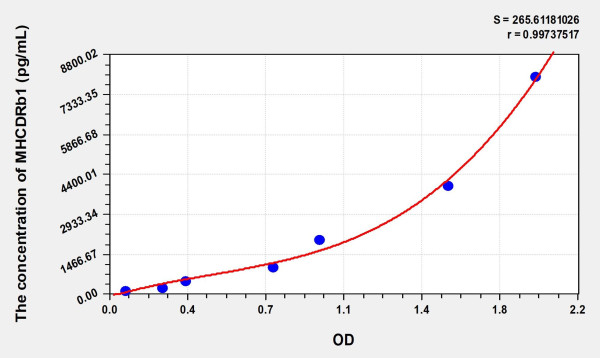
The test principle applied in this kit is Sandwich enzyme immunoassay. The microtiter plate provided in this kit has been pre-coated with an antibody specific to Human MHCDRb1. Standards or samples are added to the appropriate microtiter plate wells then with a biotin-conjugated antibody specific to Human MHCDRb1. Next, Avidin conjugated to Horseradish Peroxidase (HRP) is added to each microplate well and incubated. After TMB substrate solution is added, only those wells that contain Human MHCDRb1, biotin-conjugated antibody and enzyme-conjugated Avidin will exhibit a change in color. The enzyme-substrate reaction is terminated by the addition of sulphuric acid solution and the color change is measured spectrophotometrically at a wavelength of 450nm ± 10nm. The concentration of Human MHCDRb1 in the samples is then determined by comparing the OD of the samples to the standard curve.Detection Range: 125-8000 pg/mL. Sensitivity: 38 pg/mL. Assay Type: Sandwich. Standard: 8000 pg/mL. Sample Type: sserum, plasma, tissue homogenates and other biological fluids. Assay duration: 3.5h. Protein Function: A beta chain of antigen-presenting major histocompatibility complex class II (MHCII) molecule. In complex with the alpha chain HLA-DRA, displays antigenic peptides on professional antigen presenting cells (APCs) for recognition by alpha-beta T cell receptor (TCR) on HLA-DRB1-restricted CD4-positive T cells. This guides antigen-specific T-helper effector functions, both antibody-mediated immune response and macrophage activation, to ultimately eliminate the infectious agents and transformed cells (PubMed:15265931, PubMed:16148104, PubMed:22327072, PubMed:27591323, PubMed:29884618, PubMed:31495665, PubMed:8642306). Typically presents extracellular peptide antigens of 10 to 30 amino acids that arise from proteolysis of endocytosed antigens in lysosomes (PubMed:8145819). In the tumor microenvironment, presents antigenic peptides that are primarily generated in tumor-resident APCs likely via phagocytosis of apoptotic tumor cells or macropinocytosis of secreted tumor proteins (PubMed:31495665). Presents peptides derived from intracellular proteins that are trapped in autolysosomes after macroautophagy, a mechanism especially relevant for T cell selection in the thymus and central immune tolerance (PubMed:17182262, PubMed:23783831). The selection of the immunodominant epitopes follows two processing modes: 'bind first, cut/trim later' for pathogen-derived antigenic peptides and 'cut first, bind later' for autoantigens/self-peptides (PubMed:25413013). The anchor residue at position 1 of the peptide N-terminus, usually a large hydrophobic residue, is essential for high affinity interaction with MHCII molecules (PubMed:8145819) , Allele DRB1*01:01: Displays an immunodominant epitope derived from Bacillus anthracis pagA/protective antigen, PA (KLPLYISNPNYKVNVYAVT), to both naive and PA-specific memory CD4-positive T cells (PubMed:22327072). Presents immunodominant HIV-1 gag peptide (FRDYVDRFYKTLRAEQASQE) on infected dendritic cells for recognition by TRAV24-TRBV2 TCR on CD4-positive T cells and controls viral load (PubMed:29884618). May present to T-helper 1 cells several HRV-16 epitopes derived from capsid proteins VP1 (PRFSLPFLSIASAYYMFYDG) and VP2 (PHQFINLRSNNSATLIVPYV), contributing to viral clearance (PubMed:27591323). Displays commonly recognized peptides derived from IAV external protein HA (PKYVKQNTLKLAT and SNGNFIAPEYAYKIVK) and from internal proteins M, NP and PB1, with M-derived epitope (GLIYNRMGAVTTEV) being the most immunogenic (PubMed:25413013, PubMed:32668259, PubMed:8145819, PubMed:9075930). Presents a self-peptide derived from COL4A3 (GWISLWKGFSF) to TCR (TRAV14 biased) on CD4-positive, FOXP3-positive regulatory T cells and mediates immune tolerance to self (PubMed:28467828). May present peptides derived from oncofetal trophoblast glycoprotein TPBG 5T4, known to be recognized by both T-helper 1 and regulatory T cells (PubMed:31619516). Displays with low affinity a self-peptide derived from MBP (VHFFKNIVTPRTP) (PubMed:9075930) , Allele DRB1*03:01: May present to T-helper 1 cells an HRV-16 epitope derived from capsid protein VP2 (NEKQPSDDNWLNFDGTLLGN), contributing to viral clearance (PubMed:27591323). Displays self-peptides derived from retinal SAG (NRERRGIALDGKIKHE) and thyroid TG (LSSVVVDPSIRHFDV) (PubMed:25413013). Presents viral epitopes derived from HHV-6B gH/U48 and U85 antigens to polyfunctional CD4-positive T cells with cytotoxic activity implicated in control of HHV-6B infection (PubMed:31020640). Presents several immunogenic epitopes derived from C.tetani neurotoxin tetX, playing a role in immune recognition and long-term protection (PubMed:19830726) , Allele DRB1*04:01: Presents an immunodominant bacterial epitope derived from M.tuberculosis esxB/culture filtrate antigen CFP-10 (EISTNIRQAGVQYSR), eliciting CD4-positive T cell effector functions such as IFNG production and cytotoxic activity (PubMed:15265931). May present to T-helper 1 cells an HRV-16 epitope derived from capsid protein VP2 (NEKQPSDDNWLNFDGTLLGN), contributing to viral clearance (PubMed:27591323). Presents tumor epitopes derived from melanoma-associated TYR antigen (QNILLSNAPLGPQFP and DYSYLQDSDPDSFQD), triggering CD4-positive T cell effector functions such as GMCSF production (PubMed:8642306). Displays preferentially citrullinated self-peptides derived from VIM (GVYATR/citSSAVR and SAVRAR/citSSVPGVR) and ACAN (VVLLVATEGR/ CitVRVNSAYQDK) (PubMed:24190431). Displays self-peptides derived from COL2A1 (PubMed:9354468) , Allele DRB1*04:02: Displays native or citrullinated self-peptides derived from VIM , Allele DRB1*04:04: May present to T-helper 1 cells several HRV-16 epitopes derived from capsid proteins VP1 (HIVMQYMYVPPGAPIPTTRN) and VP2 (RGDSTITSQDVANAVVGYGV), contributing to viral clearance (PubMed:27591323). Displays preferentially citrullinated self-peptides derived from VIM (SAVRAR/citSSVPGVR) (PubMed:24190431) , Allele DRB1*04:05: May present to T-helper 1 cells an immunogenic epitope derived from tumor-associated antigen WT1 (KRYFKLSHLQMHSRKH), likely providing for effective antitumor immunity in a wide range of solid and hematological malignancies , Allele DRB1*05:01: Presents an immunodominant HIV-1 gag peptide (FRDYVDRFYKTLRAEQASQE) on infected dendritic cells for recognition by TRAV24-TRBV2 TCR on CD4-positive T cells and controls viral load , Allele DRB1*07:01: Upon EBV infection, presents latent antigen EBNA2 peptide (PRSPTVFYNIPPMPLPPSQL) to CD4-positive T cells, driving oligoclonal expansion and selection of a dominant virus-specific memory T cell subset with cytotoxic potential to directly eliminate virus-infected B cells (PubMed:31308093). May present to T-helper 1 cells several HRV-16 epitopes derived from capsid proteins VP1 (PRFSLPFLSIASAYYMFYDG) and VP2 (VPYVNAVPMDSMVRHNNWSL), contributing to viral clearance (PubMed:27591323). In the context of tumor immunesurveillance, may present to T-helper 1 cells an immunogenic epitope derived from tumor-associated antigen WT1 (MTEYKLVVVGAVGVGKSALTIQLI), likely providing for effective antitumor immunity in a wide range of solid and hematological malignancies (PubMed:22929521). In metastatic epithelial tumors, presents to intratumoral CD4-positive T cells a KRAS neoantigen (MTEYKLVVVGAVGVGKSALTIQLI) carrying G12V hotspot driver mutation and may mediate tumor regression (PubMed:30282837) , Allele DRB1*11:01: Displays an immunodominant HIV-1 gag peptide (FRDYVDRFYKTLRAEQASQE) on infected dendritic cells for recognition by TRAV24-TRBV2 TCR on CD4-positive T cells and controls viral load (PubMed:29884618). May present to T-helper 1 cells an HRV-16 epitope derived from capsid protein VP2 (SDRIIQITRGDSTITSQDVA), contributing to viral clearance (PubMed:27591323). Presents several immunogenic epitopes derived from C.tetani neurotoxin tetX, playing a role in immune recognition and longterm protection (PubMed:19830726). In the context of tumor immunesurveillance, may present tumor-derived neoantigens to CD4-positive T cells and trigger anti-tumor helper functions (PubMed:31495665) , Allele DRB1*13:01: Presents viral epitopes derived from HHV-6B antigens to polyfunctional CD4-positive T cells implicated in control of HHV-6B infection , Allele DRB1*15:01: May present to T-helper 1 cells an HRV-16 epitope derived from capsid protein VP2 (SNNSATLIVPYVNAVPMDSM), contributing to viral clearance (PubMed:27591323). Displays a self-peptide derived from MBP (ENPVVHFFKNIVTPR) (PubMed:25413013, PubMed:9782128). May present to T-helper 1 cells an immunogenic epitope derived from tumor-associated antigen WT1 (KRYFKLSHLQMHSRKH), likely providing for effective antitumor immunity in a wide range of solid and hematological malignancies , Allele DRB1*15:02: Displays an immunodominant HIV-1 gag peptide (FRDYVDRFYKTLRAEQASQE) on infected dendritic cells for recognition by TRAV24-TRBV2 TCR on CD4-positive T cells and controls viral load (PubMed:29884618). May present to T-helper 1 cells an immunogenic epitope derived from tumor-associated antigen WT1 (KRYFKLSHLQMHSRKH), likely providing for effective antitumor immunity in a wide range of solid and hematological malignancies (PubMed:19120973) , (Microbial infection) Acts as a receptor for Epstein-Barr virus on lymphocytes [The Uniprot Consortium]
| Schlagworte: | HLA-DRB1, Human leukocyte antigen DRB1, HLA class II histocompatibility antigen, DRB1 beta chain |
| Hersteller: | ELK Biotechnology |
| Hersteller-Nr: | ELK4799MS |
Eigenschaften
| Anwendung: | ELISA |
| Spezies-Reaktivität: | human |
| Format: | Solid Phase |
Datenbank Information
| KEGG ID : | K06752 | Passende Produkte |
| UniProt ID : | P01911 | Passende Produkte |
| Gene ID : | GeneID 3123 | Passende Produkte |
Handhabung & Sicherheit
| Lagerung: | vT |
| Versand: | +4°C (International: +4°C) |
Achtung
Nur für Forschungszwecke und Laboruntersuchungen: Nicht für die Anwendung im oder am Menschen!
Nur für Forschungszwecke und Laboruntersuchungen: Nicht für die Anwendung im oder am Menschen!
Hier kriegen Sie ein Zertifikat
Loggen Sie sich ein oder registrieren Sie sich, um Analysenzertifikate anzufordern.
Bewertungen lesen, schreiben und diskutieren... mehr
Kundenbewertungen für "Human MHCDRb1 (Major Histocompatibility Complex Class II DR Beta 1) Microsample ELISA Kit"
Bewertung schreiben
Loggen Sie sich ein oder registrieren Sie sich, um eine Produktbewertung abzugeben.
Zuletzt angesehen