
Cookie-Einstellungen
Diese Website benutzt Cookies, die für den technischen Betrieb der Website erforderlich sind und stets gesetzt werden. Andere Cookies, die den Komfort bei Benutzung dieser Website erhöhen, der Direktwerbung dienen oder die Interaktion mit anderen Websites und sozialen Netzwerken vereinfachen sollen, werden nur mit Ihrer Zustimmung gesetzt.
Konfiguration
Technisch erforderlich
Diese Cookies sind für die Grundfunktionen des Shops notwendig.
"Alle Cookies ablehnen" Cookie
"Alle Cookies annehmen" Cookie
Ausgewählter Shop
CSRF-Token
Cookie-Einstellungen
FACT-Finder Tracking
Individuelle Preise
Kundenspezifisches Caching
Session
Währungswechsel
Komfortfunktionen
Diese Cookies werden genutzt um das Einkaufserlebnis noch ansprechender zu gestalten, beispielsweise für die Wiedererkennung des Besuchers.
Facebook-Seite in der rechten Blog - Sidebar anzeigen
Merkzettel
Statistik & Tracking
Endgeräteerkennung
Kauf- und Surfverhalten mit Google Tag Manager
Partnerprogramm

NEU
Bei Fragen nutzen Sie gerne unser Kontaktformular.
Bestellen Sie auch per E-Mail: info@biomol.com
Größere Menge gewünscht? Bulk-Anfrage
Bestellen Sie auch per E-Mail: info@biomol.com
Größere Menge gewünscht? Bulk-Anfrage
The test principle applied in this kit is Sandwich enzyme immunoassay. The microtiter plate... mehr
Produktinformationen "Human FADS3 (Fatty Acid Desaturase 3) Microsample ELISA Kit"
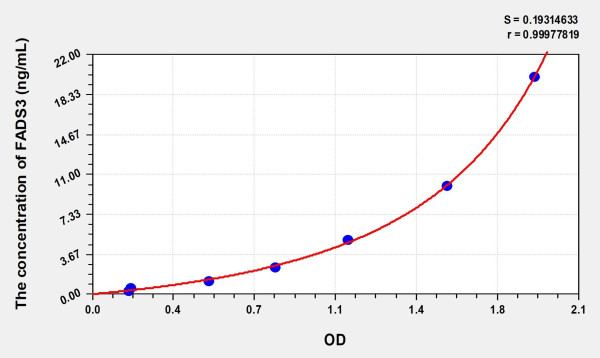
The test principle applied in this kit is Sandwich enzyme immunoassay. The microtiter plate provided in this kit has been pre-coated with an antibody specific to Human FADS3. Standards or samples are added to the appropriate microtiter plate wells then with a biotin-conjugated antibody specific to Human FADS3. Next, Avidin conjugated to Horseradish Peroxidase (HRP) is added to each microplate well and incubated. After TMB substrate solution is added, only those wells that contain Human FADS3, biotin-conjugated antibody and enzyme-conjugated Avidin will exhibit a change in color. The enzyme-substrate reaction is terminated by the addition of sulphuric acid solution and the color change is measured spectrophotometrically at a wavelength of 450nm ± 10nm. The concentration of Human FADS3 in the samples is then determined by comparing the OD of the samples to the standard curve.Detection Range: 0.32-20 ng/mL. Sensitivity: 0.124 ng/mL. Assay Type: Sandwich. Standard: 20 ng/mL. Sample Type: sTissue homogenates and other biological fluids.. Assay duration: 3.5h. Protein Function: Mammals have different sphingoid bases that differ in their length and/or pattern of desaturation and hydroxyl groups. The predominant sphingoid base that comprises mammalian ceramides is sphing-4-enine (sphingosine or SPH) which has a trans (E) desaturation at carbon 4 (PubMed:31862735, PubMed:31916624). FADS3 is a desaturase that introduces a cis (Z) double bond between carbon 14 and carbon 15 of the sphingoid base (also known as long chain base, LCB), producing LCBs such as sphinga-4,14-dienine (SPD, d18:2(4E,14Z)) from SPH (PubMed:31862735, PubMed:31916624, PubMed:37209771). Prefers SPH-containing ceramides (N-acylsphing-4-enines) as substrates (PubMed:31862735, PubMed:31916624, PubMed:37209771). Capable of metabolizing also the SPH in its free form (PubMed:31862735). SPD ceramides occur widely in mammalian tissues and cells (PubMed:31916624). Due to their unusual structure containing a cis double bond, SPD ceramides may have an opposite, negative role in lipid microdomain formation relative to conventional ceramides (PubMed:31916624). Could be involved in the detoxification of 1-deoxy sphingolipids, by desaturating the cytotoxic 1-deoxysphinganine (1-deoxySA, m18:0), produced under pathological conditions, to 1-deoxysphingenine (1-deoxysphingosine, 1-deoxySO, m18:1) (Probable). Although prefers SPH-containing ceramides (N-acylsphing-4-enines) as substrates, it also exhibits activity toward dihydrosphingosine-containing CERs (N-acylsphinganines) and produces 14Z-SPH-containing sphingolipids,which can be found in patients with DEGS1 mutations (PubMed:37209771). Its desaturase mechanism involves an electron transfer facilitated by cytochrome b5 (PubMed:37209771). FADS3 also acts as a methyl-end fatty acyl coenzyme A (CoA) desaturase that introduces a cis double bond between the preexisting double bond and the terminal methyl group of the fatty acyl chain (By similarity). Desaturates (11E)-octadecenoate (trans-vaccenoate, the predominant trans fatty acid in human milk) at carbon 13 to generate (11E,13Z)-octadecadienoate (also known as conjugated linoleic acid 11E,13Z-CLA) (By similarity) [The Uniprot Consortium]
| Schlagworte: | FADS3, Fatty acid desaturase 3, Delta(13) fatty acid desaturase |
| Hersteller: | ELK Biotechnology |
| Hersteller-Nr: | ELK3383MS |
Eigenschaften
| Anwendung: | ELISA |
| Spezies-Reaktivität: | human |
| Format: | Solid Phase |
Datenbank Information
| KEGG ID : | K10225 | Passende Produkte |
| UniProt ID : | Q9Y5Q0 | Passende Produkte |
| Gene ID : | GeneID 3995 | Passende Produkte |
Handhabung & Sicherheit
| Lagerung: | vT |
| Versand: | +4°C (International: +4°C) |
Achtung
Nur für Forschungszwecke und Laboruntersuchungen: Nicht für die Anwendung im oder am Menschen!
Nur für Forschungszwecke und Laboruntersuchungen: Nicht für die Anwendung im oder am Menschen!
Hier kriegen Sie ein Zertifikat
Loggen Sie sich ein oder registrieren Sie sich, um Analysenzertifikate anzufordern.
Bewertungen lesen, schreiben und diskutieren... mehr
Kundenbewertungen für "Human FADS3 (Fatty Acid Desaturase 3) Microsample ELISA Kit"
Bewertung schreiben
Loggen Sie sich ein oder registrieren Sie sich, um eine Produktbewertung abzugeben.
Zuletzt angesehen