
Cookie-Einstellungen
Diese Website benutzt Cookies, die für den technischen Betrieb der Website erforderlich sind und stets gesetzt werden. Andere Cookies, die den Komfort bei Benutzung dieser Website erhöhen, der Direktwerbung dienen oder die Interaktion mit anderen Websites und sozialen Netzwerken vereinfachen sollen, werden nur mit Ihrer Zustimmung gesetzt.
Konfiguration
Technisch erforderlich
Diese Cookies sind für die Grundfunktionen des Shops notwendig.
"Alle Cookies ablehnen" Cookie
"Alle Cookies annehmen" Cookie
Ausgewählter Shop
CSRF-Token
Cookie-Einstellungen
FACT-Finder Tracking
Individuelle Preise
Kundenspezifisches Caching
Session
Währungswechsel
Komfortfunktionen
Diese Cookies werden genutzt um das Einkaufserlebnis noch ansprechender zu gestalten, beispielsweise für die Wiedererkennung des Besuchers.
Facebook-Seite in der rechten Blog - Sidebar anzeigen
Merkzettel
Statistik & Tracking
Endgeräteerkennung
Kauf- und Surfverhalten mit Google Tag Manager
Partnerprogramm


Bei Fragen nutzen Sie gerne unser Kontaktformular.
Bestellen Sie auch per E-Mail: info@biomol.com
Größere Menge gewünscht? Bulk-Anfrage
Bestellen Sie auch per E-Mail: info@biomol.com
Größere Menge gewünscht? Bulk-Anfrage
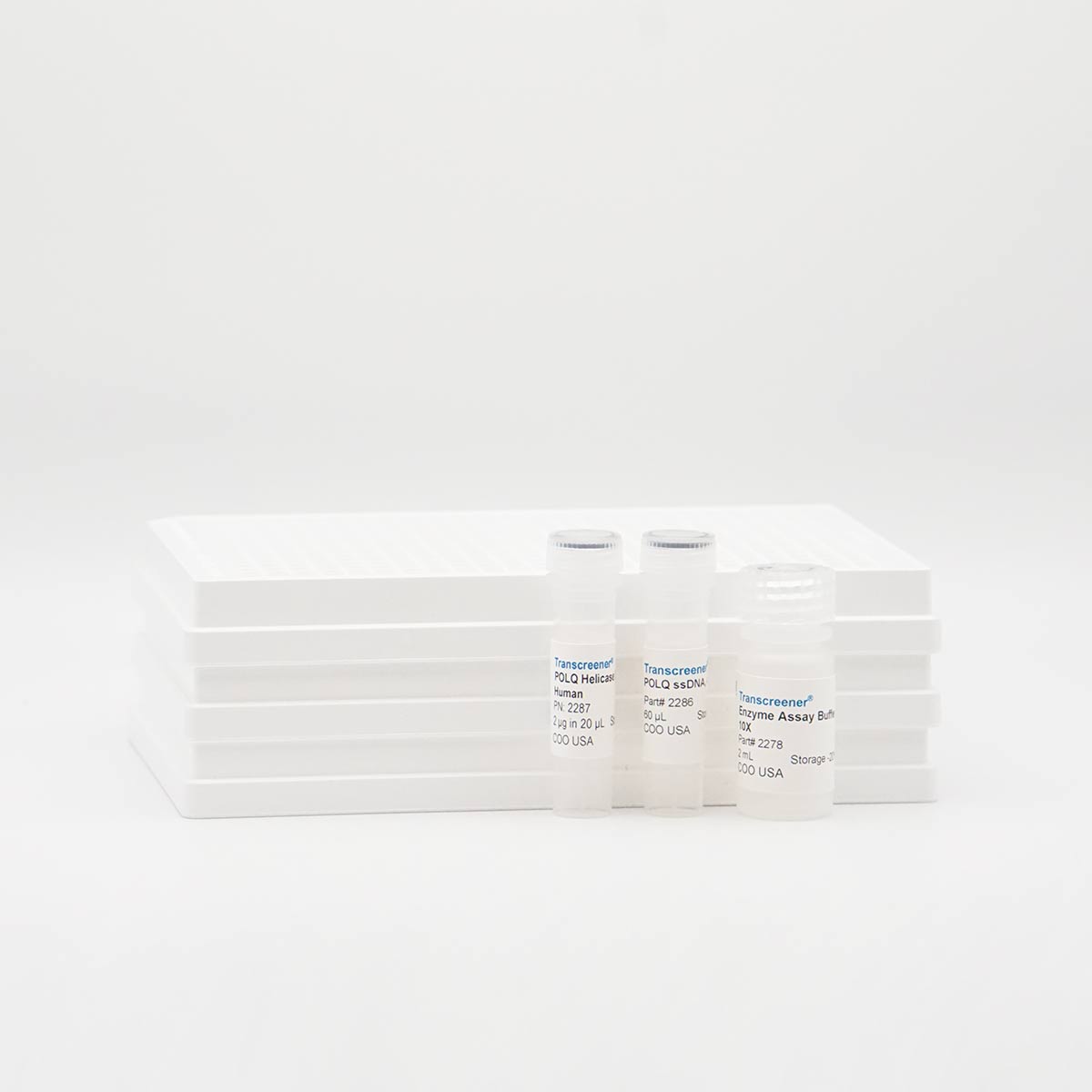
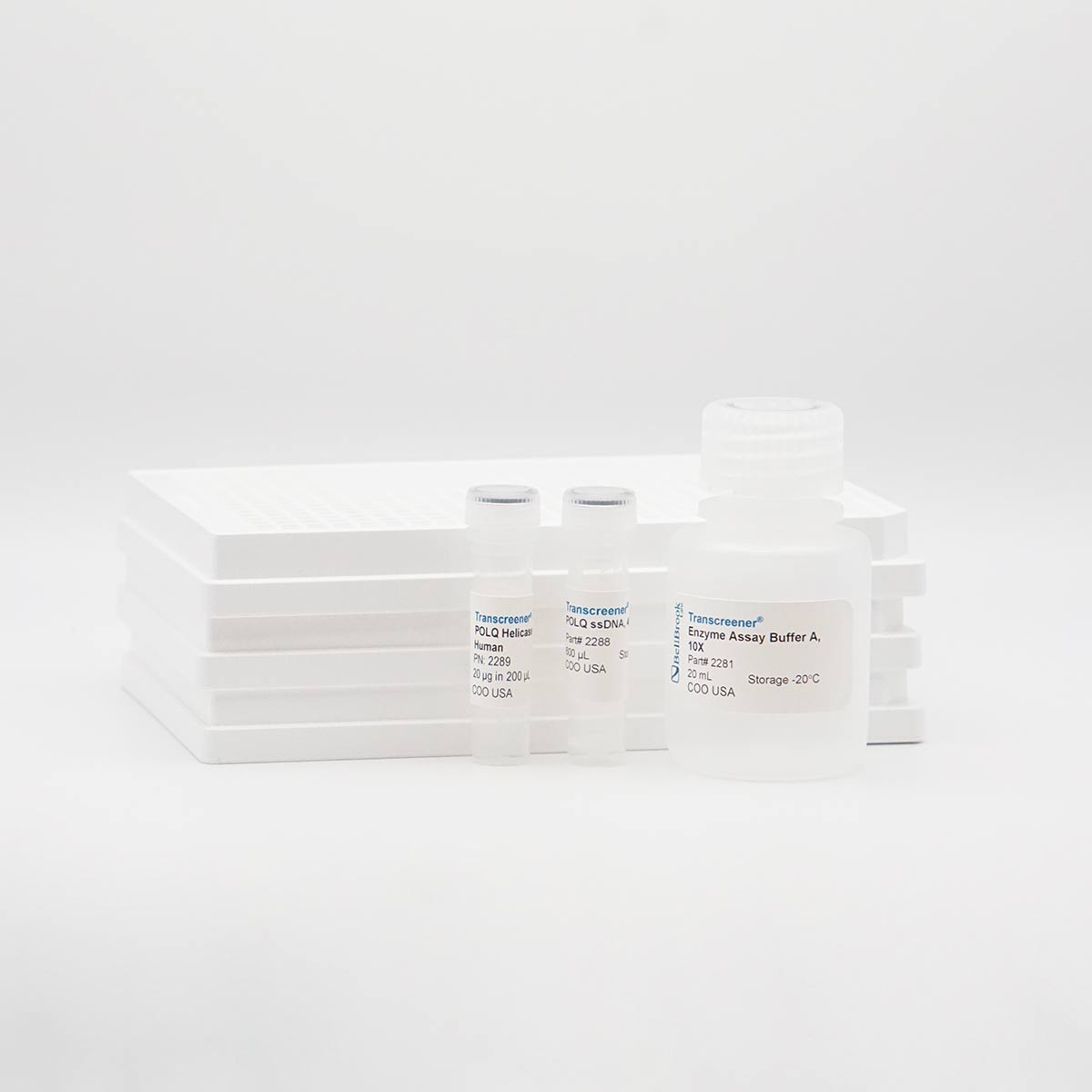
The Enzolution(R) POLQ Helicase ATPase Assay System is intended for use with the Transcreener(R)... mehr
Produktinformationen "Enzolution(R) POLQ ATPase TR-FRET Assay System"
The Enzolution(R) POLQ Helicase ATPase Assay System is intended for use with the Transcreener(R) ADP2 Assay Kits to measure the DNA-dependent ATPase activity of the POLQ Helicase domain. POLQ (also known as DNA Polymerase Theta), is a multifunctional enzyme with template-dependent DNA polymerase, ATPdependent helicase, and dNTP-dependent endonuclease activities that play important roles in double strand break repair. ADP formation by the ATPase activity of the POLQ Helicase domain can be easily measured by the Transcreener(R) ADP2 assay, a far-red, competitive fluorescence assay that enables single addition, mix-and-read detection in a continuous or endpoint format. The assay has been optimized and extensively validated for high throughput screening (HTS) and inhibitor dose response measurements using most multimode plate readers. Protein Function: Low-fidelity DNA polymerase with a helicase activity that promotes microhomology-mediated end-joining (MMEJ), an alternative non-homologous end-joining (NHEJ) machinery required to repair double-strand breaks in DNA during mitosis (PubMed:14576298, PubMed:18503084, PubMed:24648516, PubMed:25642963, PubMed:25643323, PubMed:25775267, PubMed:26636256, PubMed:27311885, PubMed:27591252, PubMed:30655289, PubMed:31562312, PubMed:32873648, PubMed:34140467, PubMed:34179826, PubMed:36455556, PubMed:37440612, PubMed:37674080). MMEJ is an error-prone repair pathway that produces deletions of sequences from the strand being repaired and promotes genomic rearrangements, such as telomere fusions, some of them leading to cellular transformation (PubMed:25642963, PubMed:25643323, PubMed:25775267, PubMed:27311885, PubMed:27591252, PubMed:31562312, PubMed:32873648). MMEJ is required during mitosis to repair persistent double-strand breaks that originate in S-phase (PubMed:37440612, PubMed:37674080). Although error-prone, MMEJ protects against chromosomal instability and tumorigenesis (By similarity). The polymerase acts by binding directly the 2 ends of resected double-strand breaks, allowing microhomologous sequences in the overhangs to form base pairs (PubMed:25643323, PubMed:25775267, PubMed:27311885, PubMed:27591252). It then extends each strand from the base-paired region using the opposing overhang as a template (PubMed:25643323, PubMed:25775267, PubMed:27311885, PubMed:27591252). Requires partially resected DNA containing 2 to 6 base pairs of microhomology to perform MMEJ (PubMed:25643323, PubMed:25775267, PubMed:27311885, PubMed:27591252). The polymerase lacks proofreading activity and is highly promiscuous: unlike most polymerases, promotes extension of ssDNA and partial ssDNA (pssDNA) substrates (PubMed:18503084, PubMed:21050863, PubMed:22135286). When the ends of a break do not contain terminal microhomology must identify embedded complementary sequences through a scanning step (PubMed:32234782). Also acts as a DNA helicase, promoting dissociation of the replication protein A complex (RPA/RP-A), composed of RPA1, RPA2 and RPA3, from resected double-strand breaks to allow their annealing and subsequent joining by MMEJ (PubMed:36455556). Removal of RPA/RP-A complex proteins prevents RAD51 accumulation at resected ends, thereby inhibiting homology-recombination repair (HR) pathway (PubMed:25642963, PubMed:28695890). Also shows RNA-directed DNA polymerase activity to mediate DNA repair in vitro, however this activity needs additional evidence in vivo (PubMed:34117057). May also have lyase activity (PubMed:19188258). Involved in somatic hypermutation of immunoglobulin genes, a process that requires the activity of DNA polymerases to ultimately introduce mutations at both A/T and C/G base pairs (By similarity). POLQ-mediated end joining activity is involved in random integration of exogenous DNA hampers (PubMed:28695890) [The Uniprot Consortium]
| Schlagworte: | POLQ, DNA polymerase eta, DNA polymerase theta |
| Hersteller: | BellBrook Labs |
| Hersteller-Nr: | 3034-1K-TR |
Eigenschaften
| Anwendung: | HTS, drug discovery, enzyme assays |
Datenbank Information
| KEGG ID : | K02349 | Passende Produkte |
| UniProt ID : | O75417 | Passende Produkte |
| Gene ID : | GeneID 10721 | Passende Produkte |
Handhabung & Sicherheit
| Lagerung: | vT |
| Versand: | -80°C (International: -80°C) |
Achtung
Nur für Forschungszwecke und Laboruntersuchungen: Nicht für die Anwendung im oder am Menschen!
Nur für Forschungszwecke und Laboruntersuchungen: Nicht für die Anwendung im oder am Menschen!
Hier kriegen Sie ein Zertifikat
Loggen Sie sich ein oder registrieren Sie sich, um Analysenzertifikate anzufordern.
Bewertungen lesen, schreiben und diskutieren... mehr
Kundenbewertungen für "Enzolution(R) POLQ ATPase TR-FRET Assay System"
Bewertung schreiben
Loggen Sie sich ein oder registrieren Sie sich, um eine Produktbewertung abzugeben.
Zuletzt angesehen