
Cookie-Einstellungen
Diese Website benutzt Cookies, die für den technischen Betrieb der Website erforderlich sind und stets gesetzt werden. Andere Cookies, die den Komfort bei Benutzung dieser Website erhöhen, der Direktwerbung dienen oder die Interaktion mit anderen Websites und sozialen Netzwerken vereinfachen sollen, werden nur mit Ihrer Zustimmung gesetzt.
Konfiguration
Technisch erforderlich
Diese Cookies sind für die Grundfunktionen des Shops notwendig.
"Alle Cookies ablehnen" Cookie
"Alle Cookies annehmen" Cookie
Ausgewählter Shop
CSRF-Token
Cookie-Einstellungen
FACT-Finder Tracking
Individuelle Preise
Kundenspezifisches Caching
Session
Währungswechsel
Komfortfunktionen
Diese Cookies werden genutzt um das Einkaufserlebnis noch ansprechender zu gestalten, beispielsweise für die Wiedererkennung des Besuchers.
Facebook-Seite in der rechten Blog - Sidebar anzeigen
Merkzettel
Statistik & Tracking
Endgeräteerkennung
Kauf- und Surfverhalten mit Google Tag Manager
Partnerprogramm


| Artikelnummer | Größe | Datenblatt | Manual | SDB | Lieferzeit | Menge | Preis |
|---|---|---|---|---|---|---|---|
| NSJ-V7860-20UG | 20 µg | - | - |
3 - 10 Werktage* |
375,00 €
|
||
| NSJ-V7860-100UG | 100 µg | - | - |
3 - 10 Werktage* |
810,00 €
|
Bei Fragen nutzen Sie gerne unser Kontaktformular.
Bestellen Sie auch per E-Mail: info@biomol.com
Größere Menge gewünscht? Bulk-Anfrage
Bestellen Sie auch per E-Mail: info@biomol.com
Größere Menge gewünscht? Bulk-Anfrage
0.2 mg/ml with 0.1 mg/ml BSA (US sourced), 0.05% sodium azide. Immunoglobulins are four-chain,... mehr
Produktinformationen "Anti-IgD Heavy Chain, clone IgD26"
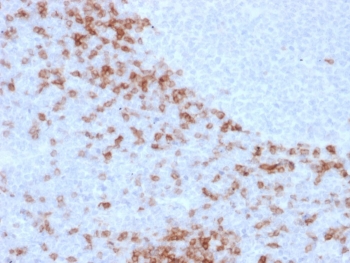
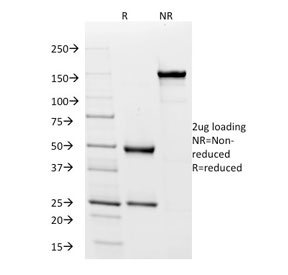
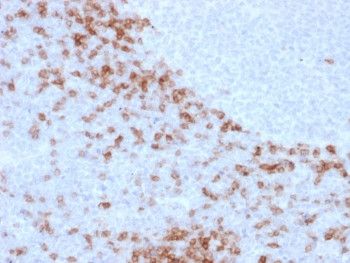
0.2 mg/ml with 0.1 mg/ml BSA (US sourced), 0.05% sodium azide. Immunoglobulins are four-chain, Y-shaped, monomeric structures comprised of two identical heavy chains and two identical light chains held together through interchain disulfide bonds. The chains form two domains, the Fab (antigen binding) fragment and the Fc (constant) fragment. Immunoglobulin D (IgD) exists as a monomer with light chains. It plays a biological role as a transmembrane receptor molecule, co-expressed with IgM on the surface of mature/naive B cells. In particular, it is found on spleen B cell surfaces. Compared to IgM, IgD exists in much lower numbers and is not expressed on immature B cells. IgD surface expression on B cells is regulated in part by IL-27. In mice, the inhibition of this immunoglobulin isotype does not cause a significant change to the immune system. Protein function: Constant region of immunoglobulin heavy chains. Immunoglobulins, also known as antibodies, are membrane-bound or secreted glycoproteins produced by B lymphocytes. In the recognition phase of humoral immunity, the membrane-bound immunoglobulins serve as receptors which, upon binding of a specific antigen, trigger the clonal expansion and differentiation of B lymphocytes into immunoglobulins- secreting plasma cells. Secreted immunoglobulins mediate the effector phase of humoral immunity, which results in the elimination of bound antigens (PubMed:22158414, PubMed:20176268). The antigen binding site is formed by the variable domain of one heavy chain, together with that of its associated light chain. Thus, each immunoglobulin has two antigen binding sites with remarkable affinity for a particular antigen. The variable domains are assembled by a process called V-(D)-J rearrangement and can then be subjected to somatic hypermutations which, after exposure to antigen and selection, allow affinity maturation for a particular antigen (PubMed:17576170, PubMed:20176268). IgD is the major antigen receptor isotype on the surface of most peripheral B-cells, where it is coexpressed with IgM. The membrane- bound IgD (mIgD) induces the phosphorylation of CD79A and CD79B by the Src family of protein tyrosine kinases. Soluble IgD (sIgD) concentration in serum below those of IgG, IgA, and IgM but much higher than that of IgE. IgM and IgD molecules present on B cells have identical V regions and antigen-binding sites. After the antigen binds to the B-cell receptor, the secreted form sIgD is shut off. IgD is a potent inducer of TNF, IL1B, and IL1RN. IgD also induces release of IL6, IL10, and LIF from peripheral blood mononuclear cells. Monocytes seem to be the main producers of cytokines in vitro in the presence of IgD (PubMed:8774350, PubMed:10702483, PubMed:11282392). [The UniProt Consortium]
| Schlagworte: | Anti-Ig delta chain C region, Anti-Ig delta chain C region WAH, Anti-Ig delta chain C region NIG-65, Anti-Immunoglobulin heavy constant delta, IgD Heavy Chain Antibody |
| Hersteller: | NSJ Bioreagents |
| Hersteller-Nr: | V7860 |
Eigenschaften
| Anwendung: | IHC (paraffin) |
| Antikörper-Typ: | Monoclonal |
| Klon: | IgD26 |
| Konjugat: | No |
| Wirt: | Mouse |
| Spezies-Reaktivität: | human |
| Immunogen: | Full length recombinant human IGHD protein |
| Format: | Purified |
Datenbank Information
| UniProt ID : | P01880 | Passende Produkte |
Handhabung & Sicherheit
| Lagerung: | +4°C |
| Versand: | +4°C (International: +4°C) |
Achtung
Nur für Forschungszwecke und Laboruntersuchungen: Nicht für die Anwendung im oder am Menschen!
Nur für Forschungszwecke und Laboruntersuchungen: Nicht für die Anwendung im oder am Menschen!
Hier folgen Informationen zur Produktreferenz.
mehr
Hier kriegen Sie ein Zertifikat
Loggen Sie sich ein oder registrieren Sie sich, um Analysenzertifikate anzufordern.
Bewertungen lesen, schreiben und diskutieren... mehr
Kundenbewertungen für "Anti-IgD Heavy Chain, clone IgD26"
Bewertung schreiben
Loggen Sie sich ein oder registrieren Sie sich, um eine Produktbewertung abzugeben.
Zuletzt angesehen