
Cookie-Einstellungen
Diese Website benutzt Cookies, die für den technischen Betrieb der Website erforderlich sind und stets gesetzt werden. Andere Cookies, die den Komfort bei Benutzung dieser Website erhöhen, der Direktwerbung dienen oder die Interaktion mit anderen Websites und sozialen Netzwerken vereinfachen sollen, werden nur mit Ihrer Zustimmung gesetzt.
Konfiguration
Technisch erforderlich
Diese Cookies sind für die Grundfunktionen des Shops notwendig.
"Alle Cookies ablehnen" Cookie
"Alle Cookies annehmen" Cookie
Ausgewählter Shop
CSRF-Token
Cookie-Einstellungen
FACT-Finder Tracking
Individuelle Preise
Kundenspezifisches Caching
Session
Währungswechsel
Komfortfunktionen
Diese Cookies werden genutzt um das Einkaufserlebnis noch ansprechender zu gestalten, beispielsweise für die Wiedererkennung des Besuchers.
Facebook-Seite in der rechten Blog - Sidebar anzeigen
Merkzettel
Statistik & Tracking
Endgeräteerkennung
Kauf- und Surfverhalten mit Google Tag Manager
Partnerprogramm

NEU
| Artikelnummer | Größe | Datenblatt | Manual | SDB | Lieferzeit | Menge | Preis |
|---|---|---|---|---|---|---|---|
| ABS-ES-141.1 | 1 pair (100 µg/100 µg) | - | - |
10 - 14 Werktage* |
1.080,00 €
|
Bei Fragen nutzen Sie gerne unser Kontaktformular.
Bestellen Sie auch per E-Mail: info@biomol.com
Größere Menge gewünscht? Bulk-Anfrage
Bestellen Sie auch per E-Mail: info@biomol.com
Größere Menge gewünscht? Bulk-Anfrage
Product Description: MKI67, also known as Ki-67, is a nuclear protein that plays a crucial role... mehr
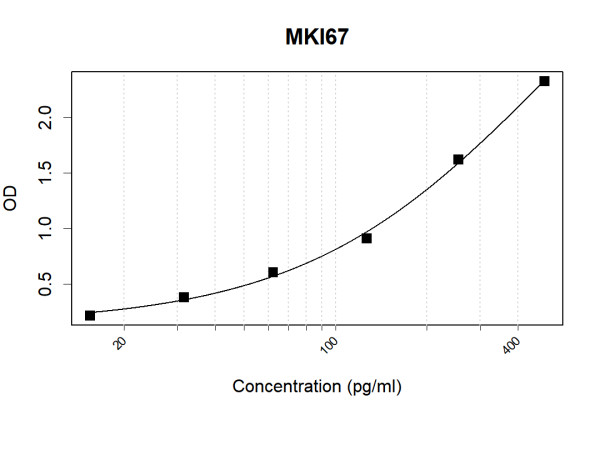
Produktinformationen "Anti-Human Ki67 Antibody Pair"
Product Description: MKI67, also known as Ki-67, is a nuclear protein that plays a crucial role in cell proliferation and ribosomal RNA transcription. Its expression levels correlate with the growth fraction of a cell population, making it a valuable biomarker for various cancers like breast, prostate, and brain carcinomas. Higher MKI67 expression is associated with increased tumor aggressiveness, metastasis, and poor prognosis in many cancers. Additionally, MKI67 facilitates the proliferation and migration of pulmonary arterial smooth muscle cells, suggesting its potential involvement in pulmonary hypertension pathogenesis. MKI67 interacts with key cell cycle regulators like RB, p53, and DREAM/MuvB complexes, regulating its expression during cell cycle progression, DNA damage response, and cellular stress. Therefore, MKI67 serves as both a diagnostic and prognostic biomarker and a potential therapeutic target in various malignancies and proliferative disorders. Protein Function: Protein that associates with the surface of mitotic chromosomes and acts both as a chromosome repellent during early mitosis and chromosome attractant during late mitosis (PubMed:27362226, PubMed:32879492, PubMed:35513709, PubMed:39153474). Required to maintain individual mitotic chromosomes dispersed in the cytoplasm following nuclear envelope disassembly (PubMed:27362226). During early mitosis, relocalizes from nucleoli to the chromosome surface where it forms extended brush structures that cover a substantial fraction of the chromosome surface (PubMed:27362226). The MKI67 brush structure prevents chromosomes from collapsing into a single chromatin mass by forming a steric and electrostatic charge barrier: the protein has a high net electrical charge and acts as a surfactant, dispersing chromosomes and enabling independent chromosome motility (PubMed:27362226). During mitotic anaphase, the MKI67 brush structure collapses and MKI67 switches from a chromosome repellent to a chromosome attractant to promote chromosome clustering and facilitate the exclusion of large cytoplasmic particles from the future nuclear space (PubMed:32879492, PubMed:39153474). Mechanistically, dephosphorylation during mitotic exit and simultaneous exposure of a conserved basic patch induce the RNA-dependent formation of a liquid-like condensed phase on the chromosome surface, promoting coalescence of neighboring chromosome surfaces and clustering of chromosomes (PubMed:39153474). Binds premature ribosomal RNAs during anaphase, promoting liquid-liquid phase separation (PubMed:28935370, PubMed:39153474). Binds DNA, with a preference for supercoiled DNA and AT-rich DNA (PubMed:10878551). Does not contribute to the internal structure of mitotic chromosomes (By similarity). May play a role in chromatin organization, it is however unclear whether it plays a direct role in chromatin organization or whether it is an indirect consequence of its function in mitotic chromosome (PubMed:24867636) [The Uniprot Consortium]
| Schlagworte: | Anti-MKI67, Anti-Proliferation marker protein Ki-67, Anti-Antigen identified by monoclonal antibody Ki-67, Human Ki67 Antibody Pair |
| Hersteller: | Absea |
| Hersteller-Nr: | ES-141 |
Eigenschaften
| Anwendung: | ELISA |
| Antikörper-Typ: | Monoclonal |
| Klon: | K16222_1A1/K16222_3D5 |
| Konjugat: | No |
| Wirt: | Mouse/Mouse |
| Spezies-Reaktivität: | human |
| Reinheit: | >85% |
| Format: | Solution |
Datenbank Information
| KEGG ID : | K17582 | Passende Produkte |
| UniProt ID : | P46013 | Passende Produkte |
| Gene ID : | GeneID 4288 | Passende Produkte |
Handhabung & Sicherheit
| Lagerung: | -20°C (avoid repeat freezing and thawing cycles) |
| Versand: | -20°C (International: +4°C) |
Achtung
Nur für Forschungszwecke und Laboruntersuchungen: Nicht für die Anwendung im oder am Menschen!
Nur für Forschungszwecke und Laboruntersuchungen: Nicht für die Anwendung im oder am Menschen!
Hier kriegen Sie ein Zertifikat
Loggen Sie sich ein oder registrieren Sie sich, um Analysenzertifikate anzufordern.
Bewertungen lesen, schreiben und diskutieren... mehr
Kundenbewertungen für "Anti-Human Ki67 Antibody Pair"
Bewertung schreiben
Loggen Sie sich ein oder registrieren Sie sich, um eine Produktbewertung abzugeben.
Zuletzt angesehen