
Cookie-Einstellungen
Diese Website benutzt Cookies, die für den technischen Betrieb der Website erforderlich sind und stets gesetzt werden. Andere Cookies, die den Komfort bei Benutzung dieser Website erhöhen, der Direktwerbung dienen oder die Interaktion mit anderen Websites und sozialen Netzwerken vereinfachen sollen, werden nur mit Ihrer Zustimmung gesetzt.
Konfiguration
Technisch erforderlich
Diese Cookies sind für die Grundfunktionen des Shops notwendig.
"Alle Cookies ablehnen" Cookie
"Alle Cookies annehmen" Cookie
Ausgewählter Shop
CSRF-Token
Cookie-Einstellungen
FACT-Finder Tracking
Individuelle Preise
Kundenspezifisches Caching
Session
Währungswechsel
Komfortfunktionen
Diese Cookies werden genutzt um das Einkaufserlebnis noch ansprechender zu gestalten, beispielsweise für die Wiedererkennung des Besuchers.
Facebook-Seite in der rechten Blog - Sidebar anzeigen
Merkzettel
Statistik & Tracking
Endgeräteerkennung
Kauf- und Surfverhalten mit Google Tag Manager
Partnerprogramm

NEU
| Artikelnummer | Größe | Datenblatt | Manual | SDB | Lieferzeit | Menge | Preis |
|---|---|---|---|---|---|---|---|
| ABS-ES-1803.1 | 1 pair (100 µg/100 µg) | - | - |
10 - 14 Werktage* |
1.080,00 €
|
Bei Fragen nutzen Sie gerne unser Kontaktformular.
Bestellen Sie auch per E-Mail: info@biomol.com
Größere Menge gewünscht? Bulk-Anfrage
Bestellen Sie auch per E-Mail: info@biomol.com
Größere Menge gewünscht? Bulk-Anfrage
Product Description: Aldo-keto reductase family 1 member B1 (AKR1B1) is a cytosolic enzyme... mehr
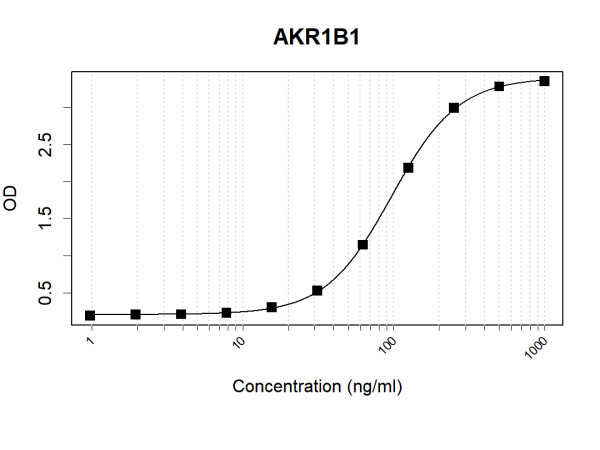
Produktinformationen "Anti-Human AKR1B1 Antibody Pair"
Product Description: Aldo-keto reductase family 1 member B1 (AKR1B1) is a cytosolic enzyme composed of 316 amino acids with a molecular weight of approximately 35.8 kDa. Unlike typical dinucleotide-binding enzymes, AKR1B1 binds NADPH uniquely and features a relatively hydrophobic active site lined with aromatic and non-polar residues. It catalyzes the NADPH-dependent reduction of various aldehydes and ketones, including glucose to sorbitol in the polyol pathway, and detoxifies lipid peroxidation-derived aldehydes. AKR1B1 is widely expressed in human tissues such as kidney, retina, nerve, heart, and liver, playing roles in glucose metabolism, osmoregulation, and protection against toxic aldehydes. Clinically, AKR1B1 is implicated in diabetic complications like retinopathy, neuropathy, and cataracts due to sorbitol accumulation. It also contributes to oxidative stress-related diseases, cardiovascular disorders, sepsis, and cancer by mediating inflammatory responses and cell proliferation. Protein Function: Catalyzes the NADPH-dependent reduction of a wide variety of carbonyl-containing compounds to their corresponding alcohols. Displays enzymatic activity towards endogenous metabolites such as aromatic and aliphatic aldehydes, ketones, monosacharides, bile acids and xenobiotics substrates. Key enzyme in the polyol pathway, catalyzes reduction of glucose to sorbitol during hyperglycemia (PubMed:1936586). Reduces steroids and their derivatives and prostaglandins. Displays low enzymatic activity toward all-trans-retinal, 9-cis-retinal, and 13-cis-retinal (PubMed:12732097, PubMed:19010934, PubMed:8343525). Catalyzes the reduction of diverse phospholipid aldehydes such as 1-palmitoyl-2-(5-oxovaleroyl)-sn -glycero-3-phosphoethanolamin (POVPC) and related phospholipid aldehydes that are generated from the oxydation of phosphotidylcholine and phosphatdyleethanolamides (PubMed:17381426). Plays a role in detoxifying dietary and lipid-derived unsaturated carbonyls, such as crotonaldehyde, 4-hydroxynonenal, trans-2-hexenal, trans-2,4-hexadienal and their glutathione-conjugates carbonyls (GS-carbonyls) (PubMed:21329684) [The Uniprot Consortium]
| Schlagworte: | Anti-AKR1B1, Anti-Aldose reductase, Anti-Aldehyde reductase, Anti-Aldo-keto reductase family 1 member B1, Human AKR1B1 Antibody Pair |
| Hersteller: | Absea |
| Hersteller-Nr: | ES-1803 |
Eigenschaften
| Anwendung: | ELISA |
| Antikörper-Typ: | Monoclonal |
| Klon: | K92029_2H5/K92029_3F2 |
| Konjugat: | No |
| Wirt: | Mouse/Mouse |
| Spezies-Reaktivität: | human |
| Reinheit: | >85% |
| Format: | Solution |
Datenbank Information
| KEGG ID : | K00011 | Passende Produkte |
| UniProt ID : | P15121 | Passende Produkte |
| Gene ID : | GeneID 231 | Passende Produkte |
Handhabung & Sicherheit
| Lagerung: | -20°C (avoid repeat freezing and thawing cycles) |
| Versand: | -20°C (International: +4°C) |
Achtung
Nur für Forschungszwecke und Laboruntersuchungen: Nicht für die Anwendung im oder am Menschen!
Nur für Forschungszwecke und Laboruntersuchungen: Nicht für die Anwendung im oder am Menschen!
Hier kriegen Sie ein Zertifikat
Loggen Sie sich ein oder registrieren Sie sich, um Analysenzertifikate anzufordern.
Bewertungen lesen, schreiben und diskutieren... mehr
Kundenbewertungen für "Anti-Human AKR1B1 Antibody Pair"
Bewertung schreiben
Loggen Sie sich ein oder registrieren Sie sich, um eine Produktbewertung abzugeben.
Zuletzt angesehen