
POV-PC

If you have any questions, please use our Contact Form.
You can also order by e-mail: info@biomol.com
Larger quantity required? Request bulk
You can also order by e-mail: info@biomol.com
Larger quantity required? Request bulk
Oxidized low-density lipoprotien (oxLDL) particles contain low molecular weight species which are... more
Product information "POV-PC"
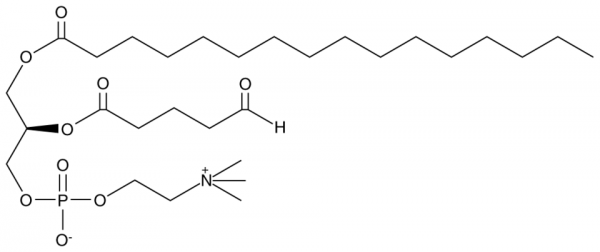
Oxidized low-density lipoprotien (oxLDL) particles contain low molecular weight species which are cytotoxic and pro-atherogenic. Many of these substances were recently isolated and purified from oxLDL, and identified as phosphatidylcholine species containing a fragmented, oxidized short-chain fatty acid remnant at the sn-2 position. 1-(Palmitoyl)-2-(5-oxovaleroyl)-phosphatidylcholine, or POV-PC, is one of the oxLDL species derived from 2-arachidonoyl or eicosapentanoyl phospholipids. POV-PC confers CD36 scavenger receptor binding affinity more potently than any hydroperoxy PC species, and may be one of the more important structural determinants of oxLDL. Treatment of cultured endothelial cells with POV-PC stimulates monocyte binding, stimulates intracellular cAMP production, and strongly inhibits the LPS-induced binding of neutrophils.Formal Name: 1-palmitoyl-2-(5-oxovaleroyl)-sn-glycero-3-phosphatidylcholine. CAS Number: 121324-31-0. Synonyms: 2-(5-oxovaleryl) Phosphatidylcholine. Molecular Formula: C29H56NO9P. Formula Weight: 593.7. Purity: >98%. Formulation: (Request formulation change), A solution in ethanol. Solubility: DMF: 15 mg/ml, DMSO: 10 mg/ml, Ethanol: 30 mg/ml, PBS (pH 7.2): 10 mg/ml. SMILES: CCCCCCCCCCCCCCCC(=O)OC[C@H](COP(=O)(O)OCC[N](C)(C)C)OC(=O)CCCC=O. InChi Code: InChI=1S/C29H56NO9P/c1-5-6-7-8-9-10-11-12-13-14-15-16-17-20-28(32)36-25-27(39-29(33)21-18-19-23-31)26-38-40(34,35)37-24-22-30(2,3)4/h23,27H,5-22,24-26H2,1-4H3/t27-/m1/s1. InChi Key: RKIDALSACBQVTN-HHHXNRCGSA-N. Side Chain Carbon Sum: 21:0.
| Keywords: | 2-(5-oxovaleryl) Phosphatidylcholine, 1-palmitoyl-2-(5-oxovaleroyl)-sn-glycero-3-phosphatidylcholine |
| Supplier: | Cayman Chemical |
| Supplier-Nr: | 10031 |
Properties
| Application: | Bioactive lipid assays |
| MW: | 593.7 D |
| Formula: | C29H56NO9P |
| Purity: | >98% |
| Format: | Solution |
Database Information
| CAS : | 121324-31-0| Matching products |
Handling & Safety
| Storage: | -20°C |
| Shipping: | +20°C (International: -20°C) |
| Signal Word: | Danger |
| GHS Hazard Pictograms: |


|
| H Phrases: | H225, H319 |
| P Phrases: | P210, P233, P240, P241, P242, P243, P264, P280, P303+361+353, P305+351+338, P337+313, P370+378, P403+235, P501 |
Caution
Our products are for laboratory research use only: Not for administration to humans!
Our products are for laboratory research use only: Not for administration to humans!
Information about the product reference will follow.
more
You will get a certificate here
Viewed